

The Semantic Shortcut: Is “Autopilot” Enough for Agent-Ready Data?
In the rush to make enterprise data “agent-ready,” the industry has hit a familiar wall. We’ve all seen the demos: a sleek AI agent navigates a database, answers a complex natural language query, and drafts a perfect summary in seconds. It looks like magic in a controlled pilot.
But in production? The magic often turns into a maintenance nightmare.
The latest industry buzz centers on the launch of Semantic View Autopilot. The promise is enticing: use AI to automate the creation of semantic views, cutting down the days-long manual labor of data engineers into mere minutes. It’s a classic “Science” win, using automation to solve a technical bottleneck.
But as we often discuss here at Solix, the science is only half the story. If you don’t balance that automation with the Art of Governance, you aren’t building a bridge to the future. You’re just building faster silos.
The Reality Check: Speed vs. Structure
The semantic layer is the essential translator for AI agents. It codifies messy technical schemas into business terms that an LLM can actually understand. Without it, agents are just guessing, and in the enterprise, guessing is a liability.
While tools like Semantic View Autopilot and the Open Semantic Interchange (OSI) initiative are massive leaps forward for interoperability, they introduce a new set of risks:
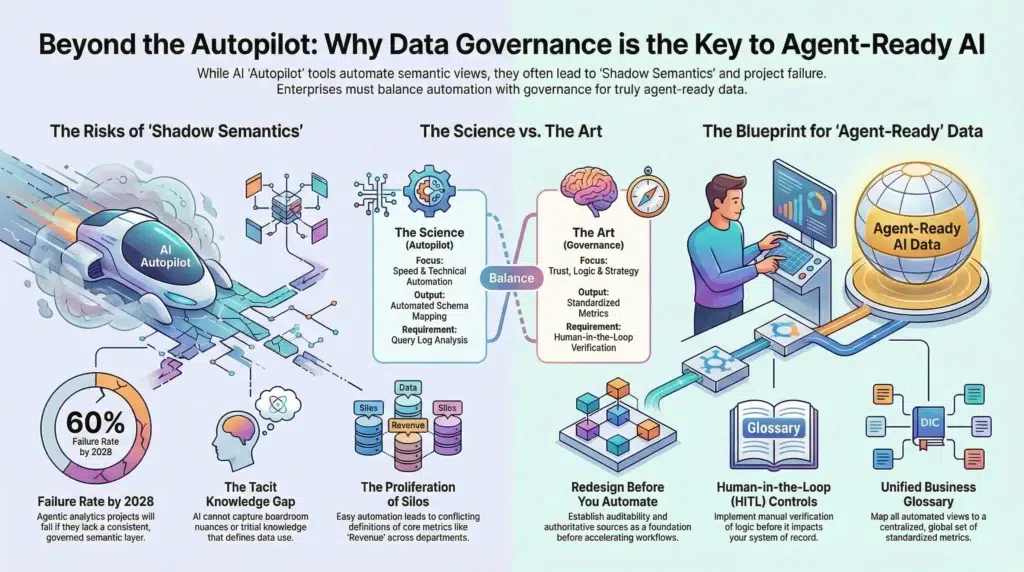
- The Proliferation of “Shadow Semantics”: When creating views becomes too easy, every department starts spinning up their own. Without a unified data ontology, you end up with three different definitions for “Revenue” across five different AI agents.
- The “Tacit Knowledge” Gap: AI can analyze query logs and suggest improvements, but it can’t sit in a boardroom. It doesn’t understand the nuance of a specific business policy or the tribal knowledge that defines how data is actually used in a crisis.
- The Missing Governance Layer: Automating the view doesn’t automate the trust. Industry research suggests that by 2028, 60% of agentic analytics projects will fail specifically because they lack a consistent, governed semantic layer.
The Solix Perspective: Redesign Before You Automate
At Solix, our strategy has always been: Redesign the foundation before you automate the workflow. Speed is a competitive advantage, but auditability is a survival requirement. If an AI agent executes an action based on an “autopiloted” semantic view, can you trace that decision back to an authoritative source? Do you have a Human-in-the-Loop (HITL) control to verify the logic before it hits your system of record?
A truly “Agent-Ready” data strategy requires more than just automated views. It requires:
- A Unified Business Glossary: Mapping automated views to a centralized, standardized set of metrics.
- Federated Governance: Ensuring that even as views are created quickly, they remain under a global policy framework.
- Active Collaboration: Bridging the gap between the technical “Science” of the data engineer and the “Art” of the business user’s intent.
The Takeaway
Automation tools are incredible accelerators, but they are not a substitute for a robust data fabric. Don’t let the ease of “Autopilot” lure you into bypassing the critical work of data governance.
Are you ready to move beyond the demo and into production-grade AI? Would you like me to help you draft a checklist for auditing your current semantic layer’s “Agent-Readiness”?
Frequently Asked Questions: Snowflake Semantic View Autopilot
What is Snowflake Semantic View Autopilot?
Snowflake Semantic View Autopilot is an AI-powered service that automates the creation of semantic views within the Snowflake AI Data Cloud. Launched in February 2026, it uses machine learning to analyze query history and physical schemas to automatically suggest business-friendly metrics, dimensions, and relationships. This significantly reduces the manual effort traditionally required by data engineers.
Why is a semantic layer necessary for AI agents?
A semantic layer acts as a translator that codifies technical data into business context. Without it, AI agents lack a consistent understanding of metrics such as revenue or customer churn, which increases the risk of hallucinations and inaccurate analytics. Gartner predicts that by 2028, 60% of agentic analytics projects will fail if they rely solely on raw data protocols without a consistent semantic layer.
How does Semantic View Autopilot improve data governance?
While Semantic View Autopilot accelerates view creation, true governance depends on aligning those views with a unified data ontology. The service supports governance by making data models more auditable and consistent, but organizations must still implement federated governance to prevent semantic silos where different departments define the same metrics in conflicting ways.
Can I migrate existing semantic models to Snowflake?
Yes. Snowflake’s Open Semantic Interchange (OSI) initiative allows organizations to ingest existing semantic definitions from external tools such as dbt Labs, Looker, and Tableau. This preserves prior investments in data modeling while enabling those definitions to power native Snowflake AI capabilities like Snowflake Intelligence.
What are the risks of using automated semantic views?
The primary risk is the absence of tacit knowledge. Automated tools can analyze SQL logs and schema patterns, but they often miss subtle business nuances, exception handling, or internal policies that are not explicitly encoded in queries. Without a comprehensive business glossary, automated views can also fragment logic across the enterprise, undermining a single source of truth.