

Bridging the Gap: Data Governance vs Analytics Governance Explained
Over the past few decades, organizations have been awash with data. In order to effectively manage and monitor large volumes of data, the Data Governance framework started gaining widespread adoption. The Data Governance framework has since been deemed to be a trusted and essential model that has been in use to transform the raw data, originating from varied sources and multiple formats, into a strategic asset, ensuring it is accurate, secure and rich in quality. However, with the onset of an Artificial Intelligence and Machine Learning era, the need to make sense of this high-quality data for competitive advantage has taken a front seat, which in turn has resulted in a sudden surge in the usage of analytical tools. These analytical tools;
- Provide meaningful and actionable insights on consumer behavior, purchasing patterns and forecast demand for the retail industry.
- Enable identification of risks and outliers during patient/ site monitoring in clinical trials for expedited decision making.
- Optimize the production line, enable predictive maintenance and expedite quality control for automobile manufacturers.
- Provide accurate credit scoring, fraud detection and customer segmentation for banks and insurance companies.
As data volumes increase rapidly and analytics becomes central to deriving insights, the need for governance has grown, paving the way for the newer and niche framework of “Analytics Governance”.
What exactly is Data Governance?
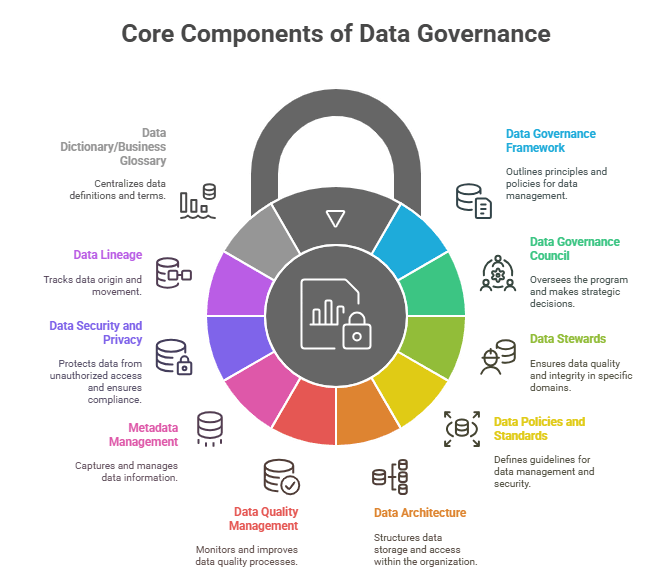
Data Governance, in general, is an essential first step in making the data ready for application of Artificial Intelligence and Machine Learning models, which is deemed to be a fundamental stepping stone towards the concept of Information Architecture (IA) for Artificial Intelligence (AI), a strategic approach for systematically discovering, capturing, storing and managing structured, semi-structured and unstructured data to facilitate creation of high-quality datasets for varied AI/ML applications. It is a comprehensive framework of processes, roles, policies and standards to ensure that the data is precise, accurate, secure and compliant to set industry norms and guidelines. In addition, it governs how data is collected, stored, maintained and shared throughout the Information Lifecycle Management (ILM) cycle, in such a manner that it is consistent, meets the specified organizational standards, is devoid of any altercation, stored securely and retired safely.
Effective Data Governance is crucial for several reasons;
- Data Governance unlocks a higher degree of accuracy and precision which in turn leads to high quality of data.
- A high-quality data which is a result of an effective Data Governance strategy would lead to the generation of meaningful insight and oversight and result in faster decision making.
- Data Governance results in enhanced compliance with respect to GDPR, HIPAA, CCPA, SOX etc.
- It can enable organizations to store and migrate data in a safe and secured manner resulting in prevention of breaches and cyber-attacks.
- Data Governance often results in improved collaboration and enhanced operational efficiency.
Then, What is Analytics Governance?
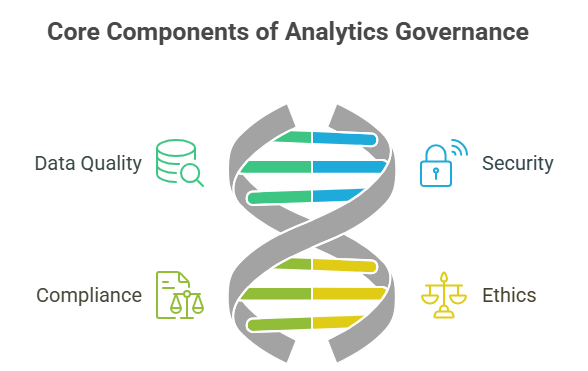
Analytics Governance, on the other hand, focusses on leveraging data for predictive modelling, creation of recommendation engines based on consumer data using prescriptive modelling, smart visualizations using AI/ML algorithms for precise business insights, Natural Language Processing (NLP) based summarizations for unstructured data and intelligent reporting. It’s about governing the tools, models, metrics, dashboards, and insights that help drive strategic decisions.
Effective Analytics Governance is crucial for several reasons;
- Normalizes KPIs and metrics for consistent insights across the board, so that a proper conclusion can be drawn and strategic decisions can be made confidently.
- Analytics Governance can ensure that decisions that are being made are repeatable, transparent, data driven and logical.
- Analytics Governance also ensures that the model outcomes are not biased or are misused in any manner.
- It ensures that the AI/ML models are fair, transparent and evaluated on a frequent basis to curb out any performance bias. Continuous evaluation and monitoring take place to check if there’s any fervent need for model up-version.
- Governance enables businesses to hyper-scale any analytics deployment by facilitating safe experimentation across the board.
Turning Data into a Strategic Asset through a Combination of Analytics and Data Governance
Data Governance and Analytics Governance are often thought of as standalone entities. Without them, organizations risk being consumed into chaotic decision making, data silos and breaching data privacy and compliances. However, combining both and getting them to operate together within a holistic, integrated framework can amplify any organization’s effectiveness to many folds.
- Enhanced Reliability and Trust: When Data Governance and Analytics Governance is combined, it unlocks a unified view into the data, from its origin to transformations and final reporting, thus, providing an in-depth insight into its audit trail.
- Regulation and Compliance Adherence: Businesses can streamline compliance and regulation by defining overarching policies that would govern the entire data flow from primary collection of data to churning it through analytical models and till its retention.
- Actionable Insights for Faster Decision Making: A comprehensive strategy can enable clean, reliable inputs and trusted, verifiable outputs (insights) which are consistent across the board. As a result of this, decisions can be made faster and logically.
Learn about the Solix Common Data Platform (CDP) that provides a modern, next-gen and future-proof architecture and propels enterprises of all sizes to implement scalable, automated, and policy-driven governance frameworks across structured, semi-structured and unstructured data.

Related Posts
Customer Analytics Platforms: Architecture Decisions That Determine Whether You Get Insights or Just Dashboards
AI Hallucination Prevention: Why Enterprise Data Governance Is the Only Reliable Fix