

Data Compliance vs Data Governance
How Are They Different, Or Are They The Same?
Gartner predicts that 80% of data and analytics governance initiatives will fail by 2027 due to inadequate strategic focus, and 83% of organizations view compliance as a strategic priority. Meanwhile, Corlytics says, regulatory penalties worldwide reached an all-time high of $19.3 billion in 2024, understanding the critical interplay – and distinction – between data governance and data compliance is now table stakes— fundamental to mitigating risk and unlocking value. This piece clarifies these often-confused concepts.
Beyond Buzzwords: Defining Data Governance and Data Compliance
Let’s establish clear foundations:
- Data Governance: This is the strategic framework governing how an organization manages its data assets throughout their lifecycle. It encompasses the people, processes, policies, standards, and technologies ensuring data is available, usable, consistent, secure, and trustworthy. Think of it as the constitution for your data – defining ownership, quality standards, security protocols, access controls, and how data flows. Its core goal is maximizing data value and integrity to support business objectives, analytics, and decision-making.
- Data Compliance: This refers to the adherence to specific external regulations and standards imposed by governments, industries, or contractual obligations. Examples include GDPR, CCPA, HIPAA, SOX, PCI-DSS, and industry-specific rules. Compliance is reactive in nature – it answers the question: “Are we meeting the legal and regulatory requirements imposed upon us?” Its core goal is avoiding legal penalties, fines, and reputational damage.
The Core Components: Building Blocks of Control
While distinct, both rely on underlying structures:
Data Governance Components
- Framework and Strategy: Establishes strategic objectives, scope boundaries, and guiding principles aligned with business goals.
- Roles and Responsibilities: Defines data owners, setting standards, stewards/access controls, custodians, and consumers with clear accountability structures.
- Data Quality Management: Implements automated monitoring, validation rules, and improvement processes.
- Metadata Management: Creates centralized repositories for data discovery, documentation, and lineage tracking.
- Data Security: Establishes access controls, encryption standards, and protection measures.
Data Compliance Components:
- Regulatory Awareness: Training and maintaining knowledge of applicable laws and industry-specific mandates.
- Risk Assessment: Identifies potential compliance gaps and associated business risks.
- Policy Adherence: Translates regulatory requirements into actionable organizational controls.
- Audit and Reporting: Establishes mechanisms to demonstrate adherence and track violations.
- Breach Response: Develops procedures for incident management and regulatory notification.
Data Governance vs Data Compliance: 10 Key Differences
Here’s where clarity is crucial:
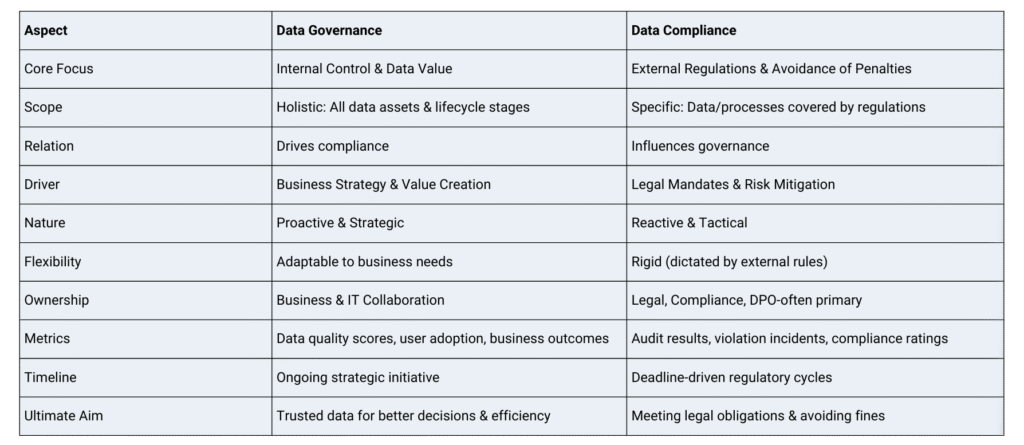
Governance vs Compliance: What Matters More?
This is the wrong question. They are interdependent. Think of governance as the engine and compliance as one of the essential destination checks. As IDC highlights, organizations implementing data governance typically see a return on investment of around 315% within three years. However, neglecting compliance can lead to devastating fines (up to 4% of global revenue under GDPR) and loss of customer trust. You need both to drive safely and legally.
- Scenario: Healthcare Provider
Strong data governance ensures accurate patient records across systems, defines access controls for sensitive health data (PHI), and manages retention securely. Data compliance (HIPAA) dictates specific requirements for protecting PHI, granting patient access, and reporting breaches. Governance enables compliance.
- Scenario: Financial Services
Governance defines data lineage for transactions, ensures data quality for risk reporting, and manages secure application retirement for legacy systems. Compliance (SOX, Basel III) mandates specific controls, audit trails, and retention periods. Governance provides the framework to meet compliance demands efficiently.
- Scenario: Global E-commerce
Governance establishes consent management processes and data classification standards. Compliance (GDPR, CCPA) requires honoring user consent, facilitating data subject requests, and ensuring privacy compliance across regions. Governance makes compliance scalable.
How Data Governance Fuels Compliance Success
Compliance without governance and governance without compliance are both fragile states. Governance lays the foundation for data management, enabling compliance. Without governance, compliance efforts may be inefficient. Governance should inherently include compliance as a core objective. According to Thomson Reuters, companies with well-established data governance frameworks are 70% more likely to consistently meet regulatory requirements across various regions.
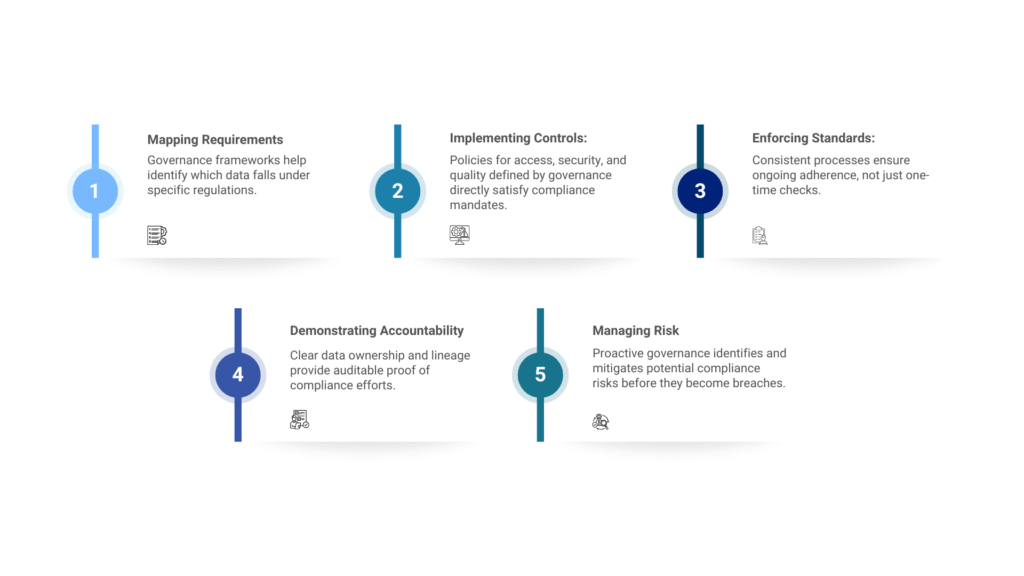
Organizations that treat data governance and data compliance as two sides of the same coin are better prepared for audits, regulatory changes, and future innovation. Strong governance practices lay the groundwork for seamless privacy compliance, risk mitigation, and data security—from active operations to application retirement.
To learn more about how Solix Common Data Platform (CDP) helps enterprises implement scalable, automated, and policy-driven data governance and compliance frameworks—spanning structured, unstructured, and legacy data—explore our approach to data management built for the age of cloud, AI, and regulation.

Related Posts

ISO/IEC 42001 AI Management System Standard: Publication Date and Scope

When Backup Systems Lose Track of Your Data: Why Enterprises Need a Data Control Plane