

Data Products 101: What They Are, Why They Matter, How To Begin?
Most organizations rarely lack data, yet we often hear data leaders say, “We manage petabytes of data, yet arriving at an accurate insight is time-consuming.” Most data teams aren’t lacking in data; they lack reliable, reusable outputs. The signs are everywhere: high costs, slower processes, inaccurate insights, duplicated efforts, and a cluttered dashboard. Without curated, “productized” approaches, raw data becomes a liability, often burdening businesses instead of enhancing their top and bottom lines.
What is a Data Product?
By definition, a data product is a curated, reliable, and documented set of data assets that solves a real user problem. Think of data products like software: it has an owner, a contract, a version, and SLOs. Good data products are consumption-ready, entirely governed, and reusable.
Key Attributes of Data Products
Great data products are discoverable (cataloged, tagged, and owned), addressable (stable URIs and versioned endpoints), secure (least-privilege access, masking, encryption), understandable (business glossary, lineage, examples), governed (policies as code, SLAs, retention or legal holds), and trustworthy (quality SLOs, audit trails, reproducible reads). These attributes for data products across inputs, semantics, storage, access, serving, and documentation are non-negotiable for creating reliable and resilient data products that consumers can find, use, and trust confidently.
Why Data Products Matter?
Curated Data Products within data management workflows help improve time to decision, reduce compliance risks, and decouple data producers and consumers while promoting data reuseability via contracts and safer change with versioning. Organizationally, this helps streamline processes by creating clear ownership while avoiding ad hoc firefighting data challenges.
Anatomy of a Good Data Produc
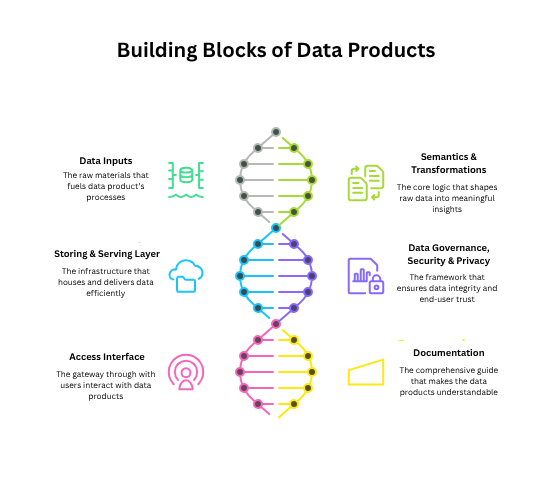
Just like a well-built software, a good data product, under the hood, has multiple layers and components working together. Here’s a broad anatomy of data products, broken down into key elements:
- Data Inputs: Every data product has associated data inputs, including operational databases, event streams, and third-party datasets. A data product clearly defines how it consumes input data, while establishing a schema, data quality expectations, and SLAs for data exchanges between data producer and consumer.
- Semantics & Transformations: This is the core logic inside the data product. It encompasses any transformations, business rules, and algorithms applied to the input data, as well as metadata, essential semantics, and a well-defined business glossary with documented definitions.
- Storage & Serving Layer: Once transformed, where does the data reside, and how do consumers access it? Depending on the complexity and business use case, this can be achieved through data marts, warehouses, lakes, or even lakehouse architectures. The storage layer must be effectively scalable, low-latency, and high-throughput to optimize performance and handle a business’s growing needs.
- Data Governance, Security & Privacy: All enterprise products must ensure a proper underlying data governance and security framework. This includes access controls, API authentication, privacy measures such as masking and obfuscation, embedded privacy policies for retention and purge, and audit logs.
- Access Interface: A great data product offers multiple interfaces for different users. For instance, a metrics product might allow for SQL, a machine learning dataset could include notebooks, and external applications might access data products through secure APIs. Data products must have at least one well-defined interface and remain stable or backwards-compatible as the product evolves.
- Documentation: If no one understands what your data products contain, they will not be utilized. Good data products are thoroughly documented and easily accessible. Documentation must include the purpose, schema, API specifications, example queries, owner/contacts, and update frequencies for the data products. Most data products store this information in a data catalog, allowing users to discover the data product through search.
Using Solix Data Lake Plus to Build AI-Ready Data Products
Customers can use Solix Data Lake Plus (as part of the Solix Common Data Platform (CDP) ) to create AI-ready data products faster because the platform concentrates the core capabilities you need across ingestion, governance, and serving:
- Unified ingestion for batch and real-time: Solix supports continuous data flows and real-time streaming to capture transactions, IoT events, logs, and social feeds without waiting for nightly batches, which are crucial for operational and ML products that depend on low-latency signals.
- Built-in catalog and metadata: Out-of-the-box data cataloging/metadata management helps you publish discoverable, documented interfaces (schemas, owners, examples), the backbone of productized data.
- Governance, privacy, and access controls: The Solix Common Data Platform provides a business glossary, data discovery and profiling, classification, masking, role-based views, workflows, and policy management. It makes it easier to enforce contracts, protect PII, and meet compliance while still enabling broad reuse.
- AI/ML readiness on cloud-native foundations: CDP unifies structured, semi-structured, and unstructured data for analytics and machine learning/AI, with ILM to keep both current and historical data compliant and available for model training and evaluation.
- Modern data architecture: Solix Data Lake Plus emphasizes end-to-end data integration and engineering on a secure, scalable platform deployable on cloud, hybrid, and on-prem systems, which is useful when your data products must graduate from MVP to enterprise-wide adoption.
Closing Thoughts
Having a product focus on data under management is crucial. Establishing clear ownership, contracts, SLOs, tests, and documentation ensures high-quality data products. To ensure project success, start small, pick just one high-leverage decision, ship a minimal but production-grade product end-to-end, and measure adoption and time-to-insights, and then reiterate deliberately to reduce risk and replace dashboard sprawls with secure, governed, reusable, product-ized data.
Platforms like Solix Data Lake Plus can enable customers to accelerate this by unifying ingestion, governance, cataloguing, and access. This allows data teams to focus on curating data quality instead of plumbing pipelines.
Schedule a call to learn more about how Solix can help augment and amplify your data management practice.

Related Posts

Data Lake Architecture in the Federal Trade Commission: Preventing a High-Cost Data Swamp Through Governance, Metadata, and Lifecycle Controls
Why Data Lakes Fail the Trust Test and How to Build an AI-Ready Data Layer