

Unified System of Records & System of Insights: One Platform for Secure, Governed AI
Today’s AI models are highly skilled, yet they often hallucinate. Probabilistic AI models often tend to invent plausible details when the underlying fact and context are missing. The solution to this problem isn’t usually a bigger model. The real fix is having a governed enterprise memory that serves as a foundation for generating enterprise insights through workflows.
A System of Records helps manage an organization’s enterprise memory by maintaining an authoritative history from operational data sources, data stores, decommissioned applications, and archives. It preserves this information with lineage, time context, retention, masking, and legal holds. This process transforms enterprise history into policy-aware, versioned data products that serve as the contract between data producers and data consumers. With trusted and explainable inputs available on demand, a System of Insights can analyze, learn, and activate while remaining compliant and reproducible, seamlessly building on the foundation provided by the System of Records.
A System of Insights typically utilizes operational data to transform facts into actionable insights, enabling executives to make informed decisions. Too often, it pulls data from operational data marts or ad-hoc pipelines instead of a governed memory. While this may work, it definitely leaves the enterprise with the potential to leverage historical data for AI and base insights on curated, governed memory.
A modern System of Insights should ideally be built upon governed data products with clear contracts and SLOs for freshness, quality, and complete lineage covering both active and archival datasets. Linked to the System of Records, the System of Insights must enable organizations to securely manage data from the past, present, and future, while ensuring compliance and maintaining a platform that is explainable and audit-ready.
The Records-to-Insights Loop
When a System of Records and a System of Insights work in sync, they essentially create a virtuous loop. Authoritative enterprise history flows forward as governed, compliant, archival data products. Through the System of Insights, this data can be used to train models and generate insights grounded in enterprise memory, while monitoring usage patterns, model outcomes, and business feedback. This enables the enrichment of workflows, leading to process optimization. This loop reduces the friction between facts, insights, and decisions, while ensuring that the models and metrics are constantly aligned with how the business actually evolves over time.
Records-to-insights Loop: Decoupled Compute, Unified Governance
Keeping the System of Records and System of Insights separate can be practical for managing SLAs, performance, cost, and risk isolation, but the drawbacks are significant. Policy drift, broken data lineage, and duplicated pipelines often increase complexity within data workflows. A balanced approach could be decoupled execution combined with a unified governance layer. Keeping compute, release, cadence, and scaling independent while centralizing the catalog, policy enforcement, lineage, and audits can help maximize the strengths of both approaches and achieve the benefits of system unification.
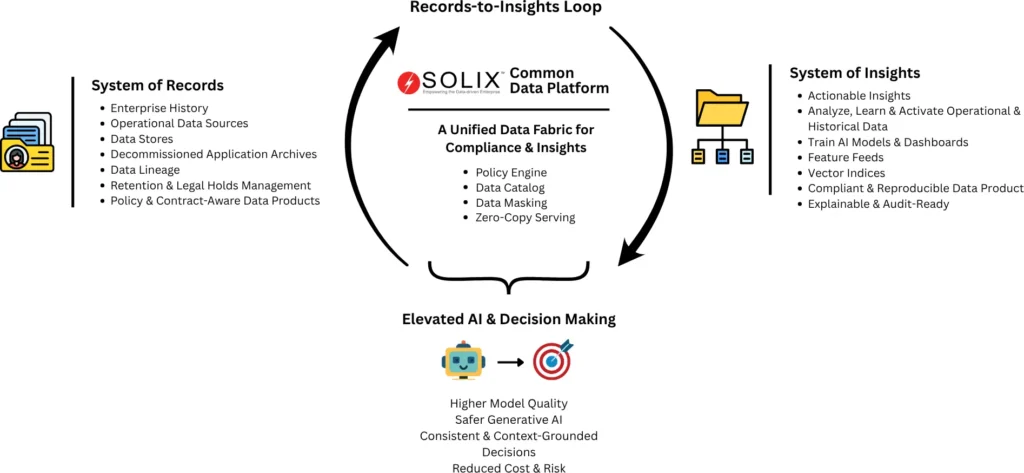
Governed Data Products: The Bridge Between Records & Insights
Data Products (archival, operational, and analytical) serve as the connecting link between Systems of Records and Systems of Insights. They package enterprise history and current data into a ready-to-use, policy-aware component that is time-sensitive (for retention and purging), reproducible, governed, and compliant by design. This improves the usability of data for the system of insights.
With the integration of Systems of Records and Systems of Insights, this link becomes a highway. The same data catalog, policy engine, and lineage graph can govern archival, operational, and analytical datasets, allowing for consistent application of access controls, masking, legal holds, and retention and purge policies both during publication and consumption. Zero-copy services ensure consistency across SQL, files, APIs, feature feeds, and vector indexes, while retrieval logs and citations support more transparent and explainable generative AI use cases.
How Records-to-Insights Unification Elevates AI & Insights?
Here are a few quantifiable metrics that help data teams create the best data products to improve AI & insights:
- Higher model quality: Archived data provides the model with a consistent enterprise history, while active datasets feed current signals. This enables AI to learn from both memory and the current state, providing better insights.
- Explainability by design: Every prediction or metric traces to a versioned data product and back to sources. Approvals and audits become faster because evidence is native.
- Safer generative AI: Retrieval workloads index only approved, versioned documents. With a unified records-to-insights loop, creating a trustworthy data product becomes easy for RAG-based AI implementations. Access is enforced during retrieval, and answers are provided with citations and retrieval logs, enabling users and auditors to see exactly what was used.
- Consistent decisions: KPI layers and semantic models read from the same governed products that power ML features and retrieval indices, keeping dashboards, forecasts, and AI assistants aligned.
- Lower cost and risk: Zero-copy patterns and tiered storage reduce duplication. A single policy surface reduces exposure and shortens incident response.
What Records-to-Insights Unification Looks Like with Solix?
The Solix Common Data Platform is a foundational layer that houses solutions that together deliver a unified System of Records and System of Insights for data-driven businesses.
Solix Enterprise Archiving
Application Retirement, Database Archiving, File Archiving, and Email Archiving create a comprehensive System of Records. Historical enterprise memory is preserved with retention, legal holds, lineage, and access controls intact.
Solix Data Lake Plus
Manages active data for analytics and AI, turning governed history into consumable datasets, document collections, and AI-ready data products for insights. Teams build dashboards, train models, and power retrieval workloads from approved, versioned products rather than ad hoc extracts.
Unified Governance Fabric
Policies are written once and enforced from ingestion to access. Lineage, quality, masking, and retention move with the data, so the same rules apply whether the workload is a dashboard, a model, or a retrieval query.
Closing Thoughts
A disconnected System of Insights can be productive, but it will always be fragile if a governed System of Records does not feed it. Unifying both on a single platform turns archives into an asset for AI, turns policy into code that travels with data, and turns insights into decisions you can defend.
With Solix Enterprise Archiving and Solix Data Lake Plus on Solix Common Data Platform, you get a single, governed backbone that spans both historical memory and active insight. Build archival data products once, use them everywhere, and keep every answer accountable.
Book a demo to see how Solix Data Lake Plus, backed by Solix Enterprise Archiving on SCDP, gives you a unified System of Records and System of Insights for secure, governed AI

Related Posts

Predictive Maintenance and Data Governance: Why Unverified Sensor Data Creates More Downtime Than It Prevents

HIPAA Compliant Backup: The Data Protection Requirements Healthcare Organizations Routinely Underestimate