

Remember, Backup is not Archiving!
I’ve been in the Information Lifecycle Management space since my days with Princeton Softech, and then IBM Optim. Way back then there was a misunderstanding about Backups really being a proxy for Archives. They aren’t. I’ve recently gotten some feedback from our field teams that this notion has not disappeared over the years.
As you know, your business is generating data faster than ever. This includes structured data from enterprise applications, plus semi-structured and unstructured content – which is typically over 80% of enterprises data. Emails, social media posts, sensor readings, attachments and video files all contribute to this growth.
Collecting data solves nothing. You need a data archiving strategy to extract value from your information assets.
Backups Versus Archives
Data backups differ from data archives. Backups provide short-term copies for disaster recovery. You use them to restore lost or corrupted data. Backups do not prepare your data for use in AI initiatives.
Archives store inactive or infrequently accessed data long-term. They are curated and catalogued, allowing for analysis and utilization in AI projects. This is a big differentiation. Archives deliver business value in four ways.
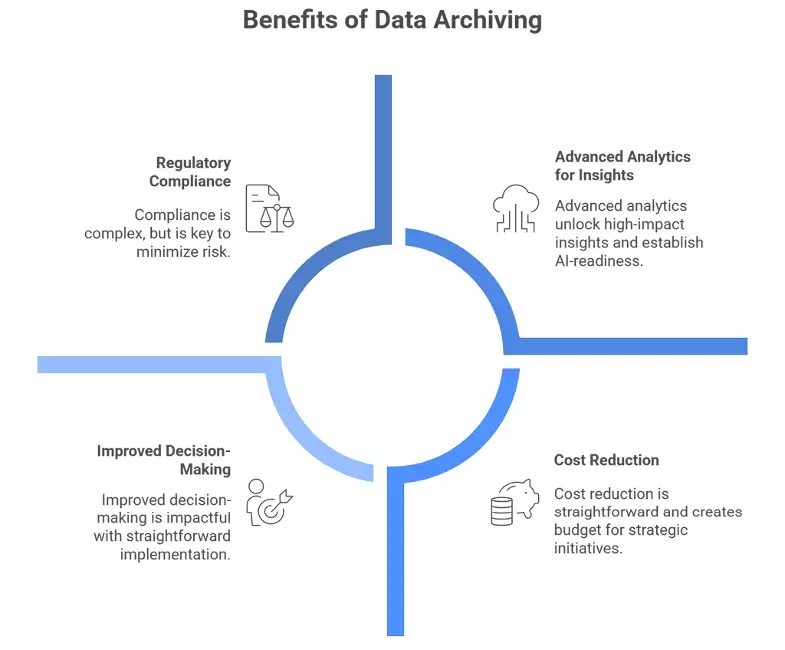
First, archives help you comply with regulations. Businesses face mandatory data retention requirements across industries. Archives ensure compliance and reduce your risk of fines and legal problems. You retrieve archived data for eDiscovery when legal teams need evidence.
Second, archives improve your decisions. Business leaders increasingly rely on data. Archived information provides historical context for current trends. You develop better strategies when you analyze patterns over time. Customer purchase patterns from archived data help you predict future demand and optimize inventory management.
Third, archives reveal hidden insights. Advanced analytics tools extract value from large datasets. Sentiment analysis of archived social media posts shows long-term customer trends and brand perception shifts. You spot patterns invisible in current data alone. As you look to introduce AI initiatives, well organized and cataloged archive data can be a strong starting point for analysis.
Fourth, archives cut your costs. Storing all active data on expensive primary storage strains your IT budget. You free up space on primary systems when you move infrequently accessed data to cheaper secondary storage. Performance improves and storage costs drop.
Beyond Database Records
Traditional structured data like financial records and customer databases have always needed archiving. Semi-structured and unstructured data now demand broader approaches.
Semi-structured data appears in emails and log files. This information has some organization but does not fit into rows and columns. Your archiving solution needs to handle its specific formats and retrieval needs.
Unstructured data forms the largest category of enterprise information. Text, images, video, and social media content fill this space. You need specialized tools to index and search within these files.
Modern archiving solutions handle this diverse data. They offer four key features.
They scale to accommodate growing volume and variety. You store different data types on the most cost-effective storage. They manage metadata to tag and index archived content for efficient search and retrieval. They provide security to ensure data privacy and regulatory compliance.
Preparing for Tomorrow
Organizations with comprehensive data archiving strategies will navigate the new AI age better than competitors. You gain competitive advantage when you access value hidden in all your data. Archives ensure compliance and enable data-driven decisions for long-term success.
Modern archiving goes beyond backup. You transform inactive data into strategic assets. Every archived email, customer record, and sensor reading becomes available for analysis and AI when you need insights.
Solix’s portfolio of archiving solutions: SOLIXCloud Enterprise Data Archiving Solution | Manage Growth
The question is not whether to archive. The question is how quickly you implement archiving across all your data types. Your competitors already started.