

Archiving with Intelligence: How is AI Bringing About a Paradigm Shift in the Email Archiving Space?
Listen to the blog
Email remains one of the most reliable pillars of enterprise communication, playing far more than just a role in everyday collaboration. Most employees in any organization consider email as a medium to communicate and collaborate with wider teams. However, they fail to acknowledge the other instrumental aspect of email that it acts predominantly as a legally recognized record, forming the foundation for regulatory compliance and often serving as a crucial element during legal proceedings and organization-wide audits. Yet the industry-wide accepted norm of email as a primary and official communication tool is propelling the email data to grow at an unprecedented scale. Managing this ever-expanding communication corpus poses a significant challenge in terms of costs, efficiency and overall strategy.
In my previous blog themed, “Secure, Comply, Retain: The Case for Enterprise Email Archiving Today”, I explored how businesses must focus on archiving, protection, and eventual disposal of historical email data to reduce risks, control storage costs, and maintain compliance. In this blog, I’ll focus on how next-gen technologies such as Artificial Intelligence (AI), Machine Learning (ML) can be instrumental in re-architecting the legacy systems, which were once used for email archiving and were innovative at the time, are now showing their limits under the weight of exploding data volumes and increasingly complex regulatory frameworks.
Standards and compliance norms such as the GDPR, HIPAA, SEC Rule 17a-4, and FINRA have stringent mechanisms to handle and manage information securely and based on predefined guidelines. Hence, storage and retrieval costs are rising, while the risk of compliance failures, fines, or litigation has grown sharply. This shifting landscape is creating space for newer and niche methodologies, with the adoption of Artificial Intelligence, Machine Learning, and Large Language Models taking center stage. Instead of treating archiving as a static storage medium, organizations are beginning to adopt more dynamic and intelligent systems. AI-powered solutions can classify, store, and retrieve messages automatically and with utmost precision, thereby improving efficiency significantly. They also offer proactive tools for spotting compliance risks early, supporting investigations during audits, and ensuring that key information can be quickly surfaced.
Amid rising regulatory pressure and sprawling communication channels, infusing email archiving with AI and LLMs isn’t a mere upgrade—it’s a widely accepted strategic imperative, leveraging years of historical email communication as training data for predictive and compliance-aware models. These technologies enable organizations to adhere to regulatory norms and guidelines and unlock greater value from records once viewed solely as regulatory obligations.
Current State of the Email Archiving Space
Traditional email archiving has typically been implemented through three main approaches:
- On-Premises Archives: Enterprises rely on local servers to store their mail. This model offers direct control but comes with high fixed costs (servers, data centers, etc.), ongoing upkeep, and significant challenges when it comes to scaling.
- Cloud Archives: Delivered as SaaS platforms, cloud-based options provide agility, more effortless scalability, and reduced dependency on internal infrastructure.
- Hybrid Archives: These act as a transitional model, keeping a portion of data in local storage while using the cloud for elasticity and broader reach.
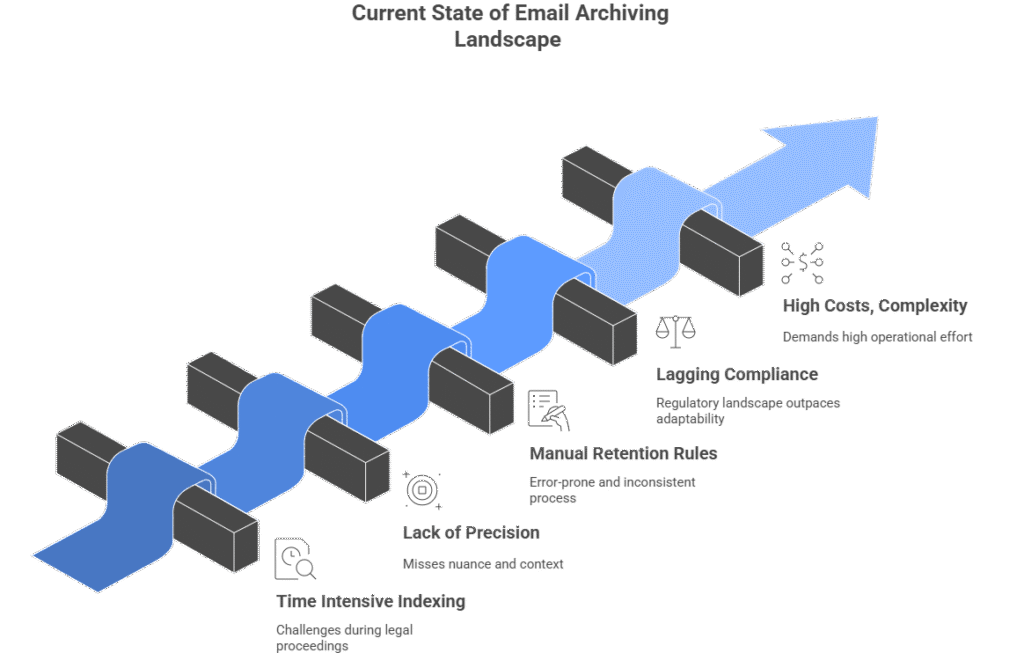
The approaches mentioned above, although widely accepted for deployment, have significant drawbacks;
- Time Intensive Indexing: Searching through large volumes of archived data often leads to delays, creating bottlenecks during legal proceedings and eDiscovery.
- Lack of Precision-based Search: Basic keyword-based searches fail to capture nuance or context, forcing compliance and legal teams to spend additional time reviewing results.
- Manual Retention Rules: Policies depend on administrators applying tags, an error-prone and inconsistent process that is extremely cumbersome, slow, and time-intensive.
- Lagging Compliance Capabilities: The dynamic regulatory landscape outpaces the adaptability of existing regulatory frameworks
- High Costs and Severe Complexity: Managing archives that scale into the 500TB-1000TB range demands high operational effort, significant number of human and capital resources.
How can AI Impact the Email Archiving Landscape Today?
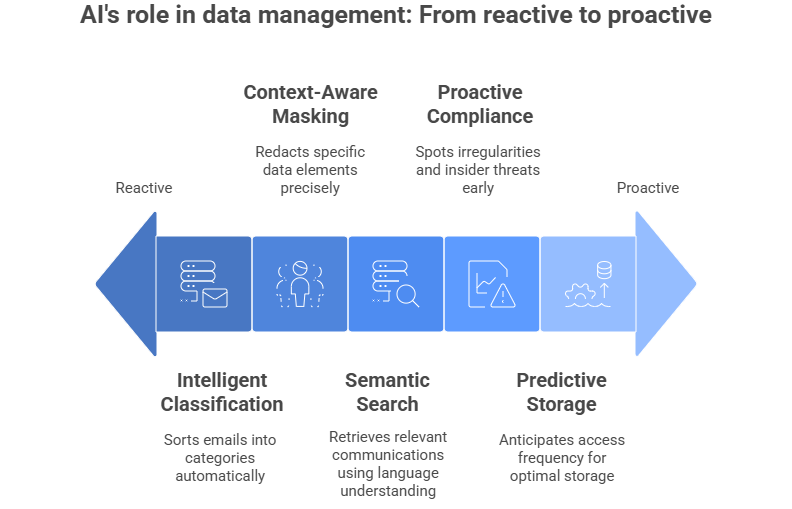
1. Intelligent Tagging and Classification
AI/ML-based systems can automatically sort emails into categories such as personal, business-related, sensitive, or high-risk. Additionally, this smart classification extends to automated classification of data into cloud tiers based on access frequency. This reduces reliance on manual tagging, ensures consistent application of retention rules across the board, and seamlessly identifies sensitive information like PII or PHI without requiring user intervention, helping organizations maintain compliance at scale.
2. Beyond Generative AI: Context-based AI for Data Masking and Redaction
Context-driven, AI-mapped redaction tools can target specific data elements, like national ID numbers, account details, or patient identifiers, and obscure them precisely. This preserves the integrity of the records in tandem with meeting all the required regulatory norms and guidelines.
3. NLP-based Semantic Search Capabilities
Search tools can move beyond basic keyword matches by leveraging Natural Language Processing (NLP). They can analyze the relationship between a set of words and produce the desired output with utmost precision and accuracy.
4. Proactive Compliance and Anomaly Detection
AI can analyze communication patterns continuously to spot irregularities such as insider threats, irregular usage trends, and unusual surges in activity that may suggest fraud or breaches of policy. This advanced capability enables auditors and compliance teams to act immediately without any delays.
5. Predictive Model-based Storage Classification
Based on the historical data, AI models such as LLMs can anticipate the access frequency of a given email record and place it in the corresponding designated tier. This intelligent and adaptive approach reduces expenses without sacrificing accessibility.
Closing Remarks
The advent of Artificial Intelligence and Machine Learning is creating unfathomable advances in the industry, and same has been the case with the Email Archiving landscape. Predictive models are being leveraged consistently to place given email records in designated storage tiers based on the access patterns, and now prescriptive models are being explored to create recommendation engines to define an appropriate retention period (marketing budget and project plan mapped emails would automatically have a more extended retention period) that balances cost and compliance. In addition, context-based AI models are being trained for enhanced precision in terms of detecting PII or PHI data from archived emails automatically and redacting them immediately. This would unlock a higher degree of security and privacy. LLMs are also being leveraged to facilitate cross-system discovery; Vectorized and unified embeddings can link archived emails with chats, documents, and tickets across channels. To summarize, with AI, Email Archiving will be seen not only as a storage mechanism but as a strategic asset that can safeguard enterprises against risks and regulatory scrutiny & generate meaningful insights and oversight.
SOLIXCloud Email Archiving Platform is a fully managed email archiving as-a-service solution that simplifies eDiscovery, seamlessly navigates through stringent regulation and compliances, and facilitates efficient management of email growth. SOLIXCloud Email Archiving offers an intelligent, secure, highly scalable, and user-friendly email archiving solution for enterprises of all sizes. Powered by Solix Common Data Platform (CDP), it simplifies the implementation of a centralized ILM compliance strategy for all types of organizational data including structured, unstructured, and semi-structured data.