

Document Archiving for the Enterprise
What Document Archiving Really Solves
- Reduces operational and regulatory risk from unmanaged documents
- Enforces retention, legal hold, and defensible deletion
- Improves audit readiness across regulated environments
- Creates trusted historical data for analytics and AI
Why Document Archiving Still Matters in 2026
Document archiving is often dismissed as a legacy concern. In reality, unmanaged documents remain one of the largest sources of compliance exposure in modern enterprises.
Across multiple regulated environments, I have seen audit findings triggered not by missing data, but by the inability to prove what should have been deleted and when. That distinction matters.
What Is Document Archiving?
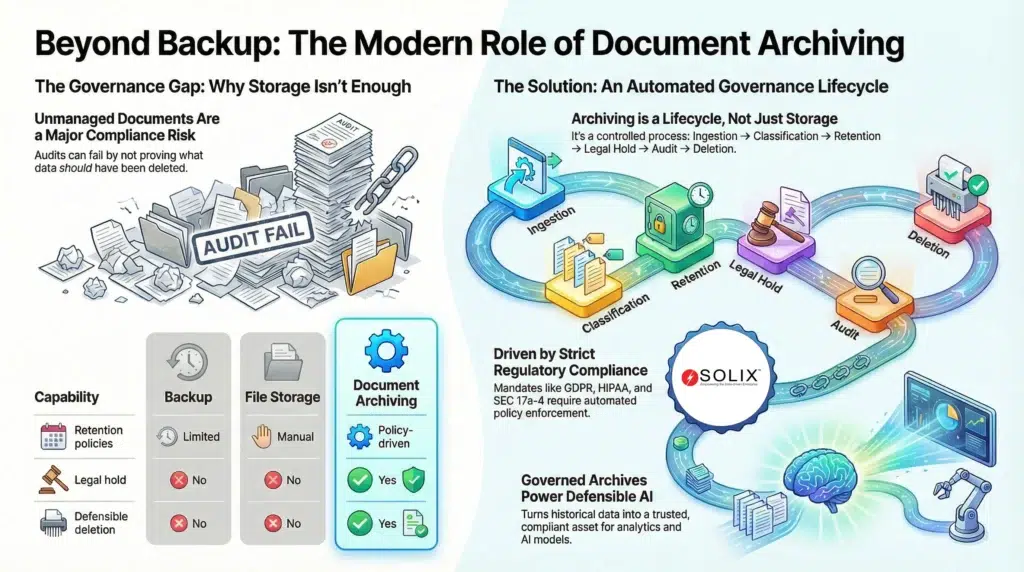
Document archiving is the controlled process of identifying, classifying, retaining, securing, and defensibly deleting documents according to legal, regulatory, and business requirements.
Unlike backup or file storage, archiving focuses on long-term governance, auditability, and proof of policy enforcement.
Document Archiving vs Backup vs File Storage
| Capability | Backup | File Storage | Document Archiving |
|---|---|---|---|
| Retention policies | Limited | Manual | Policy-driven |
| Legal hold | No | No | Yes |
| Audit trail | Minimal | None | Immutable |
| Defensible deletion | No | No | Yes |
Key Compliance Drivers for Document Archiving
- GDPR and global privacy laws
- HIPAA and healthcare record retention
- SEC 17a-4 financial record immutability
- SOX corporate governance requirements
- NIST SP 800-88 defensible disposal standards
These regulations do not tolerate best-effort processes. Archiving systems must enforce policy automatically.
Document Archiving in Cloud and SaaS Environments
Modern enterprises create documents across SharePoint, Google Drive, Box, ERP platforms, and industry-specific SaaS systems.
Effective archiving requires centralized policy control, consistent metadata, and secure search across environments.
How Document Archiving Supports AI and Analytics
Archived documents represent some of the most valuable historical datasets an enterprise owns.
When archives are governed, searchable, and access-controlled, enterprises can confidently support analytics, eDiscovery, and AI model training without introducing compliance risk.
Where Solix Fits
Solix approaches document archiving as part of a unified data governance and information lifecycle management strategy.
- Policy-driven retention and legal holds
- Defensible deletion aligned to regulatory mandates
- Search and access for compliance, audits, and analytics
- Governed data foundations for enterprise AI
Learn more about Solix approaches to Information Lifecycle Management, Enterprise Data Governance, and Email and Content Archiving.
Key Takeaways
- Document archiving is governance, not storage
- Retention without enforcement increases risk
- Compliance must be automated to scale
- Governed archives enable defensible AI
Frequently Asked Questions
Is document archiving legally required?
Regulations require retention, auditability, and defensible deletion. Archiving systems are the most reliable way to meet those obligations.
Can archived documents be searched?
Yes. Modern archiving platforms provide indexed, role-based search for compliance, legal, and operational needs.
Can archived data be used for AI?
Yes, when consent, retention, and provenance are enforced. Ungoverned archives should never be used for AI training.