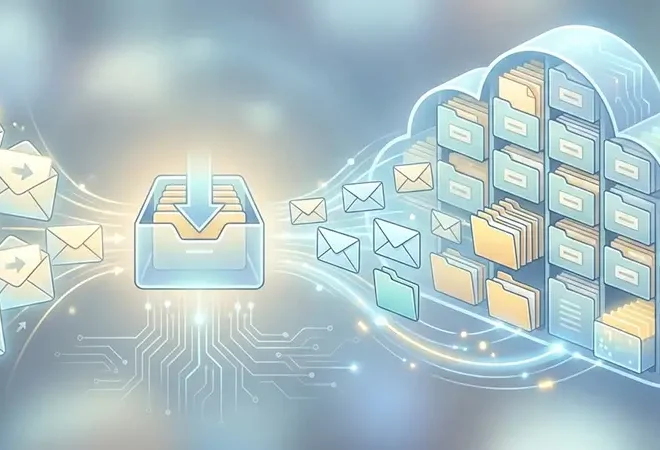

Email Archive Program: The Enterprise Standard for Compliance, Audit, and AI Readiness
An email archive program is no longer just an IT storage project. In regulated enterprises, it is a compliance-critical governance system that determines whether your organization can pass audits, respond to subpoenas, and safely use communications data for analytics and AI.
- An email archive program governs how messages are captured, preserved, searched, and produced.
- Federal regulators and courts require retention, integrity, and auditability.
- Mailbox archiving is not compliance archiving.
- Well-structured archives enable legal defensibility and AI readiness.
What Is an Email Archive Program?
An email archive program is the combination of policies, systems, and controls used to preserve business communications as legally defensible records.
The U.S. National Archives and Records Administration (NARA) defines electronic records as federal records that must be preserved with integrity, authenticity, and retrievability. These same principles now apply across regulated industries.
Academic research from institutions such as Stanford and MIT shows that ungoverned communication data becomes a primary source of legal and operational risk when it cannot be reliably preserved, searched, and produced.
Why Enterprises Must Treat Email as a Regulated Record
Email is not just correspondence. It is:
- A legal record
- A compliance artifact
- A discovery asset
- A security liability
U.S. federal agencies require regulated entities to maintain accurate and complete electronic records under SEC Rule 17a-4, FINRA retention rules, and federal eDiscovery standards. Internationally, GDPR Article 5 and Article 17 require data integrity, accountability, and controlled erasure.
These rules require more than backups. They require an operationally enforced archive.
The Five Non-Negotiable Requirements
| Control | Why It Exists |
|---|---|
| Immutable or auditable storage | Federal recordkeeping standards require proof that messages were not altered |
| Legal hold | Court orders require data to be preserved regardless of retention schedules |
| Full audit trails | Regulators require who accessed what and when |
| Encryption | HIPAA, NIST, and GDPR mandate data security controls |
| Fast search & export | Courts and examiners require prompt production |
What U.S. Federal and Academic Authorities Expect
The U.S. Federal Rules of Civil Procedure require that electronically stored information (ESI) be preserved, searchable, and producible in a usable format.
The National Institute of Standards and Technology (NIST) SP 800-53 and SP 800-88 establish how electronic records must be protected, retained, and disposed of.
Universities including UC Berkeley and Harvard Law School have published eDiscovery research showing that email remains the most litigated digital data type, making governance non-optional.
Why Email Archiving Enables AI and Analytics
Modern enterprises want to analyze communications for:
- Compliance surveillance
- Fraud detection
- Customer sentiment
- Process optimization
- AI copilots
But AI cannot safely operate on uncontrolled communications. A real email archive program adds structured metadata, retention labels, and access controls that make communications data trustworthy for analytics and machine learning.
30-60-90 Day Program Rollout
First 30 days
- Define retention schedules
- Enable capture from all mail systems
- Map legal hold workflow
60 days
- Test regulatory production requests
- Enable audit log reviews
- Train compliance and legal teams
90 days
- Decommission PST files
- Enforce automated retention
- Deploy analytics-safe metadata
Where Solix Fits
An email archive program should not live in isolation. It must integrate into the enterprise information architecture that governs all data.
Solix provides a unified, policy-driven data platform that connects email, files, records, and metadata under one governance layer. This allows organizations to operate a compliant archive while enabling secure analytics and AI across communications data.
Learn more about governed enterprise AI at: https://www.solix.com/products/enterprise-ai/