

The Solix SMART Framework for a Future-ready Data Architecture
Across industries, companies are making significant investments to turn data into strategic assets, and interest in AI is at its peak in the current market environment. However, many now face significant workflow bottlenecks due to fragmented systems, rising data management costs, and changing compliance requirements. A truly modern data architecture provides a unified, secure, and AI-ready foundation that can scale with the business while enabling all users, from data scientists and analysts to business stakeholders.
But what defines modern data architectures?
To simplify the process, enterprises can follow the Solix SMART principle to create a modern data architecture.
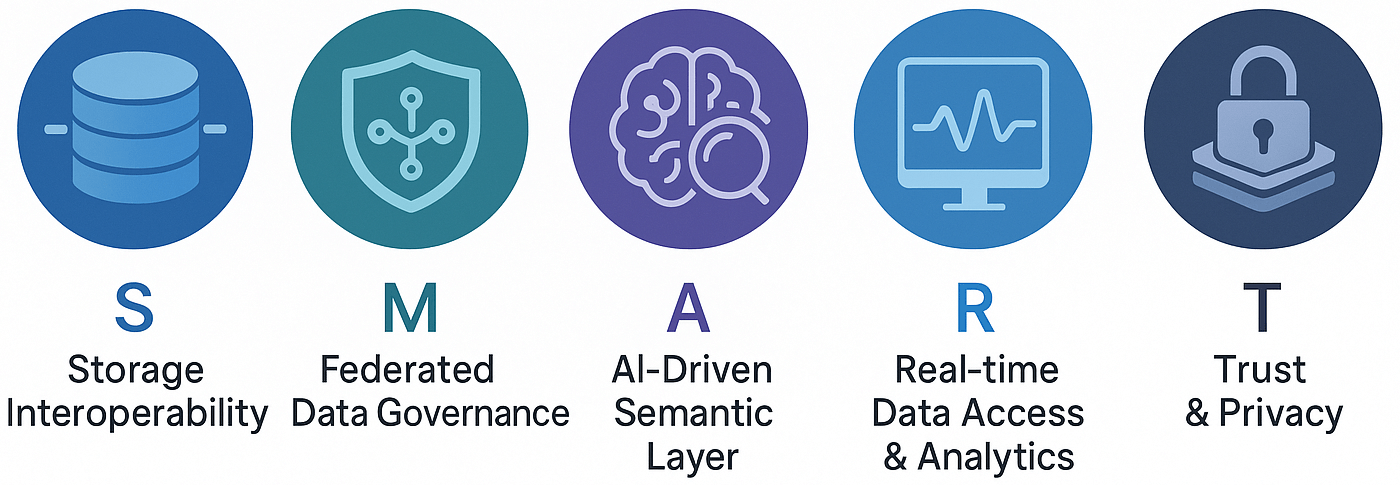
S – Storage Interoperability
Businesses no longer rely on a single vendor to solve storage challenges. Vendor lock-in typically involves high switching costs and increased dependencies on proprietary protocols and storage formats. Modern data architectures are built upon a foundation of open table formats (Hudi, Iceberg, and Delta Lake).
This brings:
- Standardized Data Access across SQL engines, data science and machine learning notebooks, and BI tools without duplication
- Enable ACID-compliant transactions so analysts can trust their queries against constantly updated datasets.
- Decoupled storage and compute, allowing enterprises to scale based on need, cost-effectively
M – Managed Data Access Through Federated Data Governance
Centralized governance principles often fail to recognize domain-specific governance and compliance needs. This model enables local data control while establishing enterprise-wide governance standards and oversight.
This brings:
- Local Stewardship: Domain teams manage their own metadata, quality and access controls
- Global Consistency: An enterprise framework ensures compliance, lineage tracking, and shared glossaries.
- Automated Enforcement: AI‑driven tools monitor policies in real time, flagging anomalies and violations as they occur
A – AI-Driven Semantic Layer
The value of enterprise data hinges on how well professionals understand their data. Large companies often decommission outdated applications and databases to streamline infrastructure. While data catalogs excel at organizing known assets, existing platforms usually can’t identify “dark” legacy data on their own. An AI-powered semantic layer can automatically uncover dark data, enrich metadata, and improve data visibility.
- Democratize and enable self-serve data access for non-technical professionals within data workflows.
- Enable “Prompt-to-SQL” querying to simplify the way data is accessed
- Improve data discoverability and institutional knowledge sharing
R – Real-time Data Access & Analytics
Modern data architectures require real-time data processing from a wide range of sources. This is essential for time-sensitive tasks such as monitoring, resource management, incident detection, and live reporting. Instant insights enable quicker decisions, minimizing delays between data collection and action.
- Enables continuous monitoring, transformation, and enrichment of data as it gets generated
- Helps improve situational awareness with live dashboards and operational analytics
- Support immediate alerting and anomaly detection through automatic threat detection
T – Trust & Privacy-By-Design
Businesses operating in highly regulated industries handle vast volumes of highly sensitive data, requiring controls to be directly embedded into the infrastructure, processes, and interfaces right from the start. A zero-trust, privacy-by-design approach to data management ensures that robust access controls, encryption, and audit mechanisms strictly govern all data assets.
- Reduces breach risk while maintaining operational agility
- Ensures governance principles are adequately enforced
- Improves traceability and accountability through detailed audit logs
Putting It All Together
While not necessarily exhaustive, adopting the Solix SMART framework can broadly guide you to help develop a cohesive data platform that drives innovation, scaling, and insights while ensuring the highest levels of discoverability, data governance, and security. Whether you’re a startup aiming to surpass existing competitors or a global enterprise reimagining traditional business practices, these principles can serve as waypoints to building a strong foundation and becoming truly data-driven.
Next steps
- Assess Your Current State: Create an inventory of your data sources, volumes, workflows, and pain points within said workflows.
- Define Objectives and Create a Roadmap: What business goals would you like to achieve with your data architecture? Define metrics for what you’d call a win, and prioritize quick wins, alongside longer-term projects.
- Build for Flexibility: Business goals and use cases will evolve as the tech powering them improves. Design for flexibility and look for solutions that natively support open architectures. This would allow you to switch things and pivot as needed without vendor lock-in.
Data management isn’t just an IT checkbox. By treating it as a strategic asset, businesses can unlock deeper insights quickly and at scale while gaining a lasting competitive edge. At Solix, we work closely with your enterprise data strategy to enable greater agility and innovation. Whether modernizing your legacy systems, driving AI initiatives, or establishing compliance excellence, Solix can be your strategic partner, helping you make faster decisions, deliver better experiences, and confidently lead in an increasingly data-driven world.

Related Posts

The Bill Comes Due: Why “AI Pilot Purgatory” Is About to Define the 2026 Boardroom

The “Reluctance” Gap: Why Canadian Financial Institutions Must Pivot from AI Pilots to AI Readiness