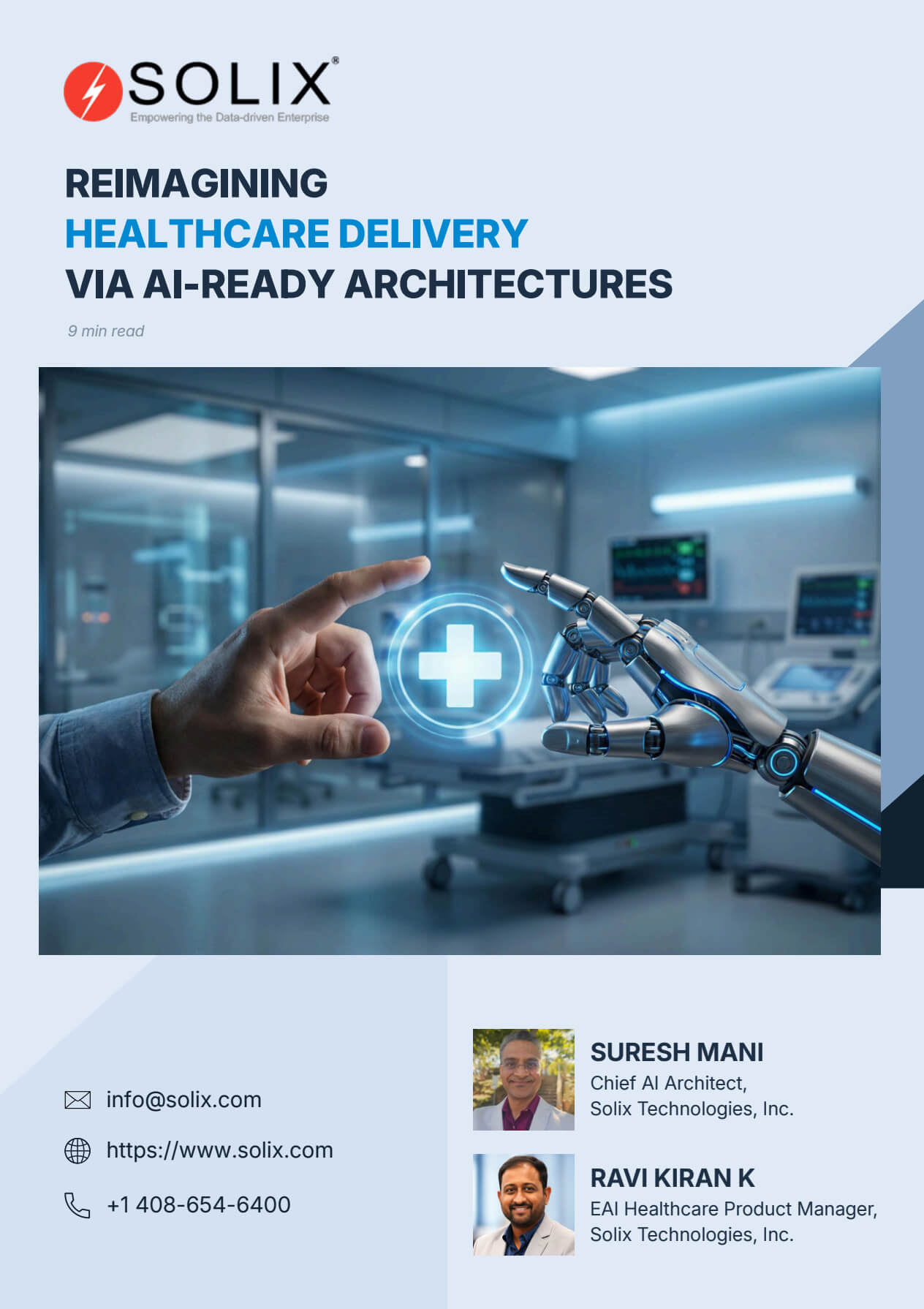
In today’s healthcare landscape, moving from fragmented data silos to a unified, AI-driven ecosystem is no longer a strategic advantage — it’s an operational necessity. Getting there means pivoting from basic digitization toward what we call Cognitive Clinical Care: a model where Unified HIMS & EHR systems and picture archival and imaging workflows come together into one longitudinal, 360-degree view of the patient journey.
When that data is governed and synchronized, AI stops being just automation and starts becoming clinical intelligence — surfacing diagnostic patterns in imaging, predicting patient deterioration before it happens, and automating the compliance work that used to eat clinician time. This white paper walks through the architecture, the governance model, and the ROI case for making that shift.
What’s inside
- Why fragmented HIMS, EHR, and imaging systems stall AI initiatives — and how a unified, FHIR-mapped data layer fixes it at the point of capture.
- The four architectural requirements for an AI-native healthcare platform: interoperability, a unified intelligence layer, continuous care delivery, and governance by design.
- How ICD code clean-up and clinical data governance create the reliable foundation predictive AI and analytics depend on.
- Where the near-term ROI shows up: clinician documentation time, bed and staffing optimization, readmission penalties, and diagnostic yield.
- A three-stage maturity model for getting there — whether you run a 50-bed community hospital or a 500-bed corporate network.
- How “governance by design” reduces breach liability and supports HIPAA, NABH, and JCI compliance posture.
Why it matters
Most hospital data platforms were built for billing and static record-keeping, not for the volume or variety of data modern medicine now generates. That leaves diagnostic patterns undetected, patient deterioration unpredicted, and compliance work reactive rather than built-in.
An AI-ready foundation changes the starting point: clinical, operational, diagnostic, and administrative data are governed and synchronized before AI ever touches them — so predictive risk modeling, clinical decision support, and remote monitoring are working with a trustworthy, longitudinal patient record instead of a partial one.
About the Author:
-

Suresh Mani
Chief AI Architect
Solix Technologies, Inc.
-

Ravi Kiran K
EAI Healthcare Product Manager
Solix Technologies, Inc.