
Application Retirement vs Application Decommissioning
Organizations across industries are grappling with an alarming reality: 77.7% of IT budgets are consumed by operations and maintenance of legacy systems, with some agencies spending up to 96% of their IT budget on maintaining outdated applications. Understanding the distinction between application retirement and application decommissioning is crucial for optimizing IT resources, enhancing data security, and ensuring privacy compliance. This blog offers a clear, authoritative guide to these processes, helping businesses make informed decisions about their IT infrastructure.
Why Understanding the Difference Matters?
Application Retirement and Application Decommissioning are often used interchangeably in casual IT discussions, but they are not strictly the same. In professional IT operations, especially in enterprises or regulated industries, the terms have specific meanings and implications. The distinction between the both isn’t merely academic—it has profound implications for data security, privacy compliance, and data management strategy.
Both processes aim to reduce technical debt and optimize IT portfolios, but they serve distinct purposes and require different approaches to data management, risk mitigation, and resource planning. Understanding these differences enables organizations to optimize resource allocation, mitigate security risks, and ensure regulatory compliance while maintaining access to critical historical data. The choice between retirement and decommissioning can determine whether an organization saves costs while preserving data accessibility or achieves complete system elimination with maximum security benefits.
Core Distinctions: A Strategic Comparison
Both application retirement and application decommissioning involve shutting down the legacy system. However, application retirement focuses on preserving and accessing legacy data, whereas application decommissioning involves removing the system and either discarding the data or transferring it in a manner not intended for continued access or use.
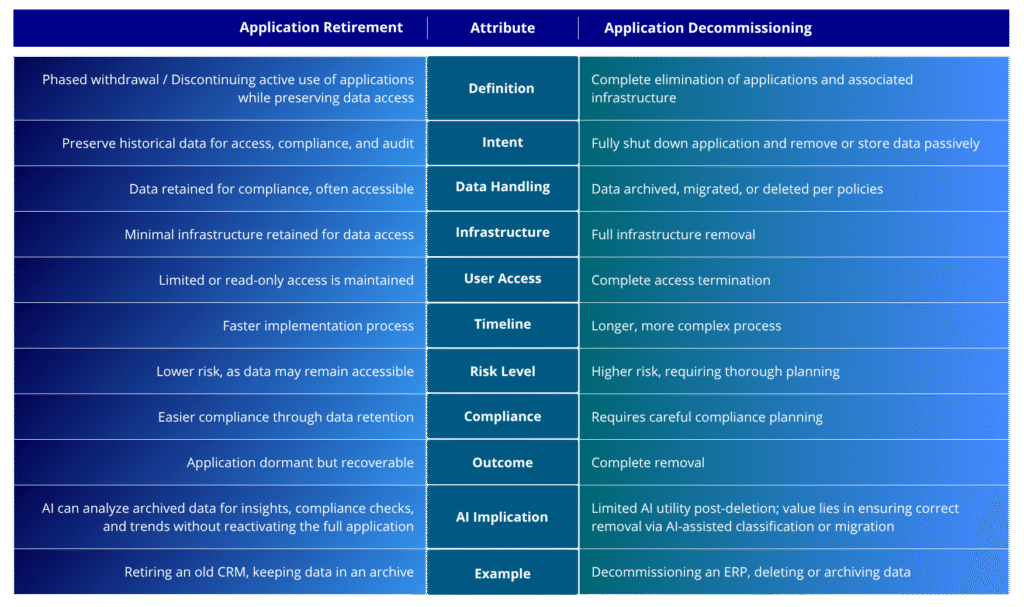
Think of retirement as an intelligent shutdown + data preservation, and decommissioning as complete sunsetting with optional data disposal. This comparison underscores that retirement prioritizes data accessibility, while decommissioning focuses on complete system removal.
What Is Application Retirement?
Application retirement, often called sunsetting, involves phasing out an application no longer in active use while preserving and maintaining access to its historical data for compliance, regulatory, or business purposes. Rather than simply deleting the application and its databases, businesses move important legacy data into a secure archive—often within a lower-cost environment that supports future retrieval for auditing, reporting, and legal requirements.
The retirement process typically involves creating data archives, establishing read-only access mechanisms, and implementing minimal maintenance protocols to ensure data availability. Organizations often choose retirement when dealing with applications that contain critical historical information, are subject to regulatory retention requirements, or serve as reference systems for ongoing business operations.
For example, a company might retire an outdated CRM system, moving its data to a data warehouse for occasional reference, thus maintaining data management integrity. This approach is especially beneficial for systems no longer in active use but still subject to regulatory retention laws (e.g., HR, finance, or healthcare records).
Key characteristics of application retirement include maintaining data integrity, preserving audit trails, ensuring compliance with retention policies, and providing controlled access to historical information.
Why Businesses Need Application Retirement?
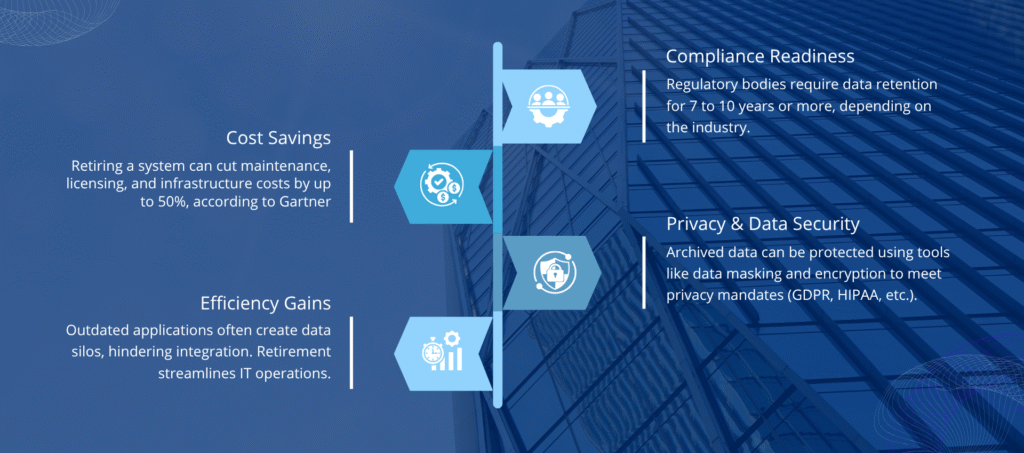
Organizations pursue application retirement for several compelling reasons that directly impact their bottom line and operational efficiency:
To know more about the Top 5 Red Flags Indicating It’s Time for Application Retirement: Bookmark the blog!
What is Application Decommissioning?
Decommissioning permanently eradicates an application and its infrastructure. Data is either migrated to modern systems, archived long-term, or securely destroyed. This approach eliminates all maintenance overhead. This is a more aggressive approach suited for non-critical or outdated systems where data retention is not required, or when retention periods have already lapsed.
Decommissioning is appropriate when applications are entirely replaced by modern alternatives, when data has no ongoing business value, or when the cost of maintaining systems exceeds their benefit. This approach delivers maximum cost savings and simplification benefits but requires higher upfront investment and more complex project management.
Why Businesses Need Application Decommissioning?
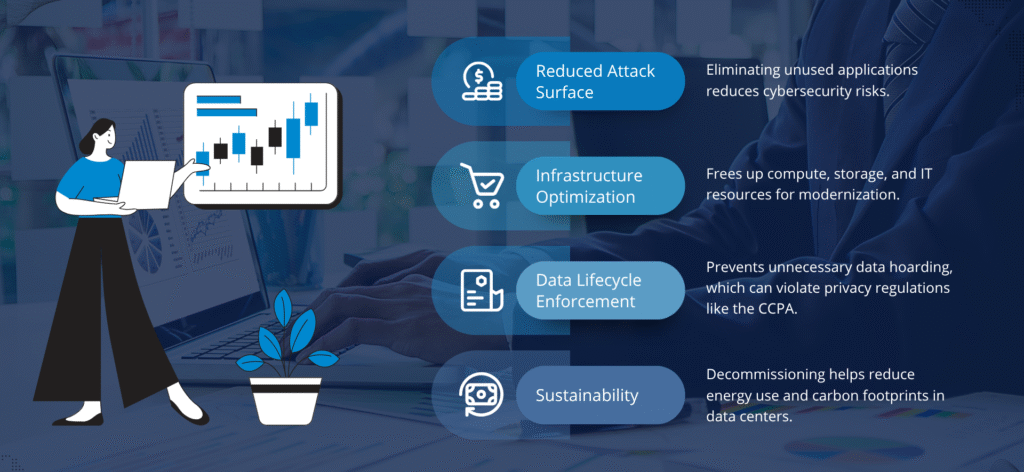
In addition to the cost-saving aspect, as mentioned above, organizations pursue comprehensive application decommissioning for several strategic reasons that align with modern IT transformation goals:
Choosing Between Application Retirement and Decommissioning
Selecting the appropriate strategy requires careful evaluation of multiple factors that impact both immediate operations and long-term business objectives. The following framework helps IT leaders make informed decisions based on specific organizational circumstances.
- Data Retention Needs: If your organization must retain data for compliance or historical purposes (e.g., GDPR or HIPAA mandates), application retirement is the better choice. It ensures data remains accessible in a secure archive, minimizing compliance risks. For example, financial institutions often retire applications to maintain auditable records.
- System Relevance: If the application’s data is no longer needed or has been fully migrated to a modern system, decommissioning is more appropriate. This approach eliminates unnecessary infrastructure, reducing costs and security risks. For instance, decommissioning is ideal for obsolete systems with no regulatory retention requirements.
- Budget and Resources: Retirement may involve ongoing costs for maintaining archives, while decommissioning eliminates all associated costs. If budget constraints are a priority, decommissioning may be preferable, provided data deletion aligns with policies.
- Risk Tolerance: Retirement carries lower risk since data remains accessible, whereas decommissioning requires meticulous planning to avoid data loss. If your organization prioritizes risk mitigation, retirement may be safer.
- Future Needs: Consider whether the application’s data might be needed for analytics or reporting. Retirement supports future access, while decommissioning is final. For example, a business planning to leverage historical data for AI-driven insights might opt for retirement.
Ultimately, assess your organization’s compliance obligations, data usage, and IT goals. Retirement suits scenarios require data preservation, while decommissioning is ideal for eliminating redundant systems.
Bottom Line
A clear understanding of when to retire versus decommission an application is fundamental to effective IT and data lifecycle management. As enterprises navigate complex regulatory environments, mounting infrastructure costs, and growing volumes of legacy data, solutions that support secure, compliant, and scalable approaches become critical. Solix Application Retirement and Decommissioning enable organizations to streamline legacy environments, preserve critical data where needed, and ensure alignment with data security and privacy mandates across the enterprise.
For deeper insights, explore the blogs in the series: “The What, Why, and When of Application Retirement: Eligibility Frameworks and Drivers Explained” and “App Retirement Isn’t Just Switch-Off — It’s Strategy + The Right Solution.”
Learn more:
Explore our comprehensive resource, The Ultimate Guide to Application Retirement: Sunsetting Simplified, for a deeper dive into building a successful application retirement strategy. This guide covers everything from identifying retirement candidates to ensuring data compliance and long-term accessibility.