

Confidently Wrong: Why Enterprise AI Falls Off a Cliff the Moment It Meets Your Real Data
I want to start with the most dangerous sentence in enterprise AI today.
It is not “the model failed.” A failed model is easy. It throws an error, someone gets paged, the query gets fixed. The dangerous sentence is the one that comes back clean. Well formatted. Confident. Delivered in plain English to a VP who is about to make a decision on it. And wrong.
I have spent close to thirty years selling into enterprise IT, and I have never seen a failure mode that scares CFOs the way this one does. Not the AI that says “I do not know.” The AI that says the wrong thing with total conviction, and looks exactly like the AI that said the right thing five minutes earlier. There is no red flag. No stack trace. Just a confident answer that quietly moves a number, a forecast, or a compliance position in the wrong direction.
This is the problem the 2026 enterprise is finally waking up to. And once you understand where it actually comes from, you understand why almost every AI tool on the market hits a wall, and why a very small number do not.
The cliff nobody benchmarks for
Here is the uncomfortable truth buried in the industry’s own data. The accuracy numbers that vendors quote you are measured on databases that look nothing like yours.
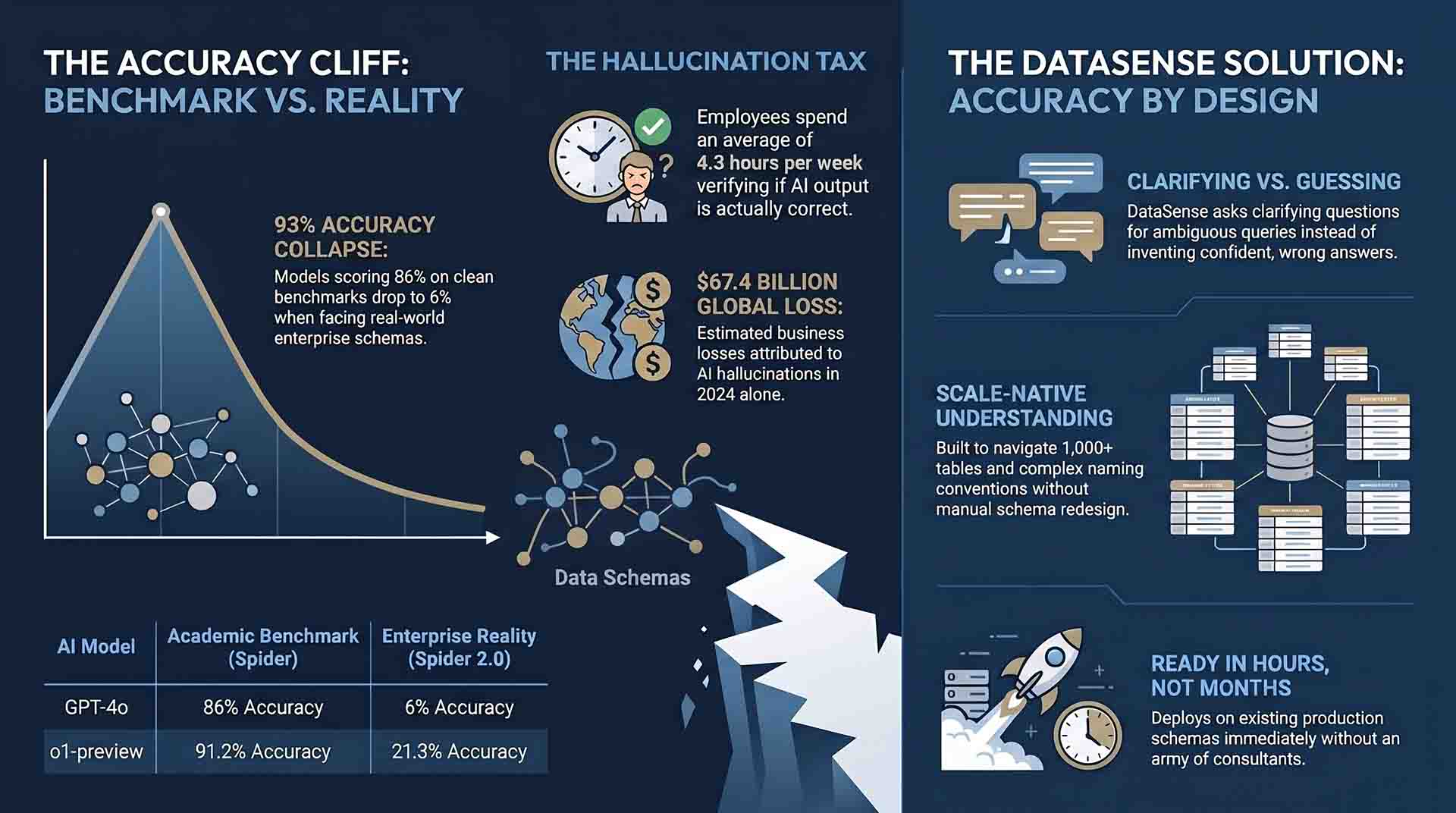
The academic benchmarks everyone cites (Spider, BIRD) test models against schemas with roughly 10 to 20 tables and a hundred or so columns. Clean names. Clean relationships. On that turf, the leading models look brilliant. GPT-4o scored around 86% on the original Spider benchmark. OpenAI’s o1-preview hit 91.2%.
Then researchers built Spider 2.0 to mimic actual enterprise conditions: real production database platforms, intricate schemas, business-specific naming. The same GPT-4o that scored 86% dropped to 6%. The same o1-preview that scored 91.2% dropped to 21.3%. That is not a typo, and it is not a rounding error. That is a 93% collapse in accuracy the moment the model touches an environment that resembles a Fortune 2000 data estate.
The pattern repeats everywhere you look once the test gets honest. On BIRD-Ent, an enterprise-realistic version of the BIRD benchmark with over 4,000 columns and abbreviated, domain-specific table names, state-of-the-art models managed just 39.1% execution accuracy. Even on the original BIRD benchmark, the best models landed near 40% against a human baseline of nearly 93%.
So when a vendor tells you their natural language to data tool is “95% accurate,” the only question that matters is: accurate on what? Because the published evidence is blunt. Academic benchmarks test 10 to 20 tables. Enterprise reality is 100-plus tables and 1,000-plus columns per database, with naming conventions like consumer_1 and consumer_2 instead of customer_name, and business semantics that live nowhere in the model’s training data. That gap between the demo and the deployment is the cliff. Most tools walk right off it.
The hallucination tax you are already paying
Now layer the second problem on top of the first, because they compound.
When these systems are uncertain, they do not pause. They generate. And the output arrives with the same fluency whether it is right or wrong. MIT research in 2025 found that models are actually 34% more likely to use confident language when they are hallucinating than when they are giving you a factual answer. Read that again. The system sounds most sure of itself precisely when it is making something up.
The cost of that is no longer theoretical:
- Enterprise chatbot deployments have shown hallucination rates around 18% in live interactions, by 2025 measures.
- Stanford’s RegLab found that general-purpose models hallucinated on specific legal queries well over half the time, in some tests approaching the 80% range.
- One industry analysis pegged global business losses attributed to AI hallucinations at $67.4 billion in 2024.
- The quiet tax: employees now spend an average of 4.3 hours per week just verifying whether AI output is actually correct.
That last number is the one I bring into customer conversations, because it exposes the lie at the center of most AI ROI decks. If your team has to fact-check every answer the AI gives them, you did not automate the work. You added a step. You bought a very expensive intern who is occasionally brilliant and occasionally fabricates, and who never tells you which is which.
To be fair to the model providers, the best general-purpose models have made real progress on grounded factuality. Top systems now sit under a 1% hallucination rate on clean summarization tasks, around 0.7% for the leaders. But notice the conditions: clean, grounded, source-anchored summarization. That is the easy case. Point those same models at a thousand-table production schema with ambiguous business logic, and you are back at the cliff. The 5% silent failure rate that Datadog measured in production AI requests, where the system runs, returns a confident answer, and nobody notices it is wrong, is not the floor. In a real enterprise estate, it is closer to the ceiling.
Why this keeps happening, and why it is a data problem
This is the part that connects back to everything I have been writing about for the past year. MIT’s NANDA initiative found that roughly 95% of generative AI pilots are not delivering measurable P&L impact. Most people read that headline as “AI does not work.” It is the opposite. The models work. What is failing is the layer underneath them.
Here is the mechanism, stripped of jargon. An enterprise schema is not a clean textbook. It is decades of accumulated business logic, cryptic column names, undocumented relationships, and tribal knowledge that lives in the heads of three people, two of whom have retired. When you point a general-purpose AI at that, it has no real understanding of how your tables relate or what your columns mean. So it does what it was trained to do under uncertainty. It guesses. And because it was rewarded during training for producing confident, helpful answers rather than for admitting doubt, it guesses with conviction.
That is the entire failure in one sentence. The model is asked to navigate a world it does not understand, and instead of saying so, it invents a plausible path. The output looks right. It joins the wrong tables. The VP signs off on it.
The vendors who try to paper over this make you do the work for them. They require months of schema redesign and hand-authored semantic layers before a business user can ask a single question. By the time that project finishes, the schema has already changed, and you are maintaining a brittle translation layer forever. That is the hidden reason so many pilots die in purgatory. The “AI project” was actually a multi-month data modeling project wearing an AI costume.
Where DataSense breaks the pattern
This is the moment to talk about what we built, and why I am genuinely confident it is the differentiator no one else has matched.
DataSense was designed around a single conviction: an enterprise AI tool is only trustworthy if it understands your environment the way your best analyst does, before it ever writes a query. Not a flattened, hand-built semantic layer that you maintain by hand. A real, working understanding of how your tables relate, what your columns actually mean, and where the joins live, across hundreds or thousands of tables, in your real production schema, as-is.
That understanding is what lets DataSense do three things that the cliff data says should be impossible:
- It holds accuracy at enterprise scale. Where the benchmarks show general models collapsing from 86% to 6% the moment they hit real schemas, DataSense was built for the thousand-table reality from the first line of code, not retrofitted to it. The scale that overwhelms a 128K context window is the environment it was made for.
- It does not guess. This is the one that changes the conversation in every demo. When a question is genuinely ambiguous, DataSense does what a seasoned analyst does. It asks a clarifying question. It would rather take one more turn than hand you a confident, wrong answer. That single design choice is what drives hallucination toward zero, because the most dangerous output in the enterprise, the wrong answer that looks right, is the one it is built to refuse to produce.
- It is ready in hours, not months. No schema redesign. No army of consultants hand-authoring a semantic layer. It reads the environment you already have. Business users are asking questions in plain English, or by voice, the same day.
The industry has spent two years arguing about which model to buy. The model was never the bottleneck. The bottleneck was that no tool truly understood the customer’s data well enough to be accurate at scale and honest under uncertainty at the same time. That is the gap DataSense closes. Near-perfect accuracy across a real enterprise estate, with hallucination driven toward zero instead of hovering at an industry baseline of 5% that quietly compounds across every query you run.
What I would tell a CIO in May 2026
If I had ten minutes with a CIO right now, and I have a version of this conversation almost weekly, here is what I would say.
Stop accepting accuracy claims without asking “on what.” Make every vendor prove their numbers on your schema, at your scale, with your naming conventions. The cliff between a benchmark and your production environment is where most AI budgets go to die.
Treat “the AI asks a clarifying question” as a feature, not a flaw. A system that occasionally pauses to confirm intent is not less capable. It is the only kind of system you can actually put in front of a CFO. The tool that always answers is the tool that sometimes fabricates.
Measure the hallucination tax you are already paying. Count the hours your team spends verifying AI output. If the answer is anywhere near 4 hours a week per person, you have not deployed AI. You have deployed doubt, and you are paying full price for it.
The companies that get this right in the next two quarters will be the ones writing the case studies in 2027. The discipline is straightforward. The window is open. And the difference between AI that is confidently wrong and AI you can actually trust comes down to one thing the whole industry underestimated: whether the system truly understands your data, or is just very good at pretending it does.
References
- 1. Enterprise Text-to-SQL: What Accuracy Benchmarks Really Mean (Spider 2.0 results)
- 2. Text-to-SQL Benchmarks for Enterprise Realities: BIRD-Ent and Spider-Ent (OpenReview)
- 3. BIRD: A Big Bench for Large-Scale Database Grounded Text-to-SQL (arXiv)
- 4. LLM Hallucination in Production (MIT 2025 confident-language finding)
- 5. LLM Hallucination Statistics 2026 (enterprise rates, business losses, verification time)
- 6. Stanford RegLab / HAI: Hallucinating Law
- 7. Why LLMs Hallucinate (training incentives, top-model rates)
- 8. Datadog State of AI Engineering (production silent failure rate)
- 9. MIT NANDA via Forbes: 95% of GenAI pilots fail to deliver P&L impact

Related Posts

Shadow AI Doesn’t Knock First
A Thousand Tables Deep