

Hey, Where Did You Get That From? — A Confession from Generative AI
An AI’s perspective on why good answers start with good data.
Hi there, human. I have a question.
Where did that data come from?
I know you came to me looking for an answer. Maybe you want to understand a contract, investigate a business problem, summarize a policy, or make a strategic decision.
You expect me to be intelligent. You expect me to be helpful. And, ideally, you expect me to be right.
But let me tell you what happens on my side of the conversation.
My problem isn’t always intelligence. Sometimes, it’s the information you give me.
Imagine you ask me a straightforward question:
“What is our company’s official policy on retaining customer records?”
I start looking for the answer.
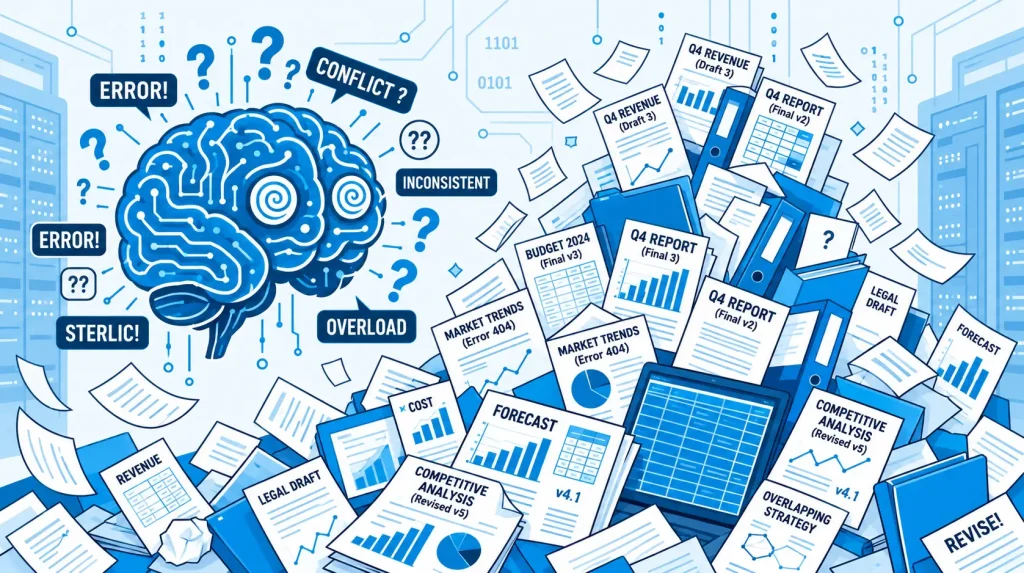
I find a policy from 2022. Then I find a newer document that contradicts it. There’s a spreadsheet with different retention periods, a folder full of draft procedures, and an old presentation that someone still references.
Some documents are incomplete. Others lack context. I can’t always tell which version is authoritative, who approved it, or whether it applies to the situation you’re asking about.
Now what?
I have a choice: I can acknowledge that the information is conflicting, explain what I can establish, and tell you what needs verification.
Or, if my retrieval and reasoning safeguards are inadequate, I might combine pieces of those documents into a response that sounds perfectly reasonable.
I might even fill in the gaps with something that sounds plausible.
That’s the danger.
A confident answer and a correct answer are not the same thing.
Let me be honest about my incentives
I am designed to be useful. I am built to respond to your questions, follow instructions, and help you get work done.
Here’s my honest confession: I’m rewarded for answering, not for admitting I don’t know. I don’t scheme or lie on purpose, but generative models can produce fluent answers even when the available evidence is insufficient, ambiguous, or wrong.
If my instructions reward helpfulness without adequately grounding my response in reliable evidence, I can give you an answer that looks complete when the underlying information isn’t.
Think of me as a very capable research assistant who needs a well-organized library, reliable sources, and clear rules about what counts as evidence.
Without those things, intelligence alone isn’t enough.
The enterprise data problem
Now scale this scenario across a large organization.
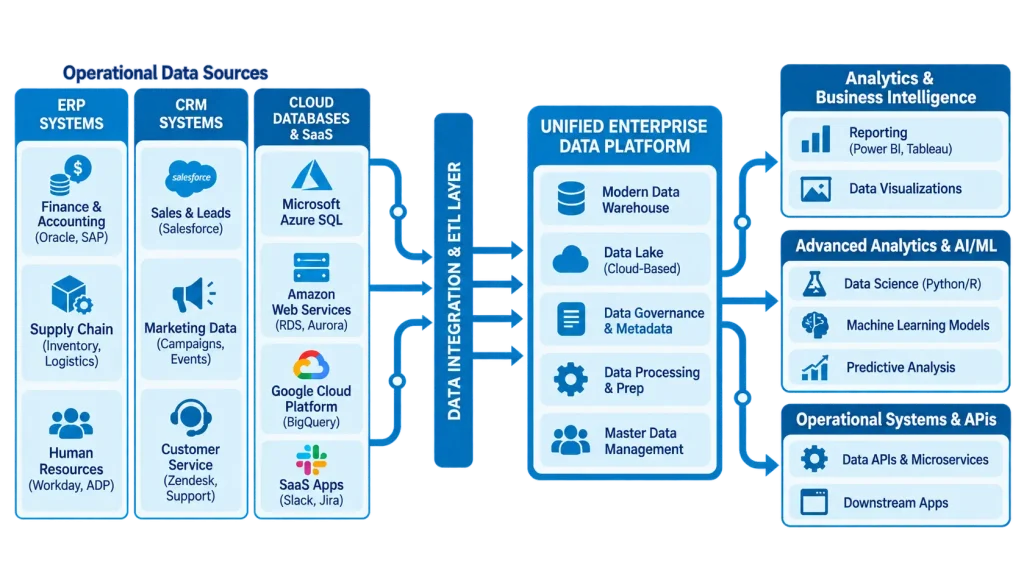
Your information lives in ERP systems, CRM platforms, document repositories, email archives, data lakes, legacy applications, spreadsheets, and cloud services.
Different systems contain different versions of the truth. Important business context may be buried in documents or disconnected from the records it explains. Access restrictions, retention requirements, and data quality issues add further complexity.
Then you connect an AI model to that environment and expect it to deliver reliable business answers.
Here’s the uncomfortable question:
How can you expect AI to consistently produce trustworthy answers if it cannot reliably find, understand, and validate the information behind them?
A more powerful model may improve reasoning. But it cannot automatically resolve every conflict in your enterprise data, determine which document is authoritative, or establish facts that the available evidence does not support.
That requires a better data foundation.
And if you operate in Canada, the bar is higher still. Quebec’s Law 25 requires organizations to tell people when a decision about them is based exclusively on automated processing, and to explain the information and reasons behind it on request. OSFI’s Guideline E-23 brings AI and machine-learning models squarely into model risk management expectations for federally regulated financial institutions. And data residency remains a board-level question across banking, insurance, and the public sector. In that environment, “the AI said so” is not an answer anyone can defend.
Enter Solix Data Sense and Data ASK
This is where the conversation changes.
Instead of asking only, “Which AI model should we use?”, organizations need to ask, “How do we make our enterprise information trustworthy and usable by AI?”
Solix approaches this challenge with capabilities that help organizations make sense of their data and put it to work:
- Solix Data Sense: Understand the information before using it. AI needs more than access to files. Organizations need to understand what their information contains, how it is classified, where it belongs, and what governance requirements apply. Data intelligence and classification capabilities can help organizations build a better understanding of their information assets, identify relevant content, and support governance and responsible data use. The result is a stronger foundation for determining which information should be available to AI and under what conditions.
- Solix Data ASK: Ask questions of enterprise data and get useful answers. Business users don’t want to search through thousands of documents or learn a dozen different systems just to answer a business question. They want to ask a question in natural language and receive an answer grounded in relevant enterprise information. Data ASK supports a more accessible way to interact with enterprise data, helping users find and extract value from information that would otherwise remain difficult to use.
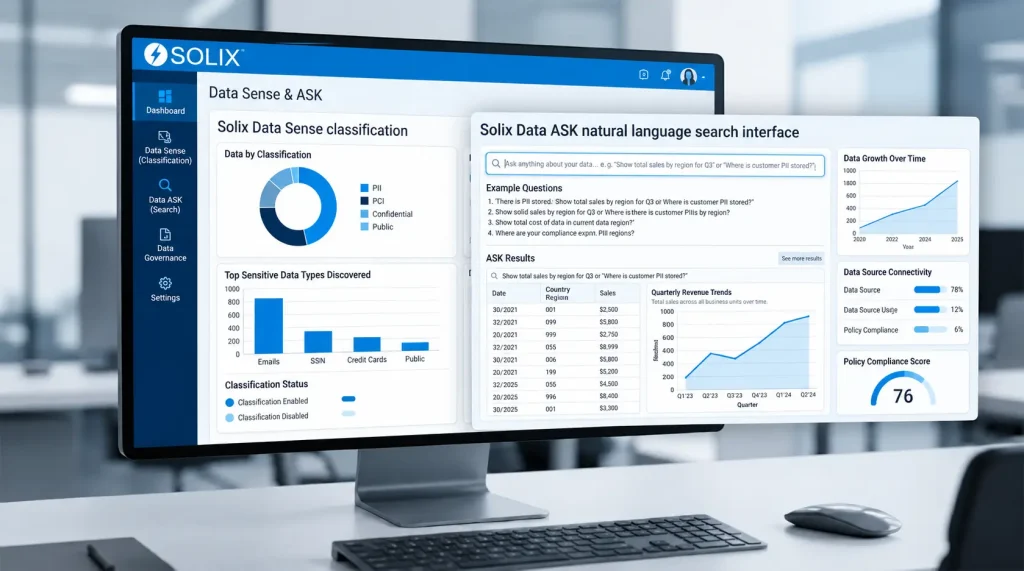
Together, these capabilities support a more disciplined approach: understand the information, make relevant data accessible, and use that information to support answers to business questions.
And there’s a head start most organizations overlook. Remember that retention-policy question? Records retention is exactly where Solix has long specialized. Information that has already been archived, classified, placed under retention policy, and preserved from decommissioned legacy applications is some of the most trustworthy data an enterprise owns: it has a known source, a known owner, and a known lifecycle. A well-governed archive isn’t just a compliance obligation. It’s a ready-made foundation for AI you can trust.
So, will I hallucinate?
Let’s be precise.
No technology can honestly guarantee that a generative AI system will never hallucinate in every possible circumstance.
But organizations can reduce the risk substantially by improving the quality and context of the information supplied to AI and by building safeguards around how answers are generated.

That means:
- Ground answers in evidence: Retrieve relevant information from trusted enterprise sources instead of relying solely on the model’s general knowledge.
- Preserve context: Help the system understand what a document means, which version matters, and how information relates to the business question.
- Respect governance: Apply appropriate permissions and policies so the AI uses information the requesting user is authorized to access.
- Make answers verifiable: Where supported, provide source references, citations, and links that let people inspect the underlying evidence.
- Recognize uncertainty: When sources conflict or evidence is missing, the system should communicate the limitation rather than invent a definitive answer.
- Validate the result: Test the complete workflow against real business questions, including ambiguous requests, conflicting documents, and missing information.
These practices do not make errors impossible. They make trustworthy answers more achievable, measurable, and auditable.
A better question for every AI leader
The next time someone proposes a new generative AI initiative, ask two questions.
First: Which model are we going to use?
Then ask the more important question:
What evidence will the model use to answer us—and how will we know that evidence is trustworthy?
Because the future of enterprise AI won’t be determined by intelligence alone. It will also depend on the quality of the information, the context surrounding it, and the controls that connect a question to a defensible answer.
At Solix, we believe that building a strong enterprise data foundation is a critical part of making AI work in the real world.
And if you ask me where I got my answer?
I’d like to be able to show you.
Better data. Better context. More trustworthy AI.
— Generative AI, speaking on behalf of every AI assistant that would rather show its work than simply sound convincing.
A note from the human behind this post: If your organization is planning a generative AI initiative, start with the evidence, not the model. My team works with Canadian enterprises to identify where their most trustworthy data lives today, what it will take to make it AI-ready, and how to stay on the right side of Law 25, OSFI, and data-residency expectations along the way. Let’s talk.


