

Application Knowledge Graphs: The Missing Layer for AI-Ready Enterprise Applications
Deploying generative AI models in corporate environments often exposes a fundamental gap: enterprise applications are simply not AI-ready applications out of the box.
When AI agents query complex systems like ERPs or CRMs, they lack an understanding of underlying business logic, table relations, and hidden dependencies. Generic AI tools promise natural-language access but routinely disappoint on real enterprise data. The gap isn’t a tuning problem—it’s a knowledge problem.
Without a deep understanding of what tables mean, how they relate, and what business rules govern them, AI is guessing. And when a wrong answer looks reasonable, that is the most dangerous kind of mistake an enterprise can automate.
Bridging this gap requires an enterprise AI architecture built on knowledge graphs for AI. Emerging as a major focus for enterprise data leaders at SOLIXEmpower 2026, the Application Knowledge Graph (AKG) serves as the dedicated intelligence layer required to make enterprise systems fully AI-ready.
The Intelligence Layer: Solix Data Sense & Data Ask
Now generally available as part of Solix Enterprise AI, Solix Data Sense and Data Ask bridge the gap between raw data and reliable AI execution.
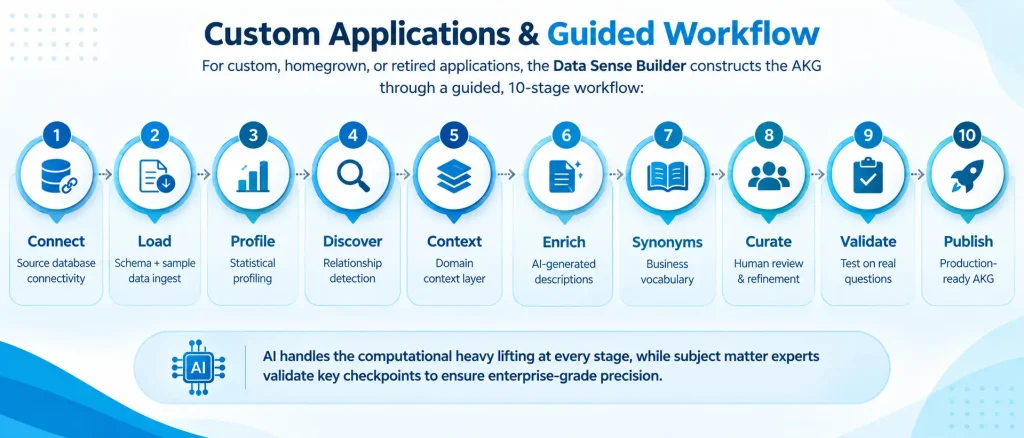
- Solix Data Sense builds the intelligence layer—the Application Knowledge Graph, Content Intelligence, and Intelligent Classification—that teaches AI what enterprise data actually means, including legacy systems with undocumented schemas whose original developers are long gone.
- Solix Data Ask puts that intelligence to work as a natural-language interface, business users can trust: grounded, cited, permission-aware, and audited across structured databases and unstructured content alike.
Data Sense: Teaching AI What Your Data Means
Data Sense builds the semantic and knowledge layer that turns data into something AI can actually use—with no manual modeling required. It covers the entire enterprise data landscape through three core capabilities:
- Application Knowledge Graph (AKG): Maps a structured application’s schema and relationships—including undeclared ones—with AI-generated, human-reviewed descriptions of what every table and column means in business terms.
- Content Intelligence: Ingests, enriches, and indexes unstructured content—contracts, policies, manuals, emails—into a semantic index that produces fully cited answers.
- Intelligent Classification: Sorts records into business categories using your custom taxonomy—your retention codes, sensitivity tiers, and regulatory tags—driving automated retention, access controls, and legal hold rules.
The Application Knowledge Graph: Enterprise Depth, Not Just a Diagram
An AKG is not static documentation. It encodes the business objects, relationships, terms, certified measures, and tested query patterns inside the core applications that run your business—across primary value streams like Procure-to-Pay, Order-to-Cash, Record-to-Report, and Make-to-Order.
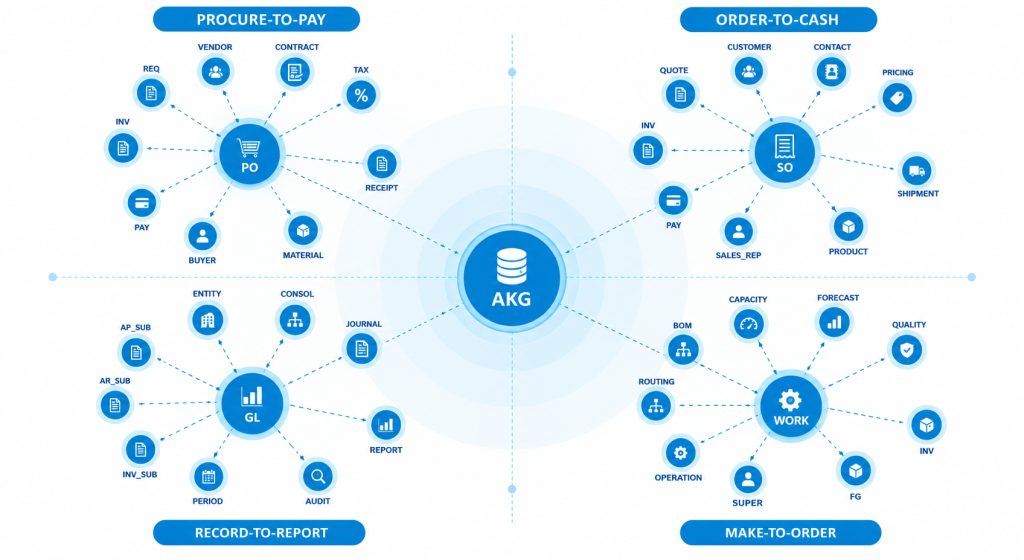
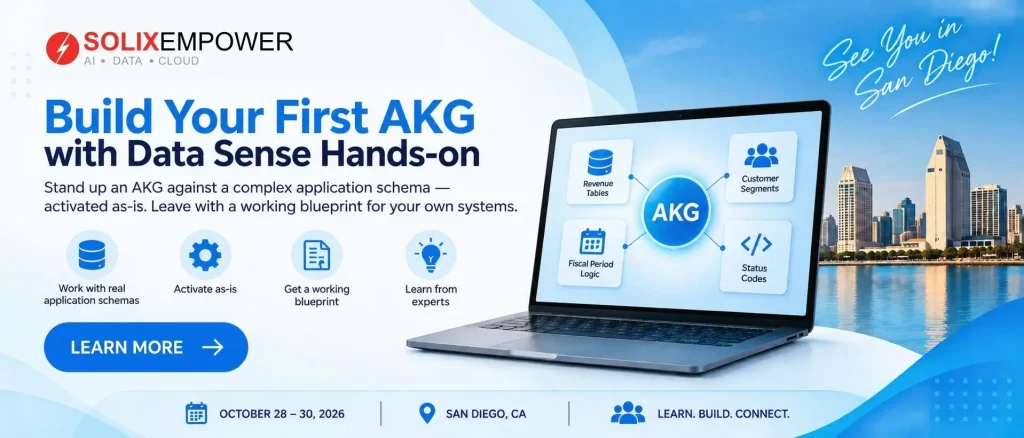
An AKG knows which tables hold revenue, how customers are segmented, what fiscal-period logic applies, and which status codes matter—ensuring natural-language access works on your real-world data.
Want to see how complex schemas are transformed into actionable semantic networks? Explore our interactive AKG Visualizations to see live schema mapping in action.
Pre-Built & Variant-Aware AKGs
Real enterprises configure applications differently and introduce custom objects that standard schemas omit. A generic graph that ignores these customizations is quietly wrong.
Solix pre-built AKGs detect your as-implemented configuration at build time and graft your customizations—custom tables, appended fields, flexfields—into a thin, per-customer overlay on top of the shared base graph. The expertise is pre-built; the fit is yours.
Accelerate your deployment timelines. Browse our library of Pre-Built Application Knowledge Graphs available for major platforms including SAP, Oracle EBS, PeopleSoft, and JD Edwards.
Transform Your Enterprise Data for AI Today
Stop letting generic LLMs guess on your complex ERP data. Equip your organization with the semantic foundation needed to drive accurate, policy-compliant, and fully audited enterprise AI applications.