

The Next Frontier of Pharma AI
The right intelligence for every scientific decision — how agentic AI, semantic knowledge, and intelligent LLM orchestration are reshaping drug discovery and drug repurposing.
The future of pharma AI is not about better models. It is about better scientific decisions. As researchers face an overwhelming volume of compounds, assays, omics, patents, and clinical evidence, the competitive advantage no longer comes from any single prediction — it comes from connecting the right evidence, tools, models, and expertise at the right moment.
That is the shift Solix EAI Pharma is built around: moving from AI that simply answers questions to an intelligent scientific system that understands a research goal, gathers and connects evidence, executes the right tools and models, reasons over the results, and keeps scientists firmly in control.
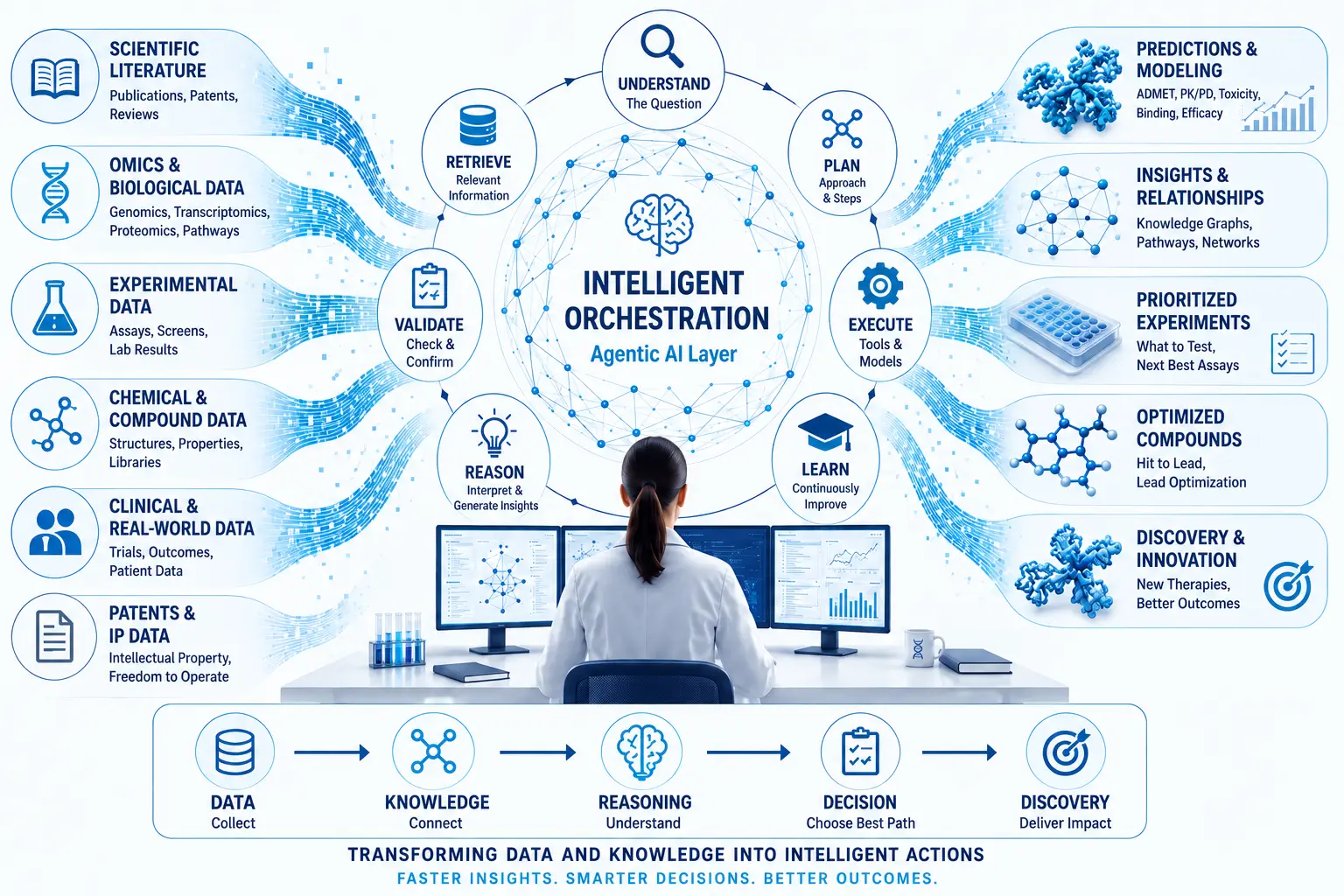
The most valuable AI system in pharma won’t be the one with the largest model or the longest context window. It will be the one that knows what information matters, what computation is required, and what evidence actually supports a decision.
From AI Models to Scientific AI Agents
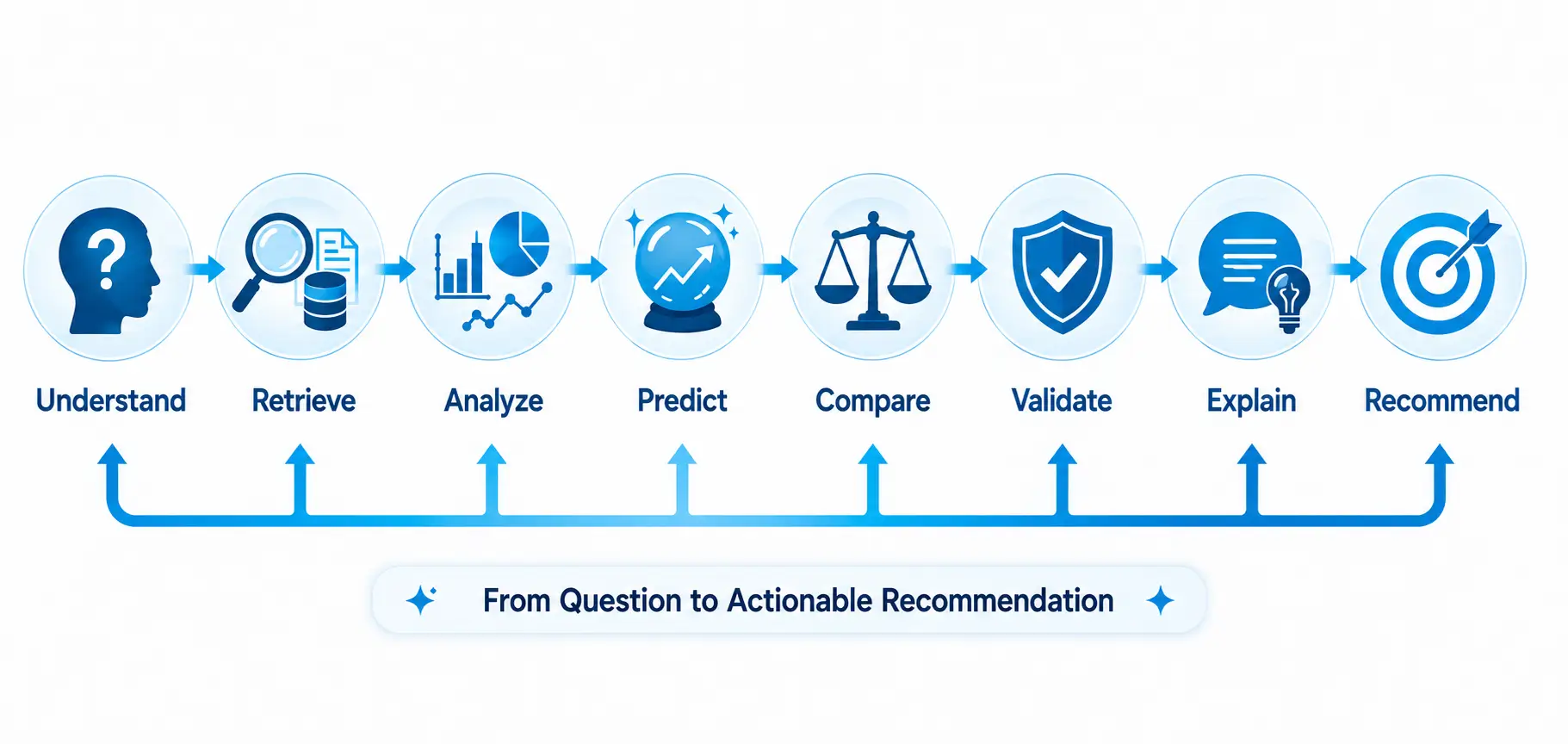
The first wave of AI in drug discovery was model-centric — predict a property, estimate toxicity, rank compounds — and those models remain essential. But real R&D questions rarely end at a single prediction. Asking “which compounds should we prioritize against this target?” isn’t a model problem; it’s an orchestration problem. It requires target context, compound retrieval, evidence, filtering, prediction, comparison, and a reasoned recommendation.
Agentic AI meets that need by turning one-shot answers into goal-driven workflows — a system that can plan, retrieve, invoke the right tools, reason over intermediate results, iterate, and validate its own output. This is not a distant vision. It maps directly onto the loop pharma R&D already runs on — Design, Make, Test, Analyze (DMTA) — and the industry is moving fast: Nature Chemical Biology now describes the field as entering “the agentic era,” and in April 2026 Merck committed to a multi-year agentic-AI partnership reported at up to a billion dollars spanning R&D and beyond.
In regulated drug discovery, autonomy must operate within governed scientific data, traceable evidence, controlled access, validated models, and human oversight. AI may continuously learn and adapt, but validated workflows and decisions must remain versioned, reproducible, and fully auditable. This makes governance and traceability core engineering principles — not afterthoughts.
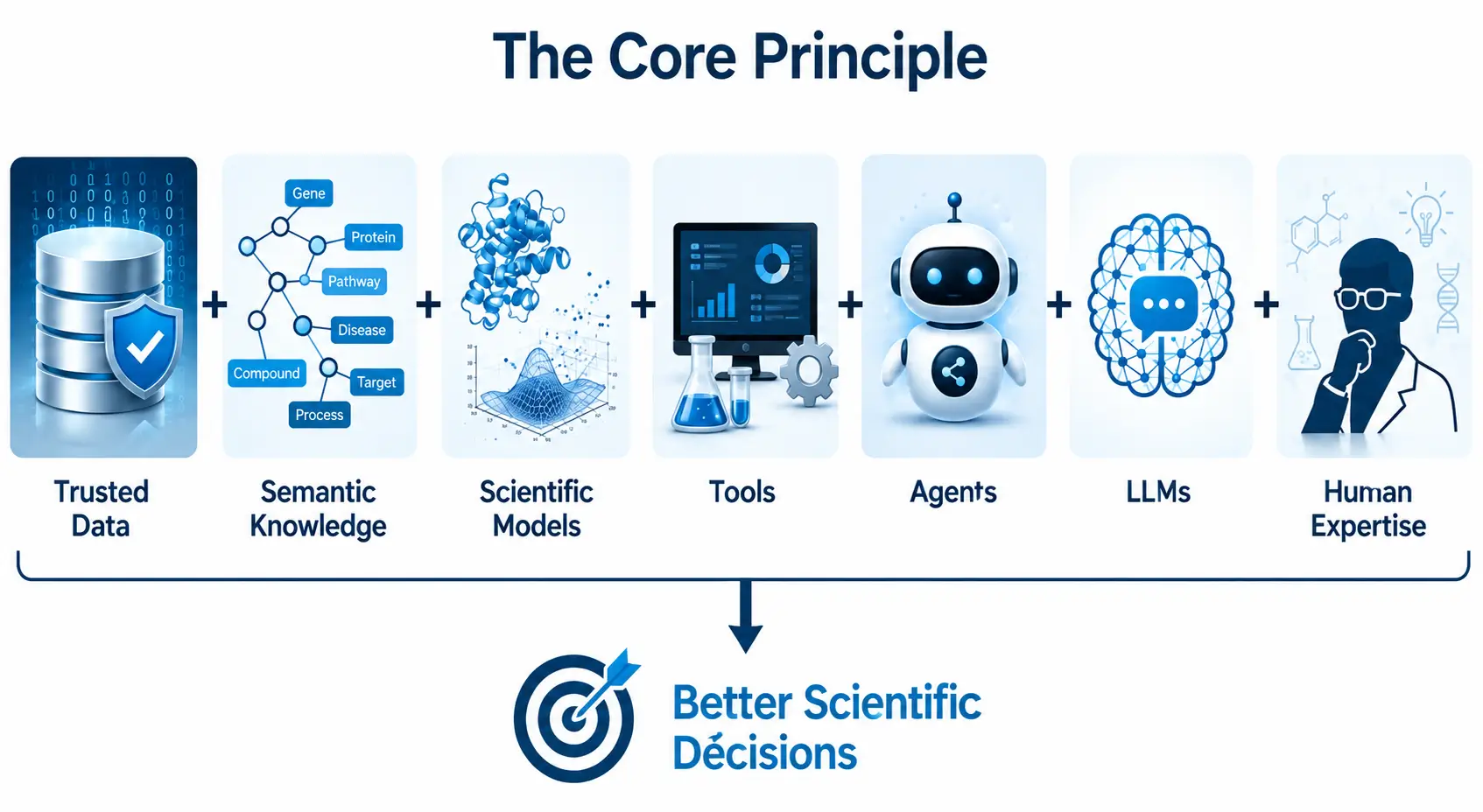
The key insight is disciplined intelligence: the most valuable AI decision may be the one the system chooses not to make. Rather than sending every task to the largest model, an intelligent drug discovery system determines what level and type of reasoning each step requires, then orchestrates the right combination of models, agents, tools, and scientific evidence.
| Scientific task | Best-fit capability |
|---|---|
| Database filtering | Database / query engine |
| Numerical calculation | Deterministic computation |
| Property prediction | Scientific tool / ML model |
| Information extraction | Efficient LLM |
| Evidence synthesis | Retrieval + knowledge graph + appropriate LLM |
| Multi-step R&D investigation | Agent + scientific tools + appropriate LLM |
Semantic Intelligence: Turning Data into Scientific Context
At enterprise scale, context is both an economic and a scientific constraint. Every record fed into an LLM consumes tokens and competes for the model’s attention. More data isn’t the goal — the minimum relevant context for a reliable decision is.
And the real problem is disconnection, not scarcity. Pharma organizations rarely lack data; they lack connected context — a target in one system, assays in another, literature and program history scattered across reports and archives. Scientists reason naturally across these links. AI needs the same foundation.
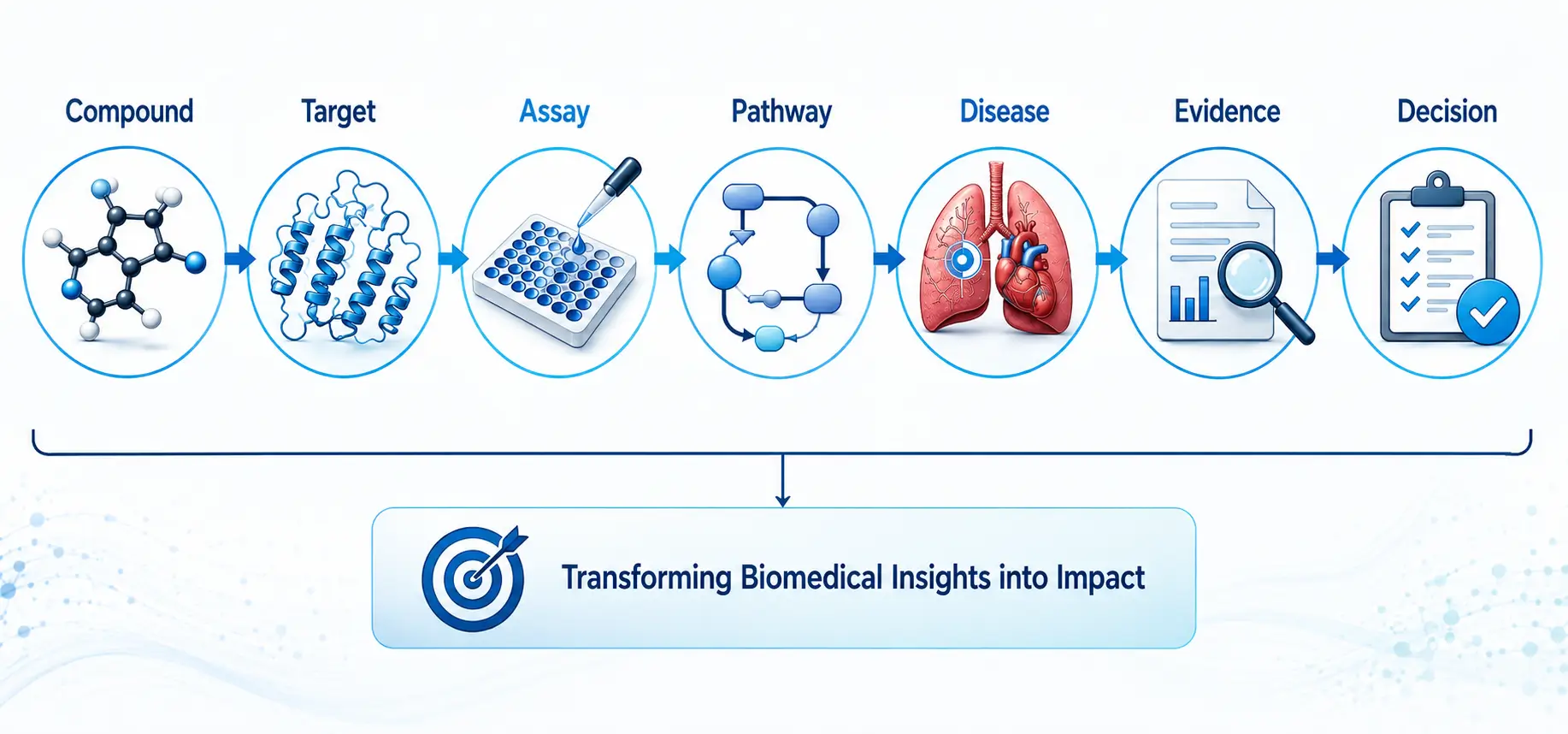
That is the job of semantic intelligence: instead of treating each document or table as an isolated object, it captures the relationships and meaning between them, turning a fragmented chain into a navigable one. This isn’t a novelty — it is how the field already frames discovery. Drug repurposing, for instance, is formally posed as a link-prediction task over a biomedical knowledge graph, where a model predicts a plausible but previously unrecorded edge between a compound and a target, or a drug and a disease. Solix’s Semantic Content Library is built for exactly this — using link prediction across drugs, genes, diseases, and pathways to surface relationships that no single document states outright.
A governed data foundation is what makes it work: consistent metadata, lineage, controlled access, and trusted source context — delivered as a control layer between existing infrastructure and AI, not a rip-and-replace. But AI-ready data is only the starting line. The real destination is AI-activated science: turning governed knowledge into predictions, evidence, and decisions.
The Larger AI Strategy: From Agentic to Autonomous Discovery
The next major leap in drug discovery is the shift from agentic to autonomous discovery. Today, AI agents can plan scientific workflows, invoke the right tools, analyze evidence, and provide recommendations for scientists to evaluate. Autonomous systems go a step further — they continuously form hypotheses, design and prioritize experiments, evaluate results, learn from outcomes, and decide what to investigate next. This does not replace the scientist; it moves the scientist up a level. Researchers define the therapeutic objectives, scientific constraints, decision criteria, and safety guardrails. Within those boundaries, AI agents can operate independently and escalate critical or uncertain decisions to human experts.
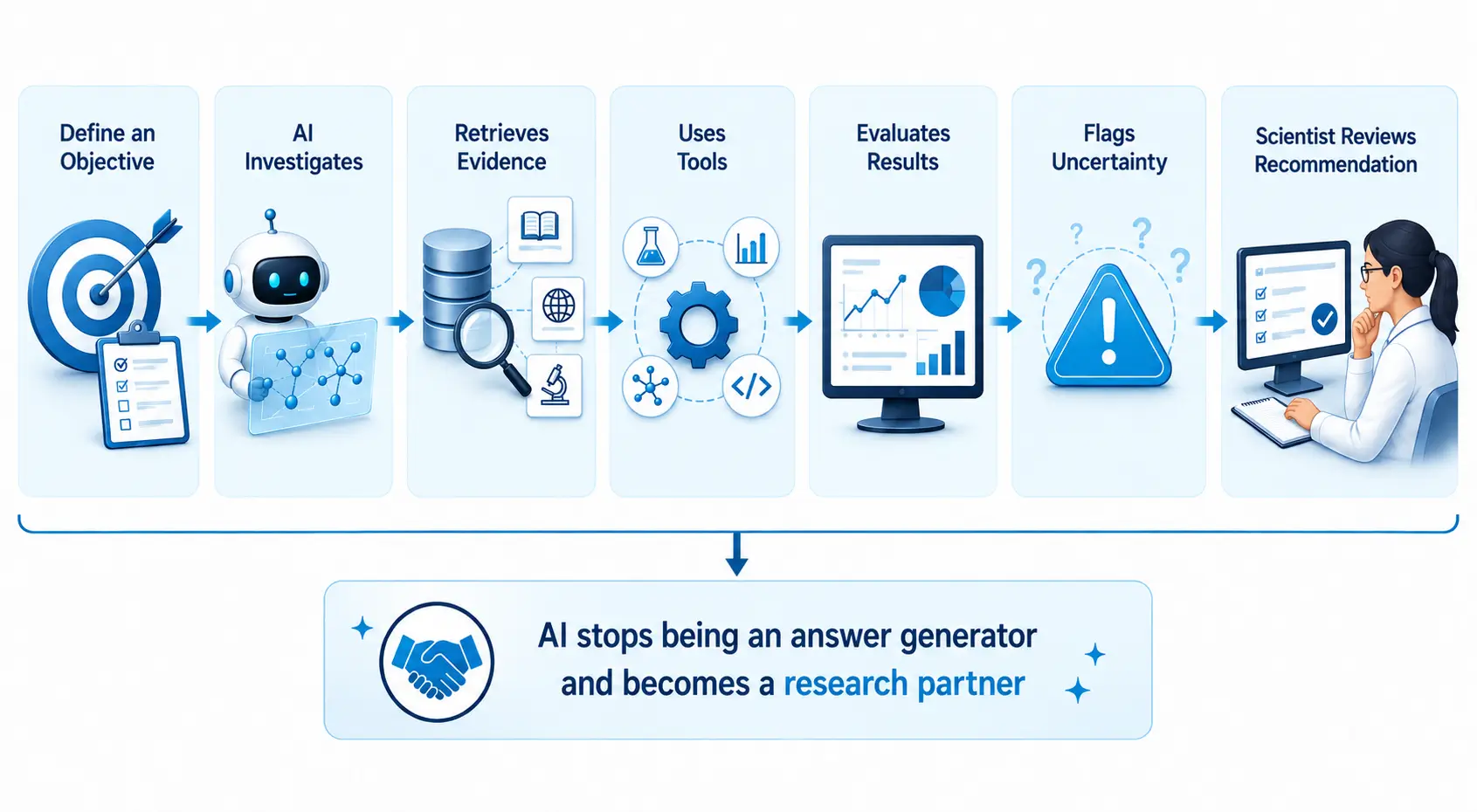
The real advantage is a continuous Discover → Design → Test → Learn → Optimize loop, in which every experiment, observation, and result informs the next decision — so the system steadily improves at identifying and advancing the most promising candidates. This is the evolution Solix EAI Pharma is built to enable.
The leap
An agentic system executes the task in front of it. An autonomous one decides which task comes next — and learns from the answer.
Building for It: The Right Intelligence at the Right Cost
A strategy is only as strong as the engineering that delivers it. Reaching the agentic and autonomous phases at scale — reliably and affordably — depends on a simple discipline: matching the right kind of intelligence to each task, and paying only for what each task actually needs.
Token efficiency is a useful illustration. It looks like a technical detail, but at enterprise scale it becomes part of the architecture. JSON remains the right standard for APIs, databases, and backend services — the opportunity is to switch to a compact representation at the moment structured data enters an LLM’s context. TOON (Token-Oriented Object Notation) is purpose-built for this: it declares fields once and encodes records compactly, with explicit lengths and headers that also help the model parse and validate what it is reading.
To test this, we evaluated JSON, TOON, and GCF on 300 synthetic pharma compound records using gpt-4o-mini via OpenRouter, across field retrieval, aggregation, filtering, structural awareness, and corruption detection.
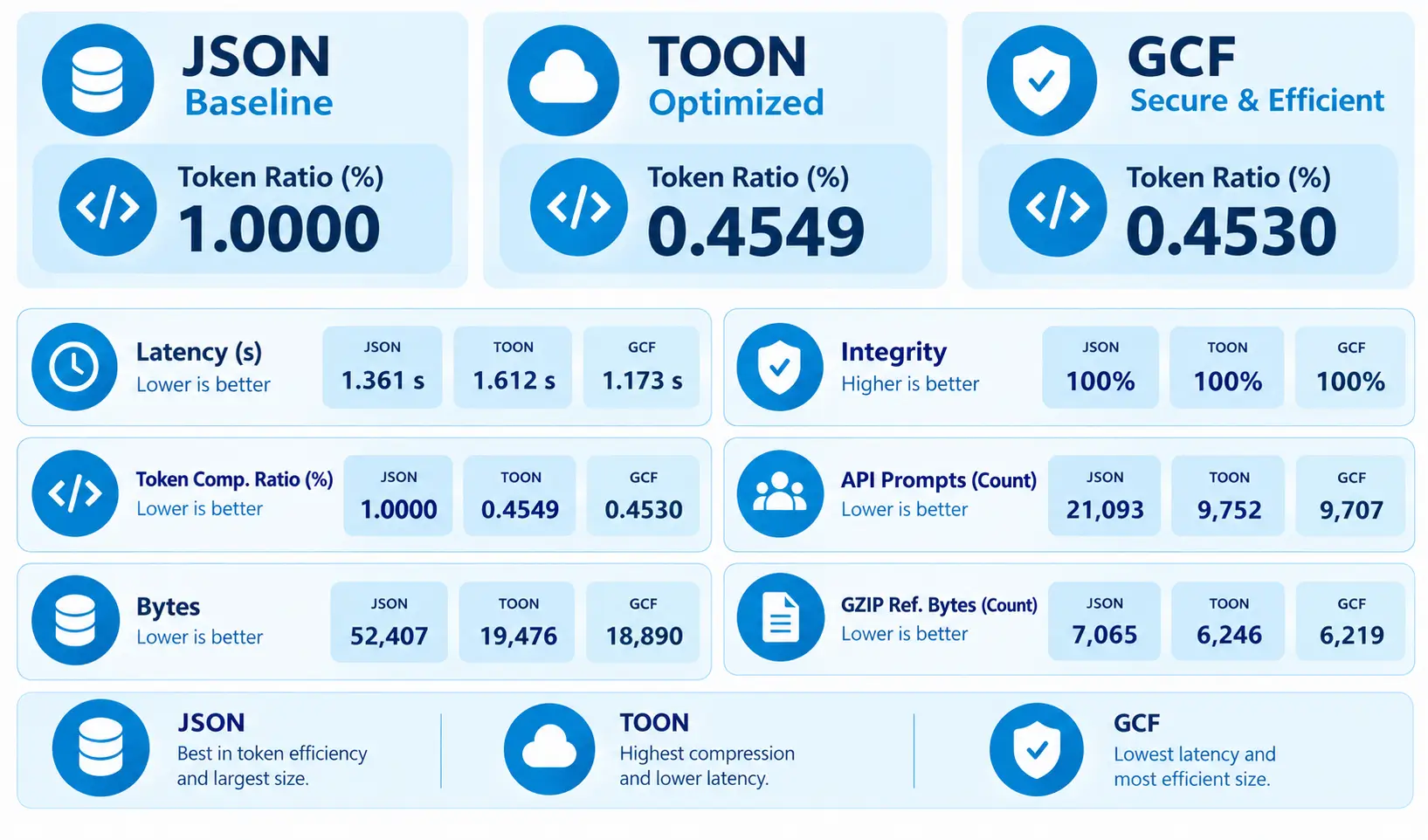
TOON used roughly 55% fewer tokens than JSON while slightly improving accuracy; GCF matched the savings but lost accuracy. This is directional, not a universal guarantee — savings vary by structure, with uniform tabular data the strongest case — and it should be validated against real Solix EAI Pharma workloads. It also tracks with the format’s own published benchmarks, which report on the order of 40% token savings and a small accuracy edge on uniform data, with CSV still competitive on flat tables.
The bigger lesson
The most important finding wasn’t the 55%. It was what happened when the model had to count or filter across a long list: those tasks performed poorly across every format. Switching JSON to TOON or GCF did nothing to fix the underlying reasoning failure — which points to the real principle:
The principle
Brilliant optimization follows brilliant direction. Define the right problem to solve, and your efficiency metrics will take care of themselves.
If a database can accurately count 10,000 compounds, the agent should let it. If a computational service can calculate a property, use it. If a scientific model is built for a prediction, invoke it. The LLM should receive only the smaller, relevant evidence set — and spend its capacity on reasoning. That reframes the objective from fewer tokens to better context: fewer unnecessary model calls, sharper model selection, and more reliable scientific reasoning.
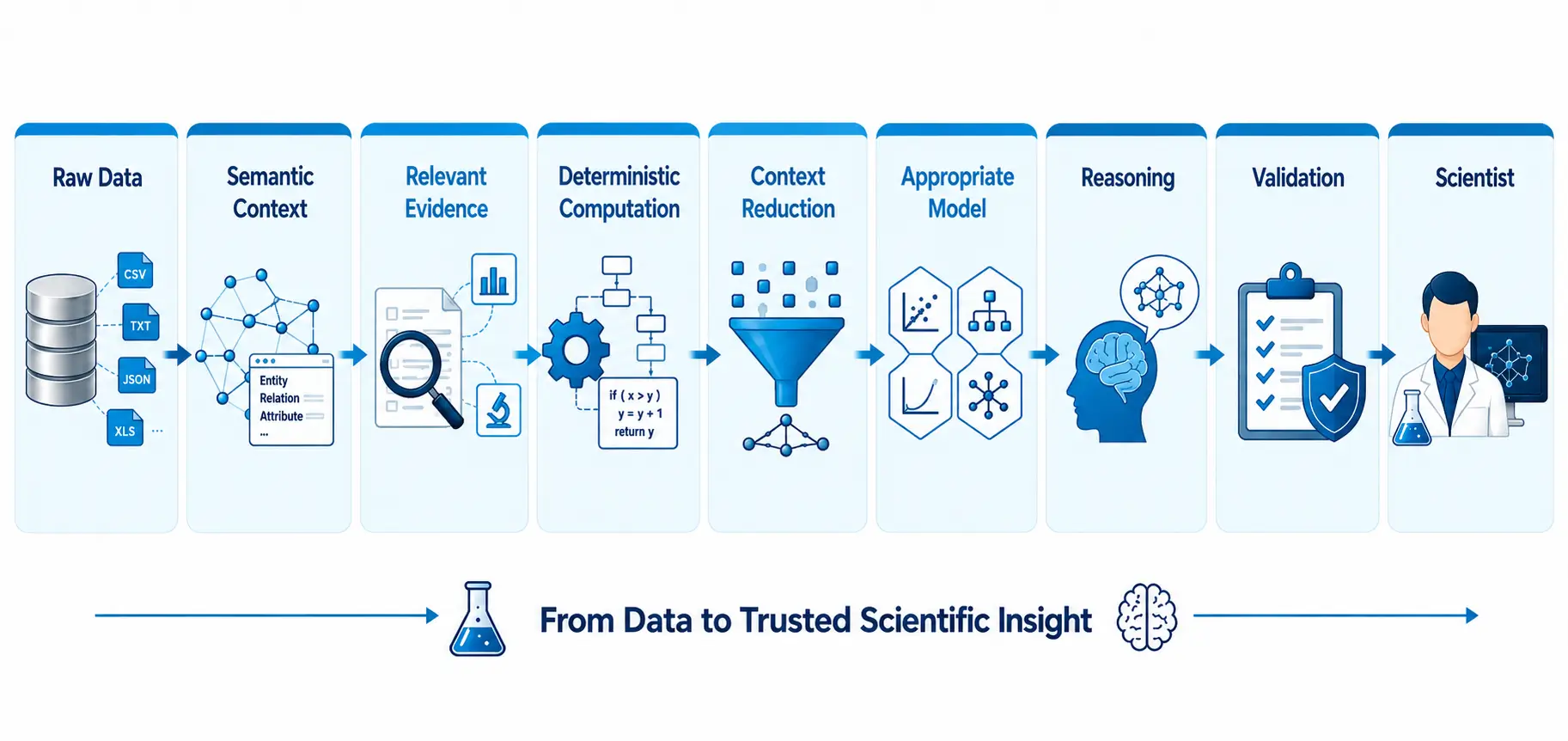
The intelligence stack
| Layer | Contribution |
|---|---|
| Data | Evidence |
| Semantic intelligence | Relationships and context |
| Scientific models | Specialized prediction |
| Computational tools | Deterministic execution |
| LLMs | Language understanding and reasoning |
| Agents | Workflow coordination |
| Scientists | Judgment and accountability |
Each layer does what it does best, and the agent coordinates them — which is what lets a system scale from assisted to autonomous without ever asking one component to do a job it was never built for.
From AI Tools to an Intelligent Research Environment
All of this reframes the discussion around the researcher’s experience. Pharma scientists don’t need another isolated AI tool — they need an environment where data, semantic knowledge, predictive models, computational tools, agents, and language models work together around a single research objective. The defining interaction becomes simply:
The interaction
“I’ve hit a major roadblock here. Help me analyze the data so we can pinpoint the root cause.”
The value of such an environment isn’t answering instantly. It’s helping determine how the question should be investigated — what evidence matters, which sources to connect, which calculations to run, which models to invoke, which parameters to optimize, how much context is needed, and where expert judgment is required.
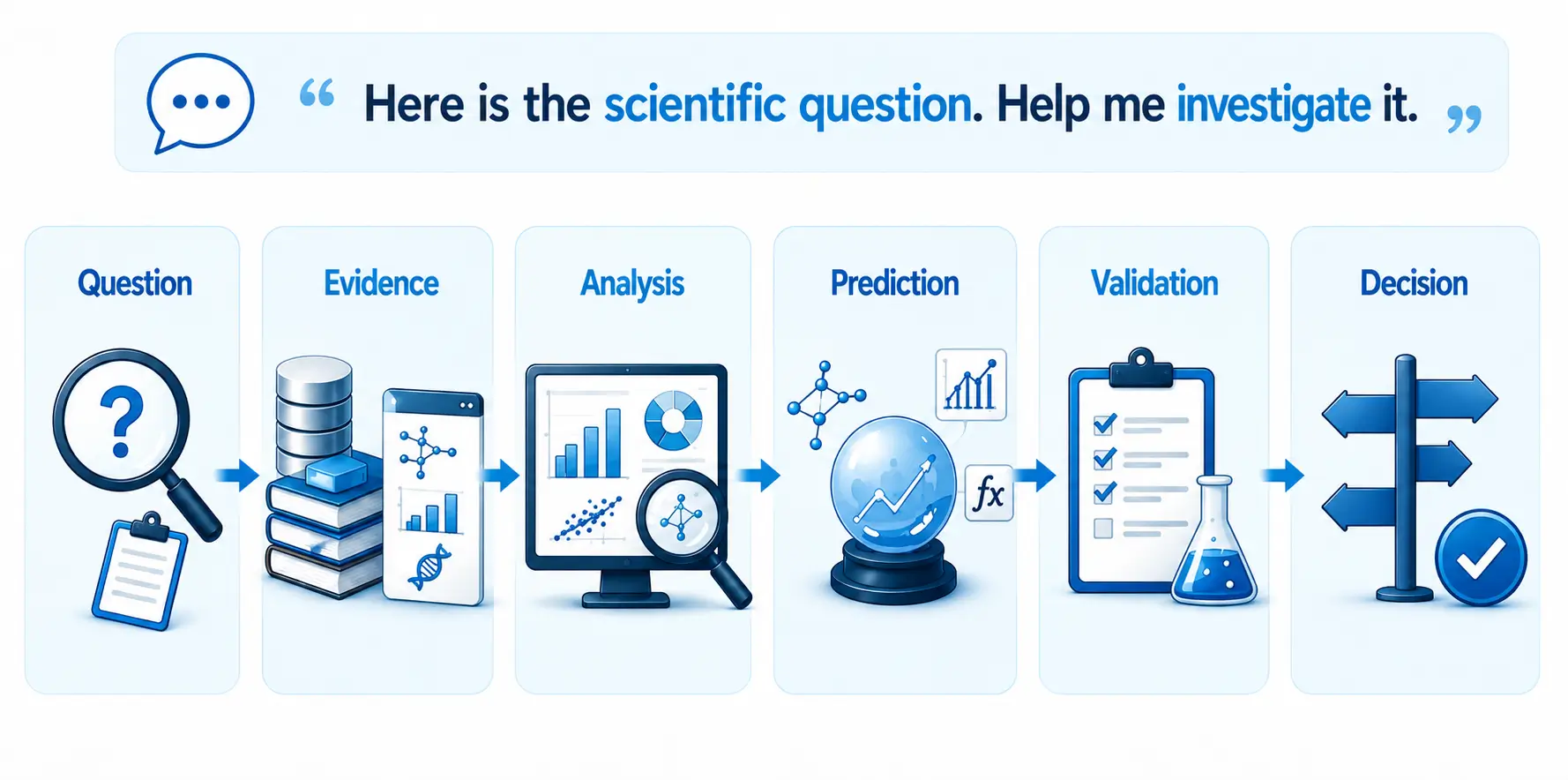
Crucially, this fits the way pharma R&D actually works: iterative loops of hypothesis, evidence, experiment, evaluation, and refinement — not a sequence of disconnected AI apps. And because scientific AI is increasingly heterogeneous — literature, knowledge graphs, compound data, predictive models, simulations, internal results — the value comes from orchestrating these capabilities, not forcing one model to do everything. Trust is part of that experience by design: researchers need visibility into provenance, model usage, assumptions, and remaining uncertainty, which is why governed, lineage-aware data underpins the whole environment.
Seen over time, a research laboratory is not a static toolset — it is an evolving scientific ecosystem, where data, methods, models, workflows, results, and expertise come together and shape one another. Each experiment builds on the ones before it, generating knowledge that refines a method, sharpens a model, updates a workflow, and informs the next question. The role of AI here is not to replace that methodology. It is to encode it, preserve it, and continuously improve it — while keeping scientific expertise and human judgment at the centre.
This is the frontier Solix EAI Pharma is positioned for, captured in five principles.
- Agentic by design: Agents orchestrate evidence, tools, and models to solve real R&D problems.
- Intelligence that fits the task: The right model, the right context, the right tool, at the right time.
- Semantic at the core: Relationships and meaning are what make knowledge actionable.
- Trust and transparency: Provenance, governance, validation, and human oversight build confidence.
- Outcomes that matter: Faster discovery, better decisions, higher impact.
The relationship between scientist and AI changes accordingly: the researcher sets the objective, AI orchestrates the investigation, and the scientist remains accountable for the decision. That is the sustainable advantage — an ecosystem where knowledge, data, models, tools, agents, and scientists work as one.
From application to foundation
Solix EAI Pharma can be more than an application. It can be the foundation on which a research lab builds — and continuously improves — its own scientific ecosystem.
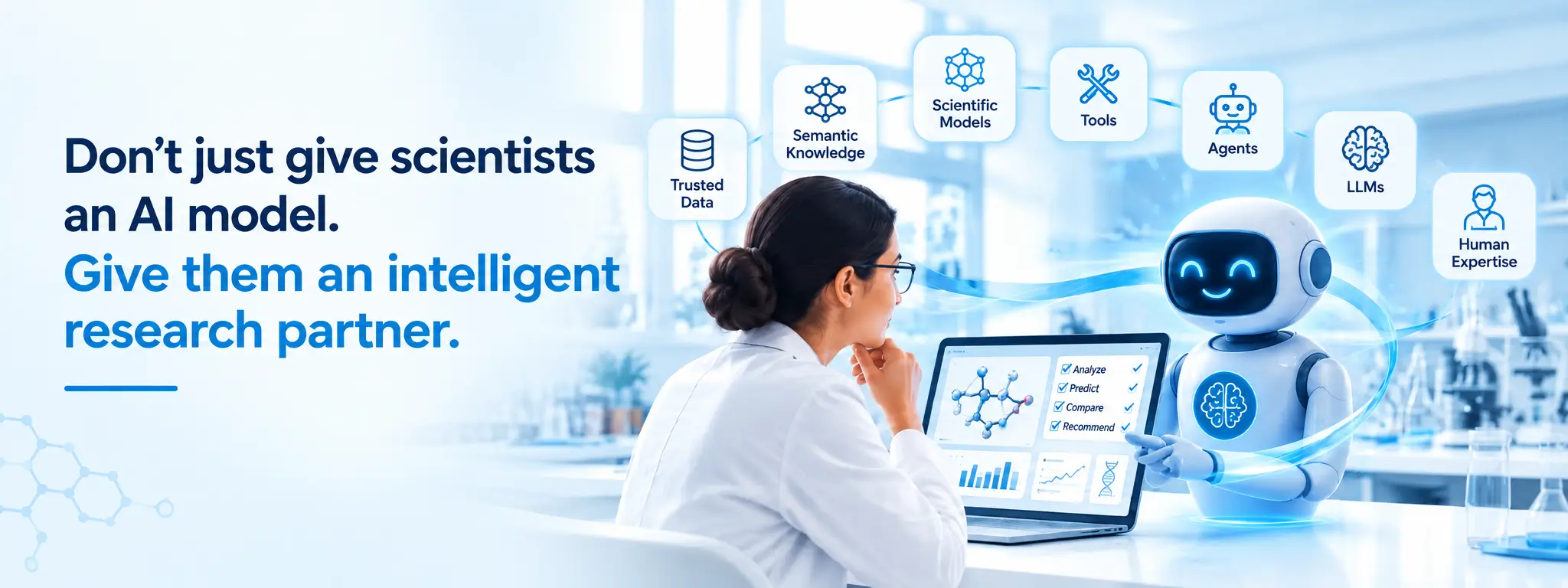
Built on Solix EAI Pharma — trusted data, the right model for each problem, optimized context and cost, and scientists firmly in control — AI moves beyond an impressive demonstration to become what the field actually needs: a scalable engine for scientific discovery.
Notes & References
Benchmark figures (JSON / TOON / GCF) are from an internal evaluation on 300 synthetic compound records and are directional rather than a universal guarantee. Diagrams are illustrative representations of the Solix EAI Pharma architecture.
- Huynh, D. L.; Seal, S.; et al. (AIA4S Consortium). AI agents in drug discovery: applications and case studies. Drug Discovery Today, 31(3):104650 (2026).
- Wei et al. From AI for Science to Agentic Science: A Survey on Autonomous Scientific Discovery. arXiv:2508.14111 (2025).
- Vijayan, R. S. K.; Cross, J. B.; et al. Entering the agentic era of AI in drug discovery. Nature Chemical Biology (2026).
- Russell et al. Agentic AI in Pharma: From Multi-Agent Systems to Self-Driving Labs. Technology Networks — Drug Discovery (2026).
- Mirasol et al. (Pistoia Alliance / BioPharm International). FAQ: What You Need to Know About Agentic AI in Drug Discovery (2026).
- Perdomo-Quinteiro, P.; Belmonte-Hernández, A. Knowledge Graphs for drug repurposing: a review of databases and methods. Briefings in Bioinformatics, 25(6):bbae461 (2024).
- TOON — Token-Oriented Object Notation. Format specification and retrieval-accuracy benchmarks. toonformat.dev (2025–2026).

Related Posts

Built Once, Used Many Times

One Substrate, Eight Workflows