

One Substrate, Eight Workflows
How a Single Semantic Layer Powers Solix EAI Pharma’s Discovery Stack
If a platform’s anatomy is real, adding an eighth capability shouldn’t require rebuilding the first seven.
Our last post argued, alongside Patrick Grady’s two-part “On Platforms” series, that AI compounds only when it sits on a real anatomy — schema, taxonomy, workflow expertise, ontology, and intelligence, built natively as one system rather than bolted together from disconnected tools. That argument was structural. This post makes it concrete, using the actual shape of the Solix EAI Pharma portfolio: Target Identification, Disease Gene Signature, Virtual Screening, Molecular Docking, Scaffold Hopping, ADMET, Drug Gene Signature, and Biovisualization.
Eight Capabilities That Could Have Been Eight Vendors
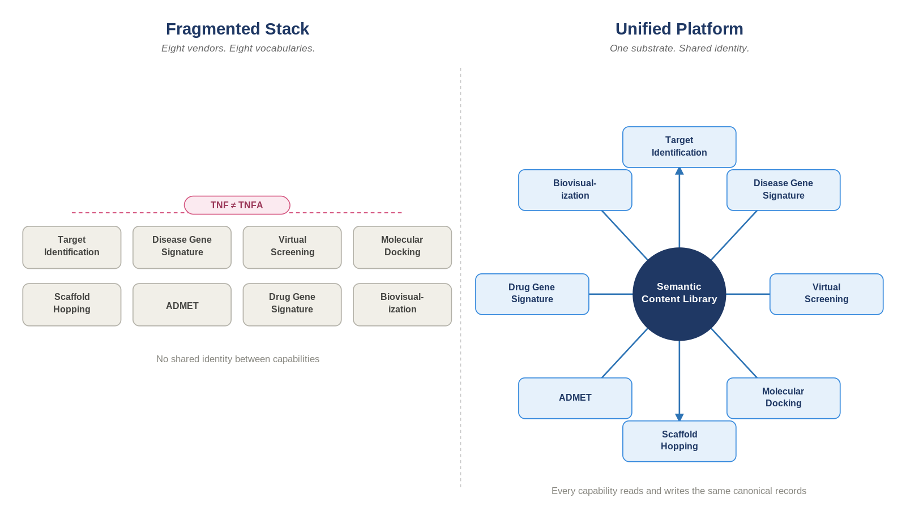
Each of these is a legitimate product category in its own right, and the drug-discovery software market is full of point solutions built around exactly one of them. Target Identification surfaces candidate genes and proteins worth pursuing. Disease Gene Signature and Drug Gene Signature characterize how a disease or a compound perturbs gene expression. Virtual Screening ranks large compound libraries against a target. Molecular Docking predicts how a specific compound binds a specific protein structure. Scaffold Hopping proposes structurally distinct alternatives that preserve a compound’s useful properties. ADMET predicts absorption, distribution, metabolism, excretion, and toxicity before a compound ever reaches a wet lab. Biovisualization renders all of the above so a scientist can actually look at it.
Bought as eight separate products from eight separate vendors, each with its own data model, this stack reproduces the exact fragmentation Blog 1 warned about: eight islands of intelligence, each fluent in its own vocabulary and blind to the others. Built on one Semantic Content Library instead, they behave as a single recursive system. The difference is easiest to see through two contrasting scenarios.
Illustrative Scenario 1 — The Reconciliation Tax of a Fragmented Stack
Consider a hypothetical team running Target Identification from one vendor and Molecular Docking from another. The Target ID tool exports its finding as gene symbol “TNF.” The docking software, populated from a different internal spreadsheet, has the same gene logged as “TNFA.” Before docking can even begin, a scientist has to manually confirm these labels refer to the same gene and the same isoform — a reconciliation step that, multiplied across every target in a pipeline, easily consumes the better part of a day per project. Get it wrong, and the docking run silently scores the wrong protein structure without anyone noticing until much later.
Now run the same scenario inside one substrate. Disease Gene Signature flags TNF — a canonical entity cross-referenced to its UniProt and Entrez identifiers — as implicated in a rheumatoid arthritis signature. That record flows directly into Molecular Docking, which immediately scores candidate compounds against the correct TNF structure, while ADMET, drawing on the same canonical entity, surfaces existing safety data already on file for that compound class. The handoff between three separate capabilities happens in the time it takes to click “run,” because there was never a translation step to get wrong in the first place.
Illustrative Scenario 2 — What a Shared Substrate Learns Over Time
A second scenario shows the recursive half of the argument — not just shared identity, but shared memory. Picture a kinase target referred to in the literature under three names: MAPK14, p38-alpha, and p38 MAPK. In the Semantic Content Library, all three resolve to a single canonical record. Disease Gene Signature analysis flags this target as significantly upregulated in a fibrosis dataset. Because Virtual Screening and Molecular Docking pull from that same canonical record, any compound scored against “MAPK14” automatically inherits the disease-linkage annotation — no one has to check whether the docking team’s “p38” and the geneticist’s “MAPK14” are the same thing.
Now suppose ADMET testing later turns up a hERG cardiac-toxicity liability for a specific compound scaffold at a defined concentration. That finding gets written back into the same shared record as an attribute of the scaffold itself — not filed away in a private ADMET report. Weeks later, when Scaffold Hopping proposes structural analogs of that chemical series for a different program, it automatically inherits the toxicity flag and can deprioritize analogs sharing the liability-prone substructure, without anyone re-running the ADMET study or digging up the old report. One tool’s output becomes every future tool’s starting knowledge — the recursive loop from Blog 2, made concrete.
Mapping This Back to the Anatomy
Both scenarios are really the same five layers from Essay II doing their job in sequence. Schema is why TNF and MAPK14 exist as typed, provenance-preserving records in the first place, not free-text strings. Taxonomy is why TNF, TNFA, and every other alias collapse into one canonical identity instead of three. Workflow expertise is why an ADMET tolerance for hERG liability is encoded as an explicit, reusable rule rather than a note in someone’s lab notebook. Ontology is why a target flagged in a disease signature is understood as the same entity a docking run scores and an ADMET filter later screens — a real relationship, not a coincidence of matching text. And intelligence is the mechanism that writes each new finding back into that same substrate, so the next query — run by any of the eight capabilities, on any future program — starts one step ahead of the last.
Where the Savings Actually Show Up
The economics follow directly from the mechanics above. A reconciliation error caught late is expensive by design: a target mix-up discovered only after a docking or synthesis campaign has already run means paying for wet-lab work against the wrong protein, and a toxicity signal missed until Phase II costs an order of magnitude more to catch than the same signal flagged at the ADMET stage. A unified substrate pulls that discovery earlier — the same MAPK14 toxicity flag that stops Scaffold Hopping from re-proposing a liability-prone analog is, in effect, a costly late-stage failure avoided before it was ever funded. That is why the payoff of a real substrate shows up as compounding cost avoidance and higher program success rates, not just faster cycle times: fewer campaigns run against the wrong target, fewer surprises discovered after significant spend, and preclinical costs that fall 2-3x precisely because the errors a fragmented stack would have shipped downstream get caught at the schema and ontology layer instead.
The Real Test of a Platform
Point solutions get evaluated one at a time: does this tool do its one job well? Platforms deserve a different test: does adding the eighth capability make the first seven better, or does it just add a ninth vocabulary to reconcile? For a stack like Target Identification, Virtual Screening, Molecular Docking, Scaffold Hopping, ADMET, Disease and Drug Gene Signature, and Biovisualization, that is not a rhetorical question — it is the difference between a portfolio of tools and a system that compounds.
Note & References
- The TNF and MAPK14 walkthroughs above are illustrative scenarios constructed to demonstrate how the Semantic Content Library is designed to function across Solix EAI Pharma’s capability set, not documented customer case studies.
- Grady, P. “On Platforms I: What They Are And Why They Matter.” Unvarnished (Substack).
- Grady, P. “On Platforms II: The Five-Layer Anatomy That Turns Chaos Into Coherence.” Unvarnished (Substack).