

The What, Why, and When of Application Retirement: Eligibility Frameworks and Drivers Explained
According to McKinsey & Company, “A company that spends more than half of its IT project budget on integrations and fixing legacy systems is likely to be caught in a tech-debt spiral in which it is paying interest only. Conversely, a company operating on a modern IT stack with little or no tech debt can direct almost all its technology investment to new offerings. Most companies sit somewhere between these two extremes.”
This widening gap between tech-debt-heavy and digitally agile enterprises highlights the growing importance of application retirement as a strategic priority. This blog dives into the key business drivers behind application retirement and outlines a practical framework to determine when and why retiring a legacy application is the right move.
The Business Imperatives Driving Application Retirement
Application retirement is the structured process of decommissioning legacy software that no longer supports business goals. It involves extracting valuable data, ensuring compliance, and shutting down systems while preserving historical information for legal and operational needs. The process goes beyond simple deletion, requiring careful handling of data dependencies and continuity planning.
According to Forrester, rationalizing application portfolios and modernizing legacy systems are among the top software priorities for IT. This reflects the growing business need to reduce costs, improve agility, and retire outdated systems. Here are the most common business drivers pushing organizations toward application retirement:
- Cost Savings: Maintaining legacy applications can consume a significant portion of IT budgets. Gartner projects that companies will spend 40% of their IT budgets on managing technical debt, with legacy systems being a major contributor. Retiring these applications reduces maintenance, licensing, and support costs.
- Technological Advancements: Modern applications offer superior performance, security, and features compared to outdated systems. Retiring legacy applications enables organizations to adopt cutting-edge technologies, enhancing efficiency and user experience.
- Business Relevance: Applications that no longer align with current business objectives or strategies can be retired to streamline operations and focus on high-value systems that support organizational goals.
- Security Risks: Outdated applications often lack modern security features, making them vulnerable to cyber threats. Retiring these systems reduces the risk of data breaches and enhances overall security.
- Resource Optimization: IT resources used to maintain legacy systems can be reallocated to strategic initiatives, boosting productivity and fostering innovation.
- Compliance and Regulatory Requirements: Ensuring data management complies with current regulations often necessitates retiring systems that fail to meet these standards, reducing the risk of penalties.
- Performance and Efficiency: Legacy applications can hinder system performance and increase complexity. Retiring them streamlines the IT environment, improving operational efficiency.
- Application Consolidation: As organizations simplify IT, application consolidation helps cut redundancies, reduce costs, and boost efficiency—saving up to 30%, reports BizTech Magazine.
- Mergers and Acquisitions: Mergers and acquisitions frequently lead to the accumulation of duplicate or redundant applications, increasing operational complexity and costs. Rationalizing them post-M&A helps cut costs, reduce complexity, and align IT with business goals.
Application Retirement Eligibility Framework: Quantify Value vs. Burden
Effective application retirement requires a systematic approach that evaluates both business value and associated costs before determining an application’s eligibility for retirement. The framework consists of two primary assessment areas: business value evaluation and cost analysis.
Business Value of Legacy Applications
Evaluating an application’s business value is a critical first step. Consider the following factors:
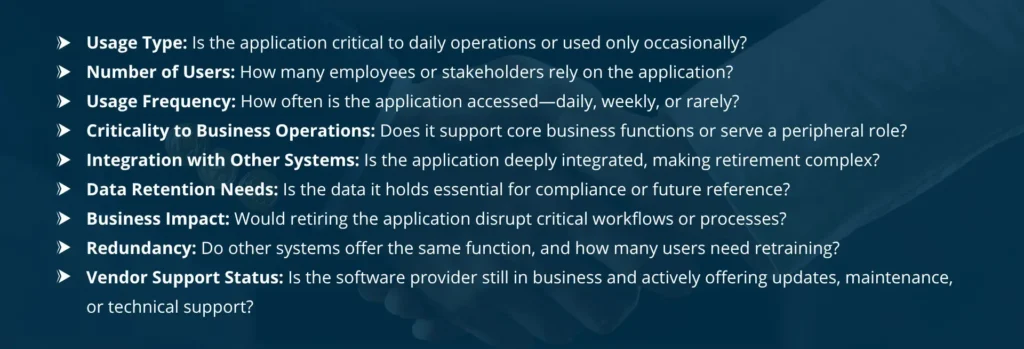
By analyzing these elements, organizations can determine whether an application’s value justifies its ongoing maintenance or if retirement is a better option.
Costs Associated with Legacy Applications
Maintaining legacy applications incurs various costs, both direct and indirect, that can significantly impact IT budgets:
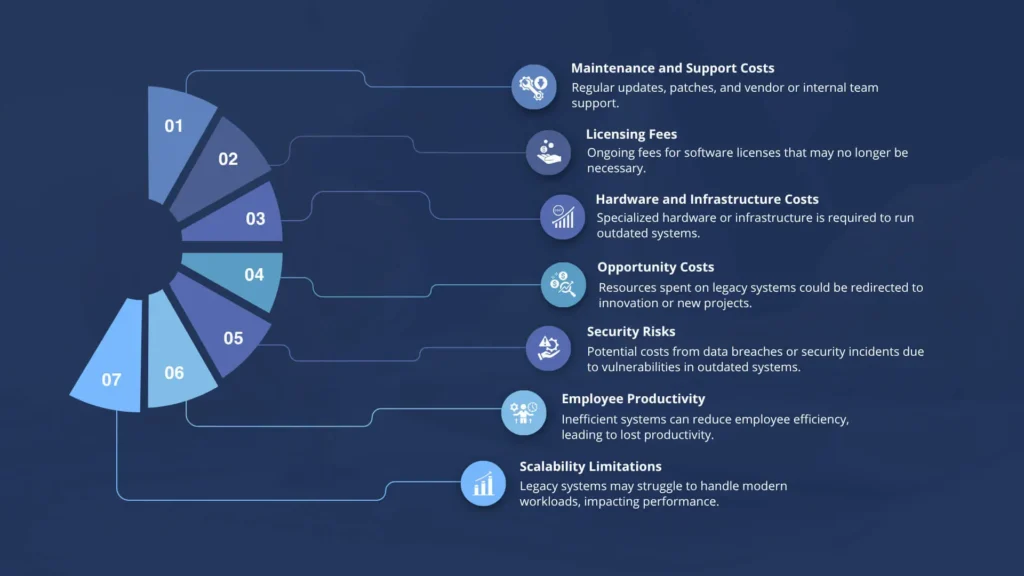
A U.S. Government Accountability Office (GAO) report highlighted that in 2019, the federal government allocated over $90 billion to IT, with 80% dedicated to operating and maintaining existing systems, including legacy applications (GAO). This underscores the financial burden of clinging to outdated systems.
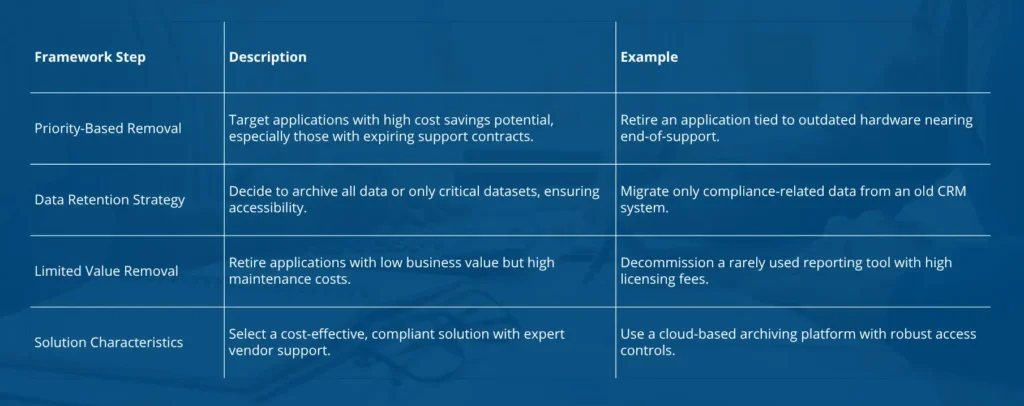
Closing Insight
Application retirement isn’t deletion—it’s intelligent preservation. By migrating data to compliant archives (like specialized ILM platforms), organizations retain access without the overhead. Leaders who systematically evaluate systems using value/cost frameworks unlock millions in savings while fortifying their security posture. The math is clear: Retirement isn’t an IT project—it’s a balance sheet imperative.
For deeper insights, explore the blogs in the series: “Application Retirement vs Application Decommissioning” and “App Retirement Isn’t Just Switch-Off — It’s Strategy + The Right Solution.”
Learn more:
Explore our comprehensive resource, The Ultimate Guide to Application Retirement: Sunsetting Simplified, for a deeper dive into building a successful application retirement strategy. This guide covers everything from identifying retirement candidates to ensuring data compliance and long-term accessibility.