
CLINICAL TRIAL DATA ARCHIVING — PART 4/5
Part 1 of this series covered cost center to strategic asset. Part 2 covered rear-view mirror data becoming AI training data. Part 3 covered archival burden from M&A becoming a unified advantage that is aligned to F.A.I.R. principles. This blog is dimension four: the application stack itself, because none of the last three blogs matter if the systems generating the data never talk to each other in the first place.
In 2026, the U.S. Office of the National Coordinator for Health IT approved new interoperability standards through its Standards Version Advancement Process, and separately, HL7 International and OHDSI, have been working to line up FHIR and OMOP so health data can move between systems in one consistent structure. Two different standards efforts, both chasing the same goal: getting systems that were never designed to work together to actually exchange data.
Reading between the lines, though, this isn’t really a standards story. It’s an application story. A typical large pharma runs a different specialized system for nearly every step of drug development: one for electronic data capture, another for the trial master file, another for trial management, another for safety and pharmacovigilance, another for real-world or genomic data. Each was picked because it was the best tool for that specific job and they weren’t picked with each other in mind.
That application fragmentation has a real & measured cost. A June 2026 trade-press analysis of clinical research operations put it plainly: data harmonization across these siloed sources including EDC, EHRs, patient-reported outcomes, wearables & imaging is “a fundamental, persistent bottleneck,” and data scientists spend most of their time wrangling data rather than analyzing and making decisions. The same analysis found that data harmonization automation could cut time-to-insight by roughly 75%.
So which way is the industry moving towards? one unified platform, or best-of-breed tools for each job? A 2024 review in the peer-reviewed Journal of Medical Internet Research looked at this question for decentralized clinical trials, and the answer is: neither approach was a clear winner. Deploying best-of-the-breed point solutions still tends to produce “a lack of interoperability, dependence on functionalities, and vendor lock-in,” because most commercial platforms aren’t open to integrating external components. But a single do-everything platform isn’t realistic either. The review notes that the lack of common data standards will “likely limit the development of one-size-fits-all digital platforms.” Its actual recommendation: an approach where organizations can mix modules from different vendors, but only if those modules share common, open standards underneath.
That’s the real deal. The best-of-breed apps sitting on top of a shared data layer that makes them behave like one system, whether they were built to or not.
- Keep specialized applications where they add real value. A dedicated safety database or genomic pipeline that provides depth usually beats a generic module bolted onto an all-in-one platform.
- Stop expecting applications to integrate with each other directly. Point-to-point integration between specialized applications breaks every time one of them upgrades. It doesn’t scale past a handful of applications.
- Put a common data model between them instead. Standards like HL7 FHIR, CDISC’s SDTM and ADaM, and the OMOP common data model exist so that data from any application lands in one shared structure.
- Govern access centrally, not application by application. A researcher shouldn’t need separate approvals from different application owners to ask patient level cross-application or cross-study questions.
- Track provenance back to the source application. A unified layer only works if every record shows lineage to the original system, version, and time period it came from.
- Treat the unifying layer as permanent infrastructure, not a project. New specialized applications will keep appearing. The shared data layer has to keep absorbing them, the same way an M&A driven archive has to keep absorbing newly acquired systems.
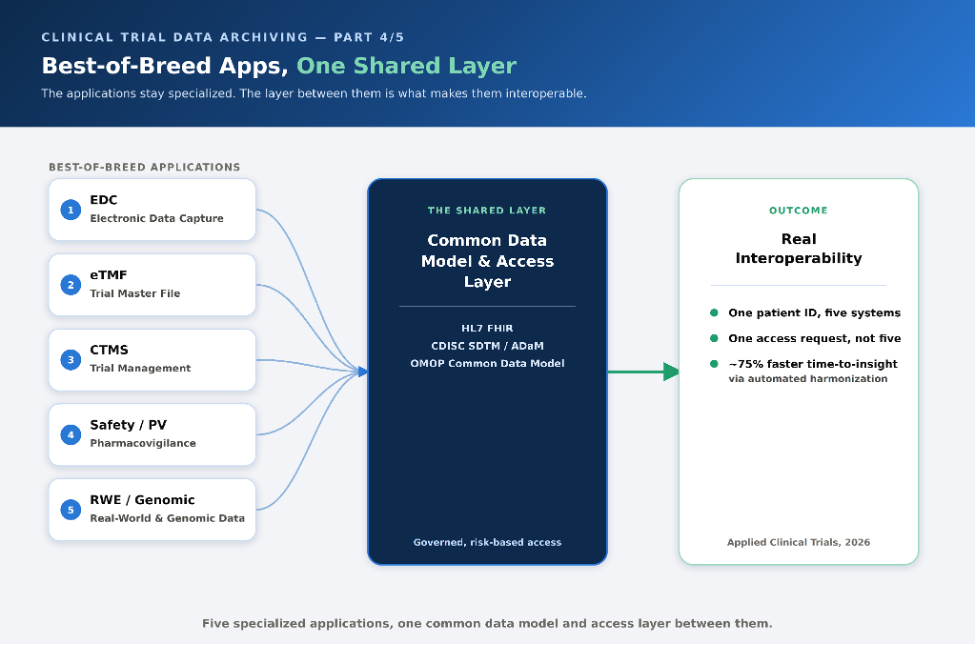
A well-publicized example from Novartis is a testimonial for this. Like most large pharmas, it ran and still runs a wide range of specialized systems across clinical and R&D work, each built for its own purpose. Broad, patient level cross-application or cross-study access to that data would have been impeded without a shared data layer. Rather than replacing those specialized systems, Novartis built data42: a company-wide, governed data lake with a risk-based access model on top of them. The specialized applications stayed and what changed was the data layer connecting them.
That same data layer only works if it’s actually built F.A.I.R — findable, accessible, interoperable, reusable, the principles this series introduced in Part 3:
- Persistent identifiers across every source application (Findable). A record has to carry one consistent ID regardless of which of the source systems it came from.
- A governed access layer, not per-application requests (Accessible). An automated, risk-based approval is what “accessible” looks like in practice, at the scale of dozens of applications.
- One common data model spanning the whole stack (Interoperable). This is where HL7 FHIR, CDISC standards, and the OMOP common data model actually do their work by translating every application’s own format into one shared structure.
- Provenance retained regardless of source system (Reusable). A researcher combining data from multiple applications has to be able to trust and trace every data field back to where it came from.
- Executive sponsorship spanning both IT and R&D. None of the above is possible without cross functional executive sponsorship and oversight. This is the one requirement that isn’t a FAIR principle or a data standard, just a plain organizational requirement.
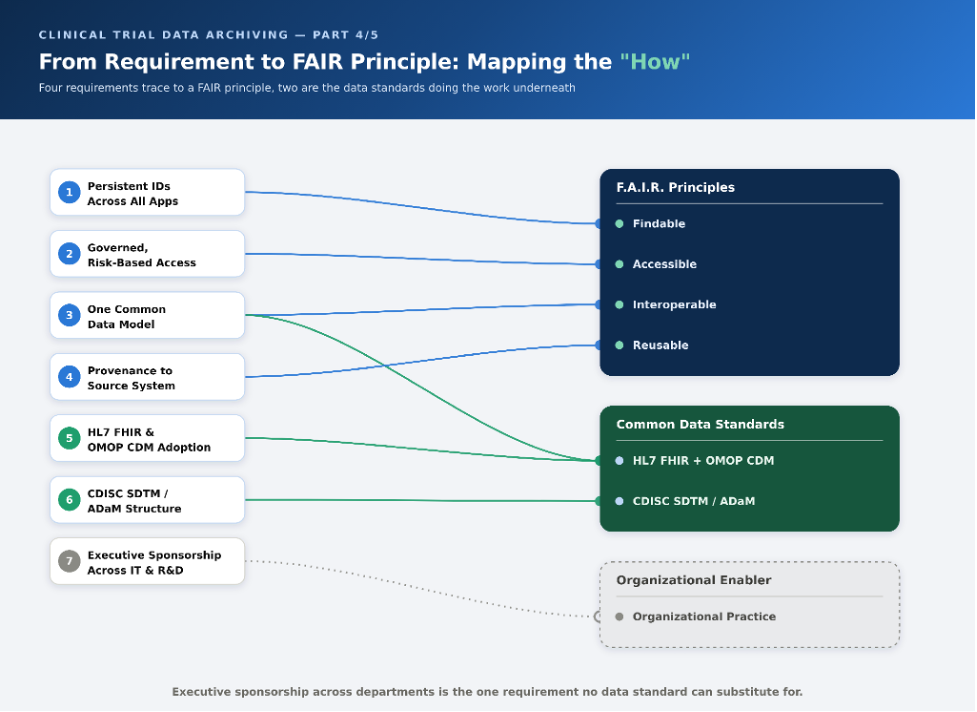
Skip any one of these and best-of-breed just means best-of-breed silos: more specialized, better at their own job, and no more able to talk to each other than before.
Which answers the question this blog opened with: will best-of-breed approach survive, and can it still deliver interoperability? Yes to both, but only conditionally. Best-of-breed keeps winning at the point of use, because a dedicated tool built for one job will keep beating a generic module built for multiple jobs. It only delivers real interoperability, if every one of those specialized tools commits to the same underlying data standards, and if a governed structured data layer based on F.A.I.R. sits above them. Without that layer, more best-of-breed adoption just means more silos and everything Part 2 of this series described about AI needing clean, representative training data becomes harder, not easier, with every new point solution added.
If you work in IT architecture, data governance, or R&D operations: does your organization’s data layer treat every application as a source to harmonize, or does each specialized system still hold its data as its own private archive?
Next in this series: the fifth and final dimension — what a genuinely F.A.I.R., interoperable data foundation actually changes for patients, not just for pharma’s own R&D.
FAQs
What is clinical trial data interoperability?
Clinical trial data interoperability is the ability of different clinical research applications and systems to exchange, understand, and use data consistently. It enables data from EDC, EHRs, safety systems, trial management platforms, genomic systems, and other sources to work together through common data standards and a shared data layer.
Why is application fragmentation a challenge in clinical trial data management?
Application fragmentation creates data silos because specialized systems often store data in different formats and operate independently. This makes cross-application data access, harmonization, governance, and analysis more difficult and increases the time researchers spend preparing data instead of generating insights.
Should pharmaceutical companies use best-of-breed applications or a single platform?
Neither approach is universally ideal. Best-of-breed applications can provide specialized functionality, while a single platform may not meet every clinical and R&D requirement. A more practical approach is to retain specialized applications while using a shared, governed data layer and common data standards to enable interoperability.
How can pharmaceutical companies integrate data from different clinical trial applications?
Pharmaceutical companies can integrate data by placing a common data layer between specialized applications and using standards such as HL7 FHIR, CDISC SDTM, CDISC ADaM, and the OMOP Common Data Model. This approach reduces dependence on point-to-point integrations and creates a consistent structure for accessing data across systems.
What role does a common data layer play in clinical trial data interoperability?
A common data layer provides a shared foundation that connects specialized applications without requiring every application to integrate directly with every other system. It can harmonize data, centralize governance, preserve provenance, and make information accessible across studies and applications.
How do FAIR principles improve clinical trial data management?
FAIR principles—Findable, Accessible, Interoperable, and Reusable—help organizations make clinical trial data easier to discover, access appropriately, combine across systems, and reuse for research. Applying FAIR principles requires persistent identifiers, governed access, common data models, and reliable data provenance.
What data standards support clinical trial data interoperability?
Key standards and models include HL7 FHIR, CDISC SDTM, CDISC ADaM, and the OMOP Common Data Model. These standards help organizations structure, exchange, and harmonize data from different clinical and research applications.
Why is data provenance important in clinical trial data archiving?
Data provenance allows researchers to trace information back to its original application, source, version, and time period. Maintaining this lineage helps establish data trust, supports auditability, and enables researchers to understand how data was generated and transformed before being reused.
How does clinical trial data archiving support AI-ready data?
Effective archiving preserves data with its metadata, context, lineage, and governance information. When data from multiple applications is harmonized and made interoperable, it becomes more consistent and reusable for AI, machine learning, analytics, and other advanced research use cases.
What are the benefits of governed access to clinical trial data?
Governed access allows researchers to access relevant data through centralized, risk-based controls rather than obtaining separate approvals from individual application owners. This can improve accessibility while maintaining privacy, security, compliance, and appropriate access to patient-level data.
Why is point-to-point integration not ideal for pharmaceutical data environments?
Point-to-point integration becomes increasingly difficult to maintain as the number of applications grows. Changes or upgrades to one system can disrupt integrations with other systems. A shared data layer provides a more scalable approach by separating applications from direct dependencies on one another.
How can pharmaceutical companies make clinical trial data F.A.I.R.?
Pharmaceutical companies can make clinical trial data F.A.I.R. by implementing persistent identifiers, centralized governance and access controls, common data models, and complete data provenance. They also need executive sponsorship across IT and R&D to ensure these practices are maintained as new applications and data sources are introduced.
References
- Applied Clinical Trials, “The Data Harmonization Imperative: How AI Is Solving Clinical Research’s Biggest Bottleneck” (June 2026) — appliedclinicaltrialsonline.com/view/data-harmonization-ai-clinical-research-bottleneck
- Journal of Medical Internet Research, “The Digital Platform and Its Emerging Role in Decentralized Clinical Trials” (2024) — jmir.org/2024/1/e47882
- Drug Discovery Today, “Democratizing data at Novartis through clinical trial data access” (2022), via PubMed — pubmed.ncbi.nlm.nih.gov/35227648
- Wilkinson et al., “The FAIR Guiding Principles for scientific data management and stewardship,” Scientific Data (2016) — nature.com/articles/sdata201618
- HL7 International and OHDSI, joint announcement on aligning FHIR and the OMOP common data model — ohdsi.org/ohdsi-hl7-collaboration
- U.S. Office of the National Coordinator for Health IT (HealthIT.gov), 2026 Standards Version Advancement Process approved standards — healthit.gov/isp
#ClinicalTrials #ClinicalDataManagement #LifeSciences #DataInteroperability #FAIRData #HealthIT #DrugDevelopment #DataStrategy

Murali Krishnam
VP - Product Strategy, Enterprise Pharma AI
DISCLAIMER: THE CONTENT, VIEWS, AND OPINIONS EXPRESSED IN THIS BLOG ARE SOLELY THOSE OF THE AUTHOR(S) AND DO NOT REFLECT THE OFFICIAL POLICY OR POSITION OF SOLIX TECHNOLOGIES, INC., ITS AFFILIATES, OR PARTNERS. THIS BLOG IS OPERATED INDEPENDENTLY AND IS NOT REVIEWED OR ENDORSED BY SOLIX TECHNOLOGIES, INC. IN AN OFFICIAL CAPACITY. ALL THIRD-PARTY TRADEMARKS, LOGOS, AND COPYRIGHTED MATERIALS REFERENCED HEREIN ARE THE PROPERTY OF THEIR RESPECTIVE OWNERS. ANY USE IS STRICTLY FOR IDENTIFICATION, COMMENTARY, OR EDUCATIONAL PURPOSES UNDER THE DOCTRINE OF FAIR USE (U.S. COPYRIGHT ACT § 107 AND INTERNATIONAL EQUIVALENTS). NO SPONSORSHIP, ENDORSEMENT, OR AFFILIATION WITH SOLIX TECHNOLOGIES, INC. IS IMPLIED. CONTENT IS PROVIDED "AS-IS" WITHOUT WARRANTIES OF ACCURACY, COMPLETENESS, OR FITNESS FOR ANY PURPOSE. SOLIX TECHNOLOGIES, INC. DISCLAIMS ALL LIABILITY FOR ACTIONS TAKEN BASED ON THIS MATERIAL. READERS ASSUME FULL RESPONSIBILITY FOR THEIR USE OF THIS INFORMATION. SOLIX RESPECTS INTELLECTUAL PROPERTY RIGHTS. TO SUBMIT A DMCA TAKEDOWN REQUEST, EMAIL INFO@SOLIX.COM WITH: (1) IDENTIFICATION OF THE WORK, (2) THE INFRINGING MATERIAL’S URL, (3) YOUR CONTACT DETAILS, AND (4) A STATEMENT OF GOOD FAITH. VALID CLAIMS WILL RECEIVE PROMPT ATTENTION. BY ACCESSING THIS BLOG, YOU AGREE TO THIS DISCLAIMER AND OUR TERMS OF USE. THIS AGREEMENT IS GOVERNED BY THE LAWS OF CALIFORNIA.
-
 White Paper
Enterprise Information Architecture for Gen AI and Machine Learning
Download White Paper -

-

-
