
CLINICAL TRIAL DATA ARCHIVING — PART 5/5
Part 1 of this series covered cost center to strategic asset. Part 2 covered rear-view mirror data becoming AI training data. Part 3 covered archival burden from M&A becoming a unified advantage. Part 4 covered application silos becoming real interoperability. This post is dimension five, the last one: what happens when someone actually has to retrieve a whole study’s data, fast, to answer a hard question.
Earlier this year, the FDA asked drug makers to remove the suicidal-thoughts warning from three GLP-1 weight-loss drugs: Saxenda, Wegovy, and Zepbound. That request followed a review that started in July 2023, when the agency first received reports of a possible link. The final analysis pooled 91 placebo-controlled trials covering 107,910 patients, plus a separate real-world study of over 2.2 million patients. The conclusion: no increased risk. The warning came off.
Reading between the lines, the real story isn’t the finding. It’s what it took to get there. Some of those 91 trials go back to the mid-2000s, run under different protocols, by different teams, long before anyone was asking this specific question. Answering it meant pulling patient-level data from each of those studies and pooling into one dataset. That’s not a search. That’s a retrieval problem, at the level of the whole study, not a single field or form.
Most clinical data search still isn’t built for that. It’s built at the application level: log into the EDC to check one thing, into the eTMF for another, into a safety database for a third. Each search is fast on its own, but stitching all of it into one complete, trustworthy study record is where the time actually goes.
That time has a real cost, and it isn’t small. Across biomedical research broadly, one widely cited economic analysis put the annual cost of irreproducible preclinical research in the US at roughly $28 billion, much of it couldn’t be verified or rebuilt from what was recorded. Clinical trials are more rigorously run than preclinical work, but the same underlying problem shows up: data that’s technically retained somewhere is not the same as data that’s actually retrievable, complete, and ready to reanalyze.
There’s a name for this type of “retrievable”: the Analysis Results Data Model (ARDM). Instead of stopping at raw data, it treats the analysis output itself: the tables, statistics, and figures a study produces as structured, machine-readable, reusable data, not a static PDF nobody can query. The idea is “write once, ready endlessly“: a result computed for one purpose stays retrievable for the next one, instead of getting locked in a document and recomputed from scratch every time someone needs it.
Four examples below make the retrieval gap impossible to write off as one bad trial.
One trial, 2026. A team reproduced the results of an already published clinical trial. The effort took several hundred person-hours across five separate teams: the original data dictionary couldn’t be found and the statistical seed numbers needed to reproduce the results were never recorded. Not because the data didn’t exist, but because the trial’s protocol link was broken. The paper’s conclusion: without the whole study package that includes protocol, dictionary & methods, the reuse barely works.
Real-world replication, 2019. Researchers tried to replicate 220 US clinical trials published in high-impact journals using real-world data (EHR & insurance claims), with only 33 trials at 15%, able to be replicated. Most failures traced back to the same root cause this series keeps highlighting: the intervention, the eligibility criteria, or the endpoint wasn’t recorded in a structured, retrievable form outside the original trial’s systems.
Critical care, 2018. A scoping review of 158 clinical practices from critical care trials found a reproduction attempt for only 66 of them at 42%. Of those, 56% produced results inconsistent with the original study. Two practices originally judged as safe and effective were later found to be harmful once properly re-examined; fluid resuscitation with hydroxyethyl starches had the most consistent evidence of harm. On average, it took 4.6 years before anyone even attempted to check.
Systematic reviews, 2016. The search itself often wasn’t reproducible. A review of 272 systematic reviews across 25 journals found that only 13% reported a search strategy detailed enough to reproduce across every database used. Search terms were reported 91% of the time, but which database they applied to, and when the search actually ran, usually wasn’t the case.
And it isn’t just retrieval: what gets reported can drift from what was pre-specified. A separate review of trial registrations found a median 31% discrepancy between registered and published primary outcomes, rising to 100% in some studies, and a 54% median discrepancy for secondary outcomes. When outcomes changed after the fact, they favored a statistically significant result about half the time.
That’s why both the industry & regulation is moving toward study-level, not application-level retrieval. The EMA has required proactive publication of full clinical study reports since its Policy 0070 took effect in 2016, not just summary results. Journal editors, through the ICMJE, have required a data-sharing plan for trials since 2018. Nonprofit platforms like Vivli exist specifically so a researcher can request complete study data, not scattered documents from multiple systems. None of this works if “the study” only exists as fragments of data across disconnected applications.
The 5 critical requirements for study-level retrieval:
- A single persistent ID for the whole study. Not one ID per document or dataset, but one ID that ties the protocol, the study data, the analysis code, and the clinical study report (CSR) together as one retrievable unit.
- A complete package, not just the dataset. The 2026 one-trial reanalysis is the cautionary tale: the raw data without the protocol, dictionary, and analysis methods is not reusable. The Analysis Results Data Model (ARDM) pushes this further.
- One governed query instead of five separate logins. A researcher or a regulator needs to pull an entire study in one action, not reconstruct from the EDC, eTMF and a statistics repository.
- Recorded methodology, down to the seed number. Exact reproducibility at this granularity depends on the details. If it isn’t captured at that time, it can’t be recovered later.
- Old and new studies are retrievable the same way. The GLP-1 review needed clinical trials from the mid 2000s to pool with trials from the 2020s. A retrieval system that only works for previous year’s studies isn’t a retrieval system at all: it’s just a temporary convenience.
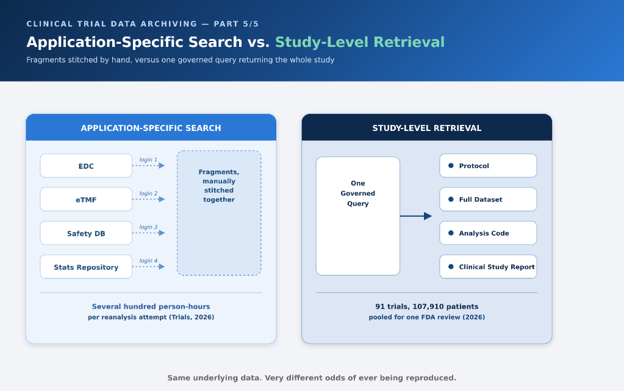
The GLP-1 safety review is the positive version of this story. Answering “is there really a suicide risk” required treating decades of Saxenda trials run long before this question existed as retrievable, poolable data, right alongside newer Wegovy and Zepbound trials. That only works if a trial’s full record survives as a coherent, retrievable package, not a folder of files that happened to survive in whatever system created them. Because it did, the agency could pool 91 trials and settle a high-profile safety question with real data instead of guesswork: the result was a warning removed, not a label made worse.
Everything in this list is really the F.A.I.R. principles this series introduced in Part 3, applied at the study level instead of the individual record:
- Findable. Every study carries one persistent ID, not scattered document IDs across separate systems.
- Accessible. A governed retrieval process returns the whole study on request, not a manual hunt across systems.
- Interoperable. Old studies and new studies use a structure that lets them sit in the same pooled analysis without need for a translation project.
- Reusable. The protocol, data dictionary, analysis methods, and results travel together, so reanalysis doesn’t depend on remembering details nobody wrote down.
Skip any one of these and study-level retrieval quietly reverts to application-specific search that is technically possible, practically slow, and one broken link away from an unreproducible result.
This closes the blog series, so it’s worth naming the throughline plainly. Each blog looked like a different problem: cost justification, AI relevance, M&A advantage, application sprawl, retrieval outcome. Each one of them was really the same question, asked from a different angle: is your data governed well enough to be found, trusted, and reused by someone who wasn’t in the room when it was created?
- Dimension 1 — Cost Center to Strategic Asset. Archived trial data, reused well, will shorten development timelines.
- Dimension 2 — Rear-View Mirror to Training Data. That same archive is the raw material for AI models, provided its provenance is documented as rigorously as the model itself.
- Dimension 3 — Archival Burden to Unified Advantage. M&A multiplies archives; F.A.I.R. principles are what will let two companies’ data become one usable resource instead of two filing cabinets.
- Dimension 4 — Application Silos to Real Interoperability. Best-of-breed applications can coexist with real interoperability, but only if a common governed data layer sits underneath all of them.
- Dimension 5 — Application-Specific Search to Study-Level Retrieval. All of the above only pays off if the whole study can actually be pulled back out, complete and reproducible, when needed.
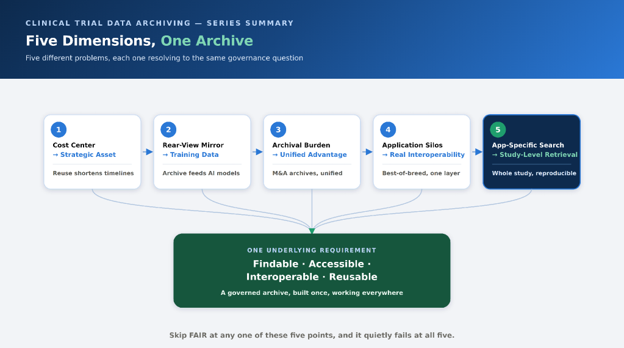
Five separate problems, one underlying requirement: data that is findable, accessible, interoperable, and reusable — for AI, for M&A, for the applications generating it, and for the moment someone has to reproduce the whole study.
None of these five dimensions is optional on its own, and none of them work in isolation either. An archive that’s cheap to create and reuse but can’t feed an AI model, unify after an acquisition, survive a multi-vendor application stack, or be retrieved whole under regulatory pressure isn’t actually done. F.A.I.R. was never really about any one of these five problems. It was always about all of them at once.
If this is the kind of problem your organization is also applying AI to earlier in the pipeline, my colleague’s Rohit Pardeshi & Soumith Babburi whitepaper is worth a look: it lays out a framework for using connected data infrastructure to speed up AI-driven drug repurposing and target identification — the same “whole study, not just a field” logic this blog argues for, applied to deciding what to research next rather than how to defend what’s already been studied. A Framework for AI-Driven Drug Repurposing and Target Identification in Pharma R&D.
If you work in biostatistics, regulatory affairs, or data management: if a regulator asked your organization tomorrow to pool every trial on one product going back fifteen years, would you retrieve the whole study or reconstruct it, one application at a time?
FAQs
What is study-level retrieval in clinical trial data management?
Study-level retrieval means retrieving a complete clinical study as one governed, trustworthy package instead of searching for individual records across separate applications. It connects the protocol, study data, analysis methods, and clinical study report so the study can be retrieved and reused as a whole.
What is the difference between application-specific search and study-level retrieval?
Application-specific search retrieves information one system at a time, such as an EDC, eTMF, or safety database. Study-level retrieval provides the complete study through one governed request, reducing the need to manually reconstruct information from multiple disconnected systems.
Why is study-level retrieval important for clinical trial data?
Study-level retrieval makes clinical trial data easier to find, access, analyze, reproduce, and reuse. Retaining data alone is not enough; the associated protocol, data dictionary, methodology, and results must also remain retrievable and connected.
What should be included in a complete clinical trial data package?
A complete clinical trial package should include the study protocol, study data, data dictionary, analysis code or methods, and clinical study report. These components provide the context required to understand, reproduce, and reuse the study rather than relying on raw data alone.
What is the Analysis Results Data Model (ARDM)?
The Analysis Results Data Model (ARDM) treats analysis outputs such as tables, statistics, and figures as structured, machine-readable, reusable data rather than static documents. This approach helps make analysis results retrievable for future use without requiring them to be recomputed from scratch.
How does study-level retrieval support clinical trial reproducibility?
Study-level retrieval supports reproducibility by keeping the information needed to reproduce a study together. This includes the protocol, data dictionary, analysis methods, and other methodological details, including exact information such as statistical seed numbers when required.
What are the five critical requirements for study-level retrieval?
The five critical requirements are a single persistent ID for the whole study, a complete study package, one governed query instead of multiple application searches, recorded methodology, and consistent retrieval of both historical and new studies.
How do F.A.I.R. principles apply to clinical trial data retrieval?
F.A.I.R. principles make clinical trial data Findable, Accessible, Interoperable, and Reusable. At the study level, this means using persistent study identifiers, governed retrieval, compatible structures, and keeping the protocol, data, methods, and results together.
How does study-level retrieval support regulatory review and safety analysis?
Study-level retrieval allows researchers and regulators to access and pool complete clinical trial data when investigating important safety or regulatory questions. The GLP-1 safety review illustrates how historical trials can be retrieved and combined with newer studies to answer a specific safety question.
Why should old clinical trials be retrievable using the same approach as new trials?
Historical studies may need to be combined with newer studies for regulatory reviews, safety analysis, or research. A retrieval system should therefore make both old and new studies accessible through the same governed approach rather than limiting retrieval to recently created data.
References
- U.S. FDA, “FDA Requests Removal of Suicidal Behavior and Ideation Warning from GLP-1 RA Medications” (April 2026) — fda.gov/drugs/drug-safety-communications/fda-requests-removal-suicidal-behavior-and-ideation-warning-glucagon-peptide-1-receptor-agonist-glp
- Science News, “Irreproducible life sciences research in U.S. costs $28 billion,” reporting on Freedman, Cockburn & Simcoe, “The Economics of Reproducibility in Preclinical Research,” PLOS Biology (2015) — sciencenews.org/article/irreproducible-life-sciences-research-us-costs-28-billion
- Kirchner et al., “Rethinking clinical study data: why we should respect analysis results as data,” Scientific Data (2022) — nature.com/articles/s41597-022-01789-2
- Ansari et al., “Reproducibility of Search Strategies Is Poor in Systematic Reviews Published in High-Impact Pediatrics, Cardiology and Surgery Journals,” PLOS One (2016) — journals.plos.org/plosone/article?id=10.1371/journal.pone.0163309
- Trials (Springer Nature), “Supporting reanalysis and reuse of clinical trial data: a case study” (2026) — link.springer.com/article/10.1186/s13063-026-09646-y
- Niven et al., “Reproducibility of clinical research in critical care: a scoping review,” BMC Medicine (2018) — link.springer.com/article/10.1186/s12916-018-1018-6
- Franklin et al., “Feasibility of Using Real-World Data to Replicate Clinical Trial Evidence,” JAMA Network Open (2020) — jamanetwork.com/journals/jamanetworkopen/fullarticle/2752575
- Jones et al., “Comparison of registered and published outcomes in randomized controlled trials: a systematic review,” BMC Medicine (2015) — link.springer.com/article/10.1186/s12916-015-0520-3
- New England Journal of Medicine, “Transparency and the European Medicines Agency — Sharing of Clinical Trial Data” (2015) — nejm.org/doi/full/10.1056/NEJMp1409464
- Wilkinson et al., “The FAIR Guiding Principles for scientific data management and stewardship,” Scientific Data (2016) — nature.com/articles/sdata201618
- Vivli, nonprofit global clinical research data-sharing platform — vivli.org
#ClinicalTrials #ClinicalDataManagement #LifeSciences #Reproducibility #FAIRData #DataStrategy #DrugDevelopment #RegulatoryAffairs

Murali Krishnam
VP - Product Strategy, Enterprise Pharma AI
DISCLAIMER: THE CONTENT, VIEWS, AND OPINIONS EXPRESSED IN THIS BLOG ARE SOLELY THOSE OF THE AUTHOR(S) AND DO NOT REFLECT THE OFFICIAL POLICY OR POSITION OF SOLIX TECHNOLOGIES, INC., ITS AFFILIATES, OR PARTNERS. THIS BLOG IS OPERATED INDEPENDENTLY AND IS NOT REVIEWED OR ENDORSED BY SOLIX TECHNOLOGIES, INC. IN AN OFFICIAL CAPACITY. ALL THIRD-PARTY TRADEMARKS, LOGOS, AND COPYRIGHTED MATERIALS REFERENCED HEREIN ARE THE PROPERTY OF THEIR RESPECTIVE OWNERS. ANY USE IS STRICTLY FOR IDENTIFICATION, COMMENTARY, OR EDUCATIONAL PURPOSES UNDER THE DOCTRINE OF FAIR USE (U.S. COPYRIGHT ACT § 107 AND INTERNATIONAL EQUIVALENTS). NO SPONSORSHIP, ENDORSEMENT, OR AFFILIATION WITH SOLIX TECHNOLOGIES, INC. IS IMPLIED. CONTENT IS PROVIDED "AS-IS" WITHOUT WARRANTIES OF ACCURACY, COMPLETENESS, OR FITNESS FOR ANY PURPOSE. SOLIX TECHNOLOGIES, INC. DISCLAIMS ALL LIABILITY FOR ACTIONS TAKEN BASED ON THIS MATERIAL. READERS ASSUME FULL RESPONSIBILITY FOR THEIR USE OF THIS INFORMATION. SOLIX RESPECTS INTELLECTUAL PROPERTY RIGHTS. TO SUBMIT A DMCA TAKEDOWN REQUEST, EMAIL INFO@SOLIX.COM WITH: (1) IDENTIFICATION OF THE WORK, (2) THE INFRINGING MATERIAL’S URL, (3) YOUR CONTACT DETAILS, AND (4) A STATEMENT OF GOOD FAITH. VALID CLAIMS WILL RECEIVE PROMPT ATTENTION. BY ACCESSING THIS BLOG, YOU AGREE TO THIS DISCLAIMER AND OUR TERMS OF USE. THIS AGREEMENT IS GOVERNED BY THE LAWS OF CALIFORNIA.
-
 White Paper
Enterprise Information Architecture for Gen AI and Machine Learning
Download White Paper -

-

-
