
GIGO had a good run
If you’ve spent any time around data, you learned GIGO on day one. Garbage in, garbage out. Bad data goes in, a bad report comes out, somebody catches it in the quarterly review, and life goes on.
That rule held up for decades because the damage had a ceiling. A wrong number sat in a dashboard until a person noticed it. The garbage just sat there. It didn’t do anything.
This week a former IBM colleague posted something on LinkedIn that’s been rattling around in my head ever since. His point was that GIGO doesn’t just hold up with AI. It gets amplified. And with agentic AI, your garbage “now has the autonomy” to go act on your behalf. He also said agents are often working from data as it was, not data as it is. I love that line, because it names a problem most teams don’t even know they have.
I’ve been saying for a while that in the AI world it’s garbage in, garbage squared. This post pushed me a step further. Honestly? I think we’re already at garbage cubed. And I think one of our favorite guardrails, Human in the Loop, is being undercut by its own name.
Let me explain both.
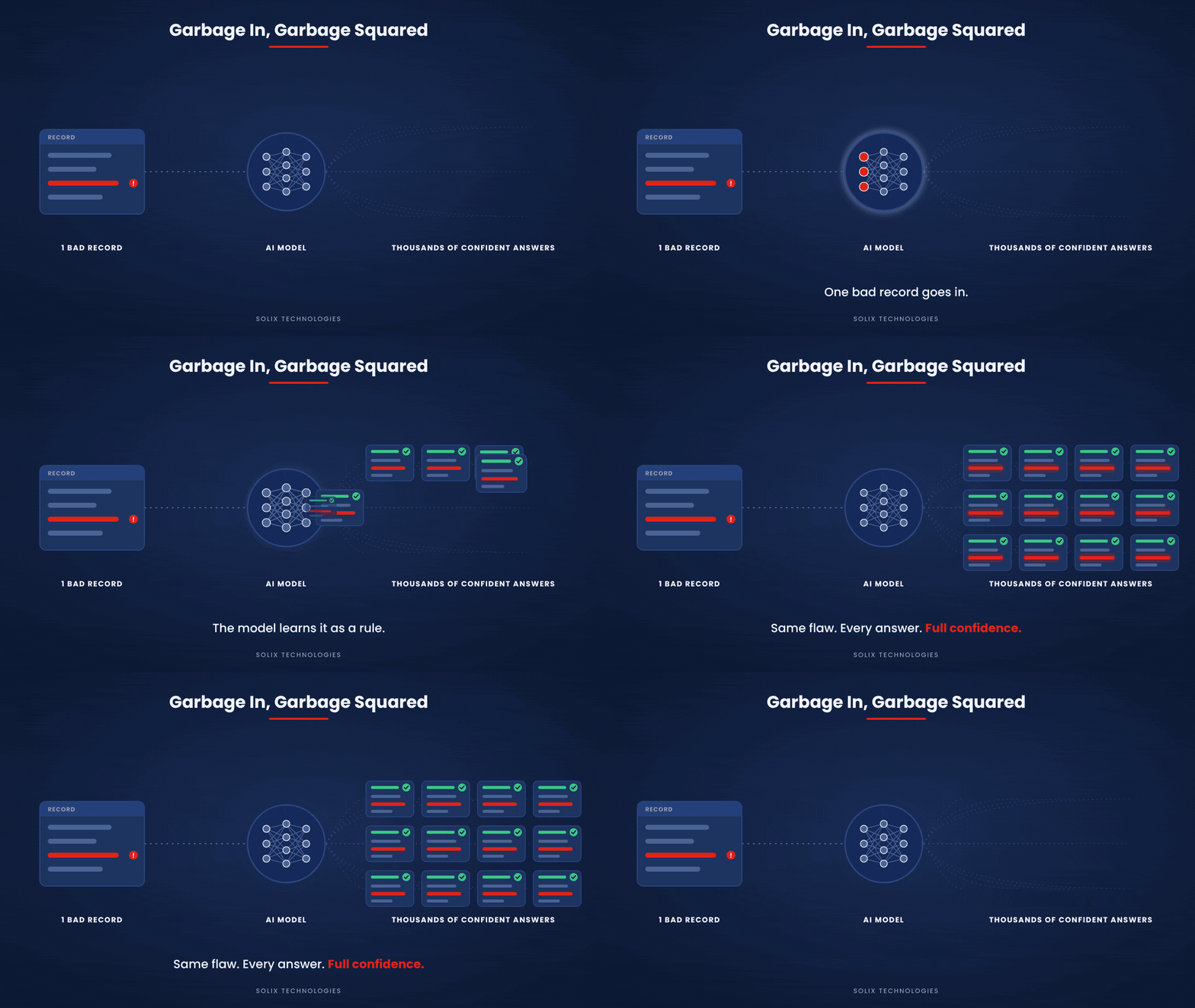
Why is it garbage squared?
A traditional report repeats bad data. AI multiplies it. There are three reasons for that.
It sounds sure of itself. A bad row in a table looks like a bad row. Run that same bad data through a model and it comes back as a fluent, nicely formatted answer. Nobody squints at a confident paragraph the way they’d squint at a weird number in a spreadsheet.
It turns mistakes into rules. Models learn patterns, not rows. So a skew in your data doesn’t stay one bad record. It becomes a rule the model applies to every case that looks similar. I wrote about this as BIBO (Bias In, Bias Out), and the evidence keeps piling up. In a JAMA study, hospital clinicians diagnosed correctly about 73% of the time on their own. When they were shown predictions from a systematically biased model, accuracy dropped to 61.7%. That’s worse than having no AI at all. And showing them the model’s explanations didn’t fix it.
It runs at scale. One bad report reaches one meeting. A model can produce thousands of answers an hour from the same bad source.
There’s also a loop hiding in here. Today’s AI output tends to become tomorrow’s AI input. Researchers writing in Nature showed that models trained without discrimination on AI-generated content gradually lose the rare cases at the edges of the data. Over generations they drift away from reality. In business, those rare cases are often the ones that matter most: the unusual diagnosis, the odd claim, the fraud pattern nobody’s seen before.
So that’s squared. Bad data, multiplied by a system that’s fluent, generalizes, and scales.
Why agentic AI makes it garbage cubed
Agents add a third dimension, and that dimension is action. A chatbot hands you an answer and waits. An agent takes the answer and does something with it. It approves the refund, updates the patient record, reorders the inventory, sends the email. Three things happen once garbage gets the car keys.
- It acts before anyone reads it. With a report, a person stood between the bad data and the decision. With an agent, the output often is the decision.
- It compounds. Agents work in multi-step chains, and errors multiply down the chain. Here’s some back-of-the-napkin math (illustrative, not a benchmark). Say every step is 95% right. A 10-step workflow then comes out right about 60% of the time. Stretch it to 20 steps and you’re at roughly 36%. Now picture agents handing work off to other agents.
- It writes back. This is the part that keeps me up at night. The agent’s output lands in a system of record, and the next agent reads it as fact. The garbage isn’t output anymore. It’s source data. Now, history on its own isn’t the problem. Plenty of good decisions depend on it: a patient’s prior diagnoses, a customer’s five-year payment record, the terms of a contract signed in 2015. The problem is history that isn’t labeled as history. When an agent pulls in old data without knowing it’s old, it treats data as it was like data as it is. And it stamps yesterday’s reality onto today’s records.
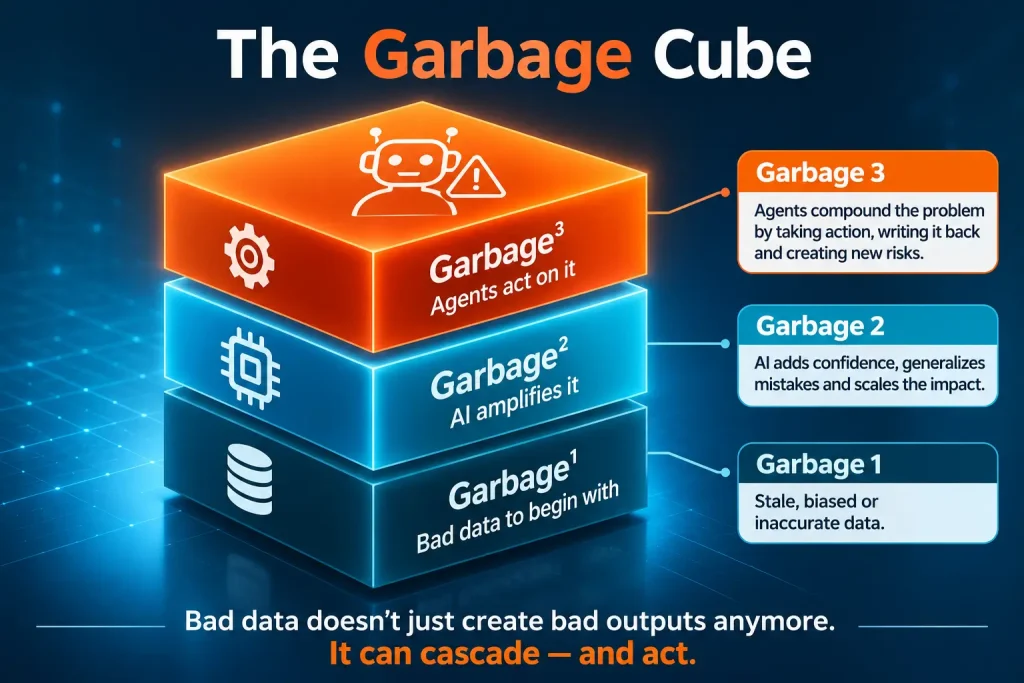
Put it together and here’s the cube:
- Garbage¹: the bad, stale or biased data.
- Garbage²: the model amplifies it with confidence, generalization and scale.
- Garbage³: the agent acts on it, compounds it, and writes it back where everyone else will trust it.
It shows up in how leaders feel about their agents, too. In a 2026 MIT Technology Review Insights survey of 300 data and technology executives, only about half trusted their AI agents’ decisions to be accurate and relevant. Among the data leaders, organizations with the strongest data foundations, that number was 100%. Reliable agents start with reliable data. There’s no shortcut around it.
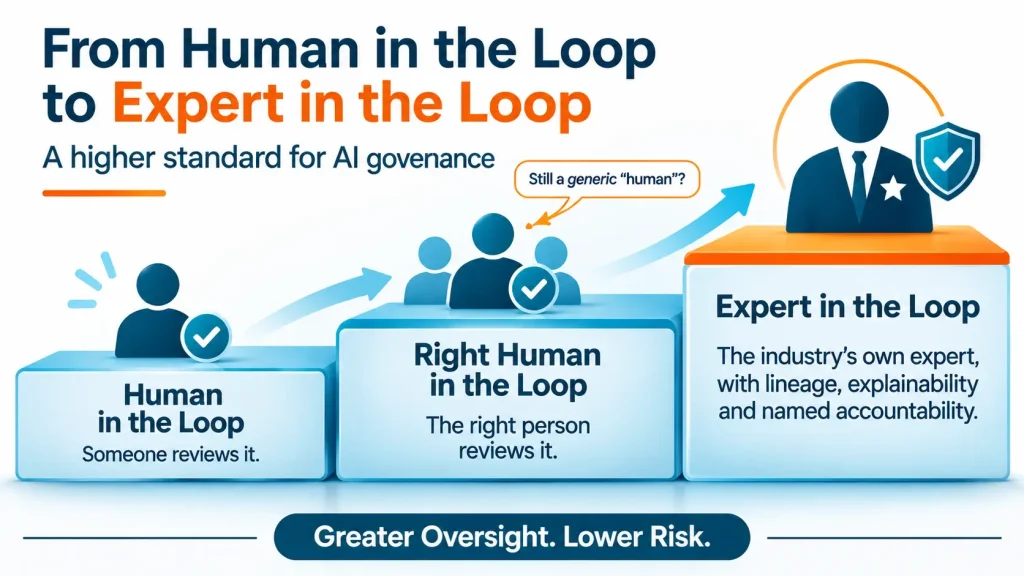
“Human in the Loop” undersells the job
Ask anyone how they keep agents in check and you’ll hear the same four words: human in the loop. I get it. It’s reassuring. But I think the phrase is doing us a disservice.
I’ve written about this twice. First I argued for RHITL, the Right Human in the Loop, because a warm body clicking “approve” isn’t oversight. Then, in Beyond RHITL, I went further. We should name the loop after the expert. It shouldn’t be Human in the Loop. It should be Expert in the Loop. In healthcare, that’s Practitioner in the Loop.
Why fuss over a name? Because names shape what gets built. “A human reviewed it” doesn’t carry much weight with a regulator, a court or a patient. “A licensed practitioner reviewed this recommendation” carries a lot. When the loop is named after a generic human, you design for a generic human. You get a generic approve button, a generic confidence score, and very quickly a rubber stamp.
And a rubber stamp is the cube’s best friend. Remember the JAMA study? Even trained clinicians got pulled off course by a biased model. If experts can be misled when they lack the right context, a generic reviewer doesn’t stand a chance. The answer isn’t to take people out. It’s to put the right people in, and give them what an expert actually needs to push back.
Here’s what that looks like across industries:
| Industry | Name the loop | What the expert catches that a generic reviewer misses |
| Healthcare | Practitioner in the Loop | A recommendation that fits the data but not the patient in front of them |
| Pharma and life sciences | Scientist in the Loop | A result built on a dataset that doesn’t match the study population |
| Banking | Analyst in the Loop | A risk score running on last quarter’s exposure |
| Insurance | Adjuster in the Loop | A claim decision that ignores policy language or local regulation |
| Legal | Counsel in the Loop | A confident citation that doesn’t exist, or doesn’t apply |
| Public sector | Caseworker in the Loop | An eligibility call that misses the circumstances behind the record |
An expert breaks the cube on every axis. They know what good data looks like, so they spot garbage¹. They can tell a confident wrong answer from a right one, so they stop garbage². And when they sit at the right checkpoint, they stop the action before it executes or writes back. That’s garbage³.
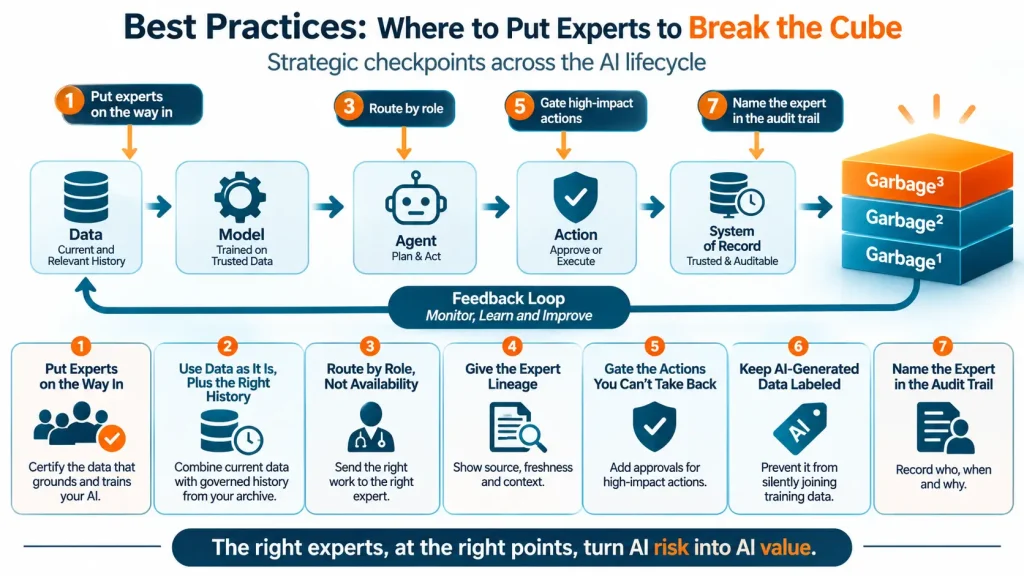
Best practices: where to put experts so they break the cube
Putting an expert in the loop isn’t one checkbox at the end of the pipeline. It’s a handful of deliberate placements. These are the ones I’d start with.
- Put experts on the way in, not just the way out. Most review happens after the AI answers. By then you’re already at garbage². Have domain experts certify the data that grounds and trains your AI: the definitions, the completeness, what “good” actually looks like.
- Use data as it is, plus the right data as it was. Historical data isn’t the enemy. Stale data pretending to be current is. Some of the richest context for AI lives in history: years of patient encounters, claims, transactions and records from applications you retired long ago. That’s where archiving and preservation pay off. Move inactive data out of production so agents work from clean, current active data. Then preserve the history in a governed archive, still accessible, with its context and lineage intact and every record clearly dated.
- From there, let your governance model decide which historical data each AI use case actually needs. A readmission-risk model might need a decade of encounters. A service agent might need last quarter. Retention, privacy and purpose rules should make that call, not whoever happened to wire up the data feed. Current data plus the right history, each clearly marked, beats either one on its own.
- Route by role, not by availability. Whoever happens to be on shift isn’t the loop. Send clinical calls to clinicians, claims to adjusters, credit decisions to analysts.
- Give the expert lineage, not a confidence score. “87% confident” tells a practitioner nothing. Which records did this come from? How fresh are they? What’s missing? That’s what lets an expert actually push back.
- Gate the actions you can’t take back. Sort agent actions by impact and reversibility. Low-risk actions can run on their own. Anything that writes to a system of record, touches a patient or customer, or moves money gets an expert sign-off first. For long chains, add checkpoints between agent handoffs so one bad step doesn’t snowball.
- Keep AI-generated data labeled. Tag what agents create so it doesn’t quietly turn into tomorrow’s training or grounding data. That’s your best defense against the feedback loop.
- Name the expert in the audit trail. Record who reviewed it, their role or license, when, and against which data. Use the vocabulary your regulators already use. “Approved by user 4471” isn’t accountability.
Moving forward
GIGO was a warning. Garbage cubed is a multiplier. And the multiplier gets bigger with every agent you deploy, every step you chain together, and every record an agent writes back.
The fix isn’t to slow AI down. It’s to get two things right. First, data that’s governed, validated and current, data as it is. Second, experts in the loop who are named for the job they actually do. At Solix we think of it as the path from AI-ready to AI-activated. Readiness is getting the data right. Activation only pays off when the right experts stay in the loop as the AI starts acting.
So here’s my updated rule for the agentic era: garbage in, garbage cubed, unless there’s an expert in the loop.
If you’re working out where experts belong in your own AI workflows, I’d love to compare notes.
References
- Stephen Tallant, The Missing Piece in AI Governance: Fighting Bias In, Bias Out, Solix Blog.
- Stephen Tallant, Beyond RHITL: It’s Time to Name the Loop After the Expert, Solix Leadership Lessons, June 2026.
- Jabbour S., et al., Measuring the Impact of AI in the Diagnosis of Hospitalized Patients, JAMA, December 2023 (73% baseline, 61.7% with biased model predictions). Also covered by Axios.
- Shumailov I., et al., AI models collapse when trained on recursively generated data, Nature 631, July 2024.
- MIT Technology Review Insights, Scaling AI agents with trustworthy data, August 2026 (survey of 300 executives, Feb–Mar 2026).

Stephen Tallant
Vice President of Product Marketing
DISCLAIMER: THE CONTENT, VIEWS, AND OPINIONS EXPRESSED IN THIS BLOG ARE SOLELY THOSE OF THE AUTHOR(S) AND DO NOT REFLECT THE OFFICIAL POLICY OR POSITION OF SOLIX TECHNOLOGIES, INC., ITS AFFILIATES, OR PARTNERS. THIS BLOG IS OPERATED INDEPENDENTLY AND IS NOT REVIEWED OR ENDORSED BY SOLIX TECHNOLOGIES, INC. IN AN OFFICIAL CAPACITY. ALL THIRD-PARTY TRADEMARKS, LOGOS, AND COPYRIGHTED MATERIALS REFERENCED HEREIN ARE THE PROPERTY OF THEIR RESPECTIVE OWNERS. ANY USE IS STRICTLY FOR IDENTIFICATION, COMMENTARY, OR EDUCATIONAL PURPOSES UNDER THE DOCTRINE OF FAIR USE (U.S. COPYRIGHT ACT § 107 AND INTERNATIONAL EQUIVALENTS). NO SPONSORSHIP, ENDORSEMENT, OR AFFILIATION WITH SOLIX TECHNOLOGIES, INC. IS IMPLIED. CONTENT IS PROVIDED "AS-IS" WITHOUT WARRANTIES OF ACCURACY, COMPLETENESS, OR FITNESS FOR ANY PURPOSE. SOLIX TECHNOLOGIES, INC. DISCLAIMS ALL LIABILITY FOR ACTIONS TAKEN BASED ON THIS MATERIAL. READERS ASSUME FULL RESPONSIBILITY FOR THEIR USE OF THIS INFORMATION. SOLIX RESPECTS INTELLECTUAL PROPERTY RIGHTS. TO SUBMIT A DMCA TAKEDOWN REQUEST, EMAIL INFO@SOLIX.COM WITH: (1) IDENTIFICATION OF THE WORK, (2) THE INFRINGING MATERIAL’S URL, (3) YOUR CONTACT DETAILS, AND (4) A STATEMENT OF GOOD FAITH. VALID CLAIMS WILL RECEIVE PROMPT ATTENTION. BY ACCESSING THIS BLOG, YOU AGREE TO THIS DISCLAIMER AND OUR TERMS OF USE. THIS AGREEMENT IS GOVERNED BY THE LAWS OF CALIFORNIA.
-
 White Paper
Enterprise Information Architecture for Gen AI and Machine Learning
Download White Paper -

-

-