
Why File Archiving Matters More Than Ever
Most organizations today are sitting on a massive, growing pile of files—and they don’t know what to do with them. These aren’t the neat, organized records in your databases. These are the PDFs, emails, documents, images, and reports that accumulate over years of business operations. Understanding how to properly archive and manage these files has become one of the most important challenges facing IT and business leaders today.
The Scale of the Problem
Let’s start with some context. Unstructured data—files without a predefined format or organization—makes up about 80% of all enterprise data. This includes everything from email attachments and Word documents to images, videos, spreadsheets and log files. This type of data is growing at 55% to 65% per year, far outpacing the growth of traditional structured data in databases.
Think about your own organization. Every day, employees create presentations, save documents, exchange emails with attachments, and generate reports. Server systems log activity, IoT devices collect readings, and customer interactions generate records. All of this accumulates into vast stores of unstructured information.
The challenge isn’t just the volume—it’s what happens to this data over time. Unlike database records that are actively managed and queried, unstructured files often get saved once and then forgotten. They pile up in shared drives, cloud storage buckets, and local folders across the organization.
Why Traditional Approaches Fall Short
Many organizations treat file storage as a simple capacity problem. When they run out of space, they buy more storage. When performance slows down, they add more servers. But this approach misses the bigger picture.
Here’s what typically happens: Files get created and saved in whatever location seems convenient at the time. Different departments develop their own storage conventions. People leave the company, taking their knowledge of where important files are located with them. Legacy systems get retired, but their data gets copied to new locations without proper organization.
The result is a sprawling, unorganized collection of files that becomes increasingly difficult to navigate, secure, and manage. Most organizations can’t answer basic questions like: What files do we have? Where are they located? Which ones contain sensitive information? Which ones are still relevant?
The Hidden Costs
This disorganization creates real business problems that extend far beyond storage costs. When employees can’t find the files they need, they waste time searching or recreate work that already exists. When the same document exists in multiple versions across different locations, people work from outdated information.
From a security perspective, unorganized files create significant risk. Sensitive documents might exist in unsecured locations. Personal information could be scattered across multiple systems without proper access controls. When auditors or regulators ask for specific records, organizations struggle to locate and produce them quickly.
Compliance becomes increasingly difficult when you can’t reliably identify what data you have and where it’s stored. Data retention policies become impossible to enforce when files are scattered across dozens of locations with no central governance.
Additionally, there is the “ROT-Factor”: Redundant, Obsolete and Trivial files. These files are absolutely not needed, but are still being managed as if they were. Discovering, categorizing and purging the ROT is something many organizations need to consider.
The AI Factor
The emergence of enterprise AI has added a new dimension to this challenge. AI systems need large amounts of high-quality data to function effectively. The more context and information an AI system has access to, the better it can understand your business and provide relevant insights.
But here’s the key point: AI systems can only work with data they can access and understand. Unorganized files sitting in forgotten folders don’t contribute to AI capabilities. Worse, if AI systems do access poorly organized data, they might provide inaccurate or misleading results.
This means that organizations wanting to leverage AI effectively need to get their file management house in order. The same documents, emails, and reports that have been accumulating for years could become valuable training data for AI systems—but only if they’re properly organized, classified, and accessible.
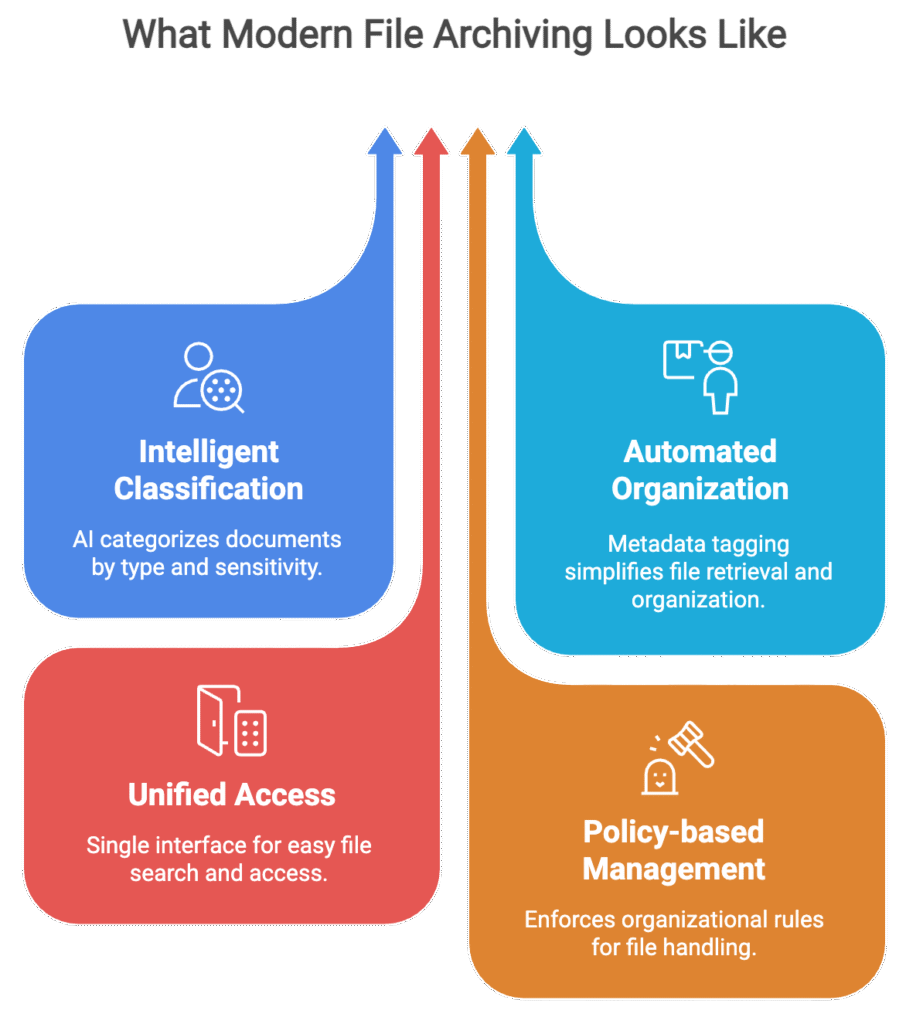
What Modern File Archiving Looks Like
Effective file archiving today goes far beyond simply moving old files to cheaper storage. Modern archiving solutions focus on making data more organized, accessible, and useful throughout its lifecycle.
Building a Practical Strategy
Implementing effective file archiving requires a systematic approach. Start by understanding what you have—conduct an inventory of your major file repositories and estimate their size and growth rate. Identify which files contain sensitive information and which are subject to regulatory requirements.
Next, develop clear policies about file retention, access, and security. Different types of files will have different requirements. Customer records need strict security controls, while general marketing materials might have more relaxed access requirements.
Choose archiving solutions that can grow with your organization and integrate with your existing systems. Look for tools that can automatically classify and organize files rather than requiring manual intervention for every document.
Finally, train your staff on the new processes and make sure they understand how proper file management supports both compliance and business objectives.
The Business Case
Organizations that implement comprehensive file archiving strategies see measurable benefits. They reduce storage costs by eliminating duplicate and obsolete files. They improve security by ensuring sensitive files have appropriate access controls. They enhance compliance by being able to quickly locate and produce required records.
Perhaps most importantly, they position themselves to take advantage of AI technologies that require well-organized, accessible data. As AI becomes more central to business operations, the organizations with the best-organized data will have significant competitive advantages.
File archiving isn’t just about managing storage—it’s about creating a foundation for future innovation and ensuring your organization can adapt to changing technology and regulatory requirements.
The investment in proper file archiving pays dividends in operational efficiency, risk reduction, and future readiness. Organizations that address this challenge proactively will be better positioned for whatever comes next.
Learn more about comprehensive file archiving solutions at https://www.solix.com/products/file-archiving/
