

App Retirement Isn’t Just Switch-Off — It’s Strategy + The Right Solution
Despite the growing shift toward cloud-first strategies — with 85% of organizations expected to embrace the approach (Gartner) — legacy systems still dominate IT landscapes. According to Gartner (2023), about 65% of enterprise applications are now legacy systems, with many organizations dedicating 60–80% of their IT budgets to maintaining them rather than investing in innovation. This heavy spending on maintenance, estimated at over $2.5 trillion globally (IDC) (a figure greater than the GDP of most nations), not only drains resources but also stalls innovation. Clearly, retiring legacy applications isn’t about switching off the application — it demands a thoughtful strategy and the right tools to modernize without disruption.
This blog explores proven strategies for application retirement and key factors for selecting the right retirement solutions, empowering organizations to modernize efficiently and securely.
Strategies for Retiring Applications
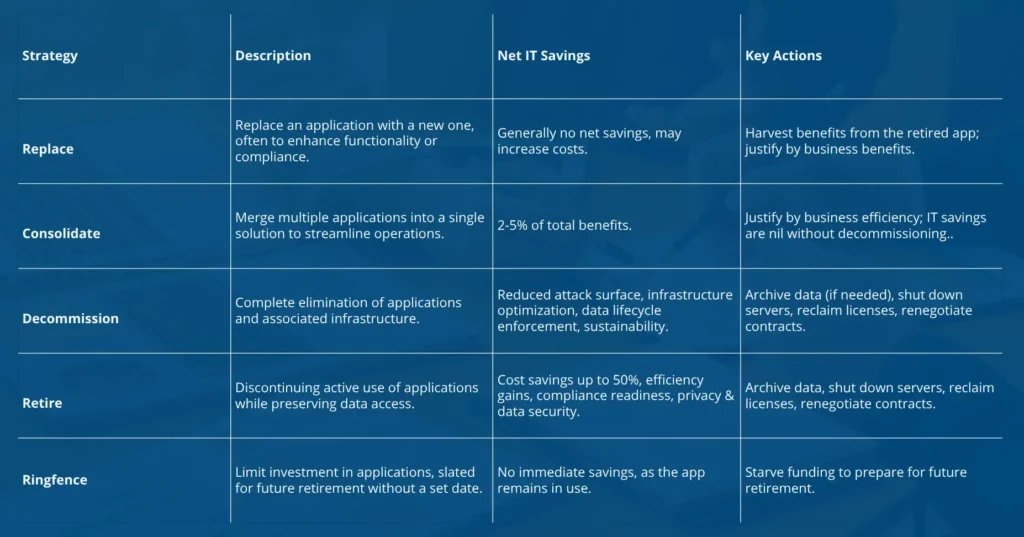
When organizations assess their application portfolios, they often uncover dozens or even hundreds of candidates for retirement. Since retiring them all at once isn’t feasible, a clear strategy is needed to prioritize which applications and associated data should be phased out — and in what order.
Retiring applications require careful planning and the right approach. Below are five key strategies, each suited to different scenarios, to help organizations manage their application portfolios effectively.
According to Gartner’s comprehensive research, successful application decommissioning requires executing three critical tasks:
- Delineate Between Replacement, Decommissioning, or Retirement
Organizations must clearly separate the responsibilities of implementing new applications from decommissioning old ones. This separation prevents the common scenario where new applications go live while old ones remain in use.
- Appoint an Application Undertaker
The application undertaker role demands commitment to the process and diligence, with responsibility for defining policies, procedures, and services related to decommissioning activities. This role is best suited to senior IT managers with solid project management backgrounds.
- Estimate Decommissioning Costs
Cost estimation is challenging because there’s no correlation between the original implementation cost and decommissioning expenses. Organizations must evaluate the cost of ownership, scope, complexity, and dependencies to establish appropriate budgets.
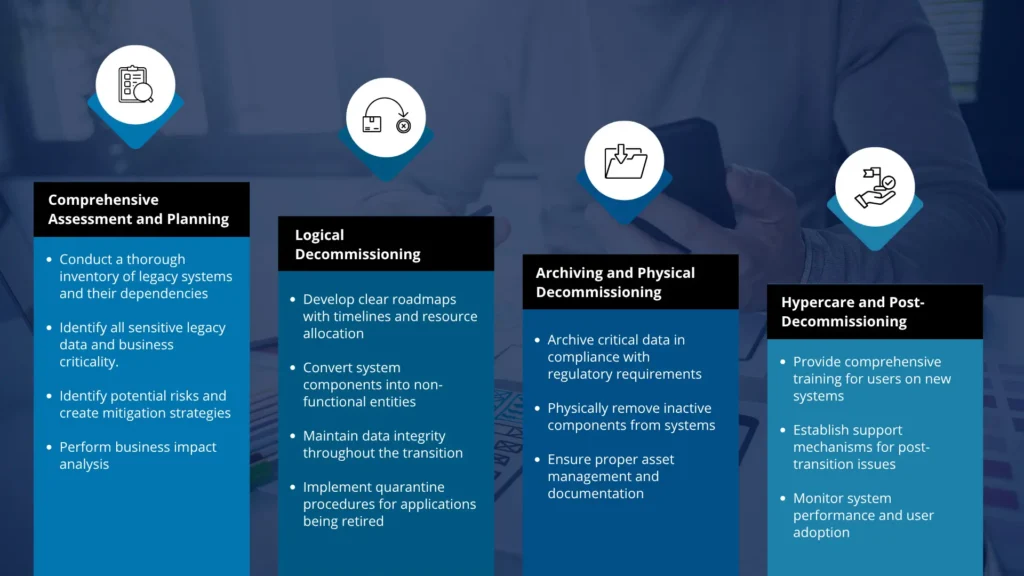
The Four-Phase Decommissioning Framework
Leading organizations implement a systematic four-phase approach:
Selecting Your Application Retirement Solution
Choosing the right solution for application retirement is critical for a smooth and compliant process. Here are key factors to consider when evaluating solutions:
- Data Management Capabilities: The ideal application retirement solution must excel in data extraction, transformation, and loading (ETL) capabilities. Look for platforms that can handle diverse data formats and maintain referential integrity during migration. The solution should support transformation to application-neutral formats like XML for future-proofing.
- Integration Architecture: Modern retirement solutions should provide robust API capabilities and a microservices architecture to minimize disruption to existing systems. The platform should support middleware solutions that bridge legacy systems and modern applications.
- Compliance and Security Features: Given the regulatory landscape, retirement solutions must include built-in compliance capabilities for GDPR, HIPAA, SOX, and industry-specific regulations. Essential features include encryption, access controls, audit trails, and legal hold capabilities.
- Scalability and Performance: Evaluate vendors based on their ability to handle enterprise-scale data volumes and complex system interdependencies. The solution should demonstrate proven performance with organizations managing hundreds of applications simultaneously.
- Service and Support Model: Look for vendors offering comprehensive service models, including assessment, migration, and ongoing support. Solix’s Application Retirement Factory approach using near-shore and off-shore staffing helps achieve velocity and scale, demonstrating the importance of service delivery capabilities.
- Technology Standards Compliance: Ensure the solution adheres to industry standards for long-term data preservation and maintains a chain of custody for archived information. The platform should support standards-based formats for future accessibility.
- Phased Rollout Strategy: Implement retirement solutions using a phased approach, starting with less critical applications to validate processes and build organizational confidence. This incremental strategy minimizes risk while building expertise.
- AI Enablement: Pre-retirement, AI can assist in identifying retirement candidates by analyzing usage, dependencies, and risk. Post-retirement, AI can unlock insights from archived data. Real-time AI capabilities can support anomaly detection, data classification, validation, and compliance monitoring during migration and access.
While retiring an application, it’s essential to evaluate specific data retention requirements. Even when the application is no longer active, certain data elements—such as transaction records, customer history, or audit logs—may still need to be retained for compliance, reference, or legal purposes. In such cases, organizations must ensure that this historical data remains accessible in a secure, searchable format.
Solix Application Retirement ensures your historical data secure, searchable, and accessible—enabling self-service access and data intelligence through powerful text search, queries, and EBR templates.
Additionally, leveraging platform like Solix Application Retirement can help consolidate and preserve this legacy data in one central repository—creating a foundation for downstream AI platforms to analyze, extract insights, and support intelligent decision-making from historical trends.
Bottom Line
Retiring legacy applications is a critical step toward modernizing IT infrastructure, reducing costs, and enhancing data security. By employing strategies like replace, consolidate, decommission, retirement, or ringfence, and selecting solutions that prioritize data handling, compliance, and efficiency, organizations can navigate this process successfully. For deeper insights, explore our previous blogs: “Application Retirement vs. Application Decommissioning” and “The What, Why, and When of Application Retirement: Eligibility Frameworks and Drivers Explained.“
Learn more:
Discover how Solix simplifies decommissioning while ensuring secure, compliant, and cost-effective data retention. The whitepaper “How the Solix Application Retirement Solution Leads the Way” explores the SOLIX Approach, key capabilities, unmatched benefits, and customer success stories. Read the whitepaper now: SOLIXCloud Application Retirement | Retire Apps, Cut Costs