
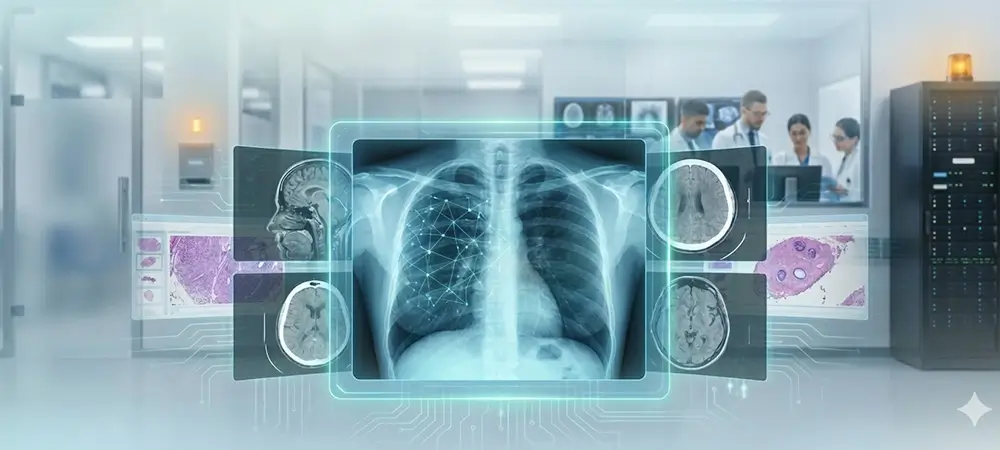
AI-enabled Medical Image Interpretation in Regulated Healthcare Environments
Problem Overview
AI-enabled medical image interpretation refers to the application of machine learning and generative AI techniques to assist clinicians in analyzing diagnostic imaging studies. The increasing volume and complexity of medical imaging data has created structural strain across radiology and diagnostic workflows. Imaging specialists must interpret large numbers of studies under time pressure, often within constrained staffing environments, while maintaining diagnostic accuracy and regulatory compliance.
The challenge is not solely algorithmic performance, but the ability to operationalize AI safely within existing clinical, data, and governance frameworks. Without careful integration, AI-enabled image interpretation can introduce workflow disruption, trust gaps, and compliance exposure rather than measurable clinical benefit.
Mention of any research source, technology category, or solution type is for descriptive context only and does not constitute endorsement, recommendation, or validation of efficacy, security, or regulatory suitability.
Key Takeaways
- Medical imaging has become one of the most data-intensive domains within healthcare delivery.
- AI-enabled interpretation is primarily adopted to improve diagnostic timeliness, workflow prioritization, and clinician sustainability.
- Operational success depends as much on data readiness and governance as on model accuracy.
- Trust, validation, and regulatory alignment remain central adoption constraints.
- AI functions as a clinical augmentation layer, not a replacement for medical judgment.
Drivers of Adoption
- Rising diagnostic complexity across modalities such as X-ray, CT, MRI, ultrasound, and digital pathology.
- Operational backlogs caused by increased imaging demand and specialist shortages.
- Clinician burnout associated with repetitive reads and manual prioritization.
- Pressure to improve diagnostic consistency and reduce time-to-intervention.
Enumerated Capability Areas
- Abnormality detection and flagging of high-risk findings.
- Worklist prioritization to accelerate urgent case review.
- Differential diagnosis support using pattern recognition.
- Image enhancement, segmentation, and synthesis for clinical and research use.
Comparison Table
| Capability Area | Clinical Impact | Workflow Dependency | Governance Sensitivity | Regulatory Exposure |
|---|---|---|---|---|
| Abnormality Detection | High | Medium | High | High |
| Worklist Prioritization | Medium | High | Medium | Medium |
| Image Enhancement | Medium | Low | Medium | Low |
| Generative Interpretation Support | Emerging | Medium | High | High |
Integration Layer
The integration layer enables ingestion of imaging metadata and study outputs from PACS, modality systems, and downstream analytics environments. Identifiers such as study_id, modality_type, and exam_timestamp support consistent linkage across systems.
Integration stability is a prerequisite for AI-assisted interpretation, as fragmented data pipelines can distort prioritization logic and undermine clinical confidence in AI outputs.
Governance Layer
Governance ensures that AI-enabled interpretation operates within defined clinical, legal, and ethical boundaries. This includes lineage tracking through attributes such as lineage_id, quality indicators like QC_flag, and version controls such as model_version.
Clear provenance and auditability are critical for regulatory review, incident investigation, and clinician trust, particularly when AI contributes to diagnostic decision support.
Workflow & Analytics Layer
Workflow orchestration determines how AI insights are surfaced within clinical reading environments. Analytics layers evaluate performance metrics such as detection accuracy, false-positive rates, and turnaround time.
Misalignment between AI outputs and clinical workflows is a common failure mode, even when underlying models demonstrate high technical performance.
Security and Compliance Considerations
AI-enabled medical imaging expands the healthcare cyberattack surface and introduces additional data privacy considerations. Imaging data may contain embedded or residual patient identifiers, requiring robust de-identification and access controls.
Compliance obligations vary by jurisdiction and may include software-as-a-medical-device classification, data residency requirements, and audit readiness for AI-assisted workflows.
Decision Framework
Evaluation of AI-enabled medical image interpretation should consider clinical value, workflow impact, governance maturity, and long-term operational sustainability. Isolated accuracy metrics are insufficient without supporting data and process controls.
Operational Scope and Context
Within regulated healthcare environments, AI-enabled image interpretation is typically framed as an augmentation layer integrated into existing diagnostic workflows, rather than a standalone analytical system.
Concept Glossary
- Data Lineage: Traceable record of data origin, transformation, and downstream usage.
- Clinical Augmentation: AI-supported enhancement of clinician decision-making.
- Workflow Orchestration: Coordination of data and insight delivery across systems.
- Model Validation: Continuous evaluation of AI performance within real-world settings.
Operational Landscape Expert Context
In practice, AI-enabled medical image initiatives most often stall not due to insufficient model accuracy, but due to misalignment between data governance controls and clinical workflow realities. Latent friction frequently emerges at handoff points where AI outputs must be trusted, explained, and operationalized by clinicians under time pressure.
Safety and Neutrality Notice
This content is informational only. It does not define clinical guidance, regulatory requirements, or operational standards. Applicability must be evaluated independently within appropriate clinical, legal, and organizational frameworks.
Reference
Source: Gartner Research (2025)
Context Note: Included for descriptive industry context. This reference does not imply endorsement, validation, or applicability to any specific clinical or operational implementation.

Related Posts

Shadow AI in Healthcare: When Unvetted Tools Access Patient Data Without Oversight

HIPAA Compliant Backup: The Data Protection Requirements Healthcare Organizations Routinely Underestimate