Open-Source vs. Proprietary Data Analysis Tools
Key Takeaways
- Open-source data analysis tools offer flexibility and cost efficiency but require strong governance.
- Proprietary tools deliver usability, support, and compliance features at a higher cost.
- Most enterprises ultimately adopt a hybrid model combining both.
- Data governance, lineage, and auditability matter more than the tool itself.
Why This Decision Matters More Than Ever
Enterprises today are under pressure to extract value from data faster while meeting stricter regulatory, security, and AI governance requirements. Choosing between open-source and proprietary data analysis tools is no longer just a cost decision. It directly impacts scalability, compliance, operational risk, and long-term AI readiness.
In regulated industries like financial services, healthcare, life sciences, and the public sector, data analysis platforms must support not only insight generation but also defensible governance.
What Are Open-Source Data Analysis Tools?
Open-source data analysis tools are platforms whose source code is publicly available and community maintained. They are widely adopted for their flexibility, extensibility, and lack of licensing fees.
Common examples include tools such as for large-scale processing, libraries for analytics, and visualization frameworks like:
Strengths of Open-Source Tools
- No or low licensing costs
- High customization and extensibility
- Strong innovation driven by global communities
- Vendor independence
Limitations to Consider
- Requires in-house expertise to operate at scale
- Limited native governance and compliance features
- Fragmented support and accountability
What Are Proprietary Data Analysis Tools?
Proprietary tools are commercially developed platforms that provide integrated analytics, visualization, governance, and support under a licensed model. These tools are designed for enterprise adoption with usability and risk reduction in mind.
Examples include platforms such as
Strengths of Proprietary Tools
- Enterprise-grade support and SLAs
- Built-in security, role-based access, and auditing
- Lower learning curve for business users
- Clear accountability and vendor roadmap
Limitations to Consider
- Higher licensing and subscription costs
- Vendor lock-in risks
- Limited customization compared to open-source
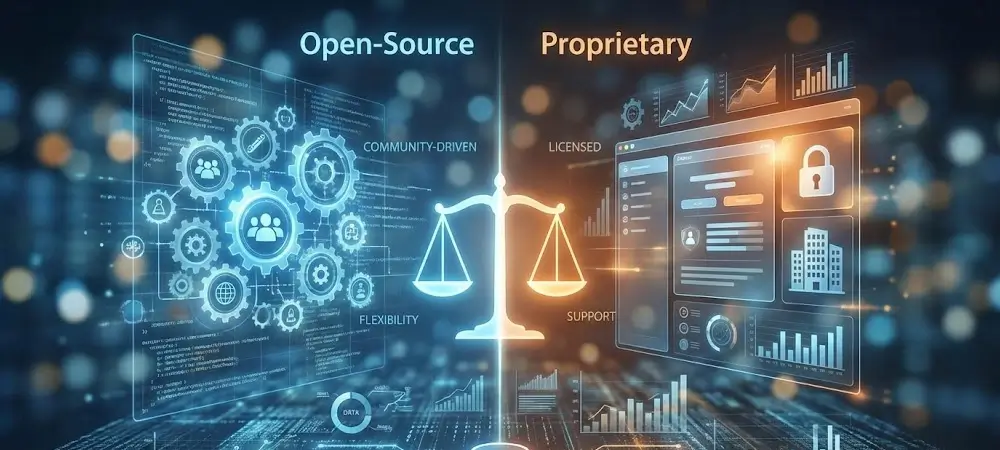
Open-Source vs. Proprietary: Side-by-Side Comparison
| Dimension | Open-Source | Proprietary |
|---|---|---|
| Cost | Low licensing, higher operational cost | Higher licensing, predictable spend |
| Governance | Requires external frameworks | Often built-in |
| Scalability | Highly scalable with expertise | Scales with vendor architecture |
| Compliance | Manual and process-driven | Tool-enforced controls |
| AI Readiness | Flexible but fragmented | Integrated but opinionated |
A Practitioner Insight
In multiple enterprise engagements, we have seen analytics initiatives stall not because of poor tools, but because no one could prove where data came from, how it was transformed, or who accessed it. In one financial services organization, an analytics dashboard was pulled from production during an audit simply because lineage documentation could not be produced within 48 hours.
This is why governance, metadata, and lifecycle management matter as much as the analytics layer itself.
Where Solix Fits in This Decision
Solix does not replace analytics tools. Instead, Solix provides the governed data foundation that makes both open-source and proprietary analytics platforms trustworthy at scale.
By unifying data archiving, retention, metadata management, and policy-driven access, Solix enables enterprises to:
- Run open-source analytics with enterprise-grade governance
- Reduce risk in proprietary BI environments
- Support regulatory requirements such as GDPR, HIPAA, SEC 17a-4, and SOX
- Prepare clean, auditable datasets for AI and machine learning
Frequently Asked Questions
Is open-source always cheaper than proprietary tools?
Not always. While licensing costs are lower, staffing, integration, and governance can increase total cost of ownership.
Do proprietary tools guarantee compliance?
No. They provide controls, but compliance still depends on data quality, policies, and organizational discipline.
Which option is better for AI analytics?
AI success depends more on governed, high-quality data than on the analytics tool itself. Both approaches can support AI if the data foundation is sound.