

Tools Automate. Platforms Compound.
Why Architecture — and Anatomy — Beat a Pile of Point Solutions in Pharma AI
Every pharma R&D organization now owns more AI tools than it did three years ago — and, by most internal accounts, less clarity about what any of them are learning together.
That paradox is the subject of a two-part series by Patrick Grady on Unvarnished. In “On Platforms I: What They Are And Why They Matter,” Grady argues that tools are tactical while platforms are architectural: tools accelerate a task, platforms accelerate understanding; tools reduce the cost of execution, platforms reduce the cost of complexity. In the follow-up, “On Platforms II: The Five-Layer Anatomy That Turns Chaos Into Coherence,” he goes a step further — architecture alone does not make a platform operational. “A platform without anatomy,” he writes, “is a body without organs — conceptually unified, but incapable of perception, action, or learning.” For a data-drenched, high-stakes field like drug discovery, that distinction between having a platform and merely calling something one is the difference between AI that compounds and AI that quietly decays into another expensive pilot.
The Industry Has a Tools Problem, Not a Talent Problem
Biopharma has never lacked for algorithms. McKinsey’s 2022 analysis of AI in biopharma research split the vendor landscape into two camps: point-solution providers selling AI as a service, and platform-native players building AI directly into an integrated drug development pipeline. McKinsey’s conclusion was blunt — progress has been throttled less by model quality than by the industry’s habit of funding marquee pilots and one-off capability builds instead of coordinated, at-scale research systems.
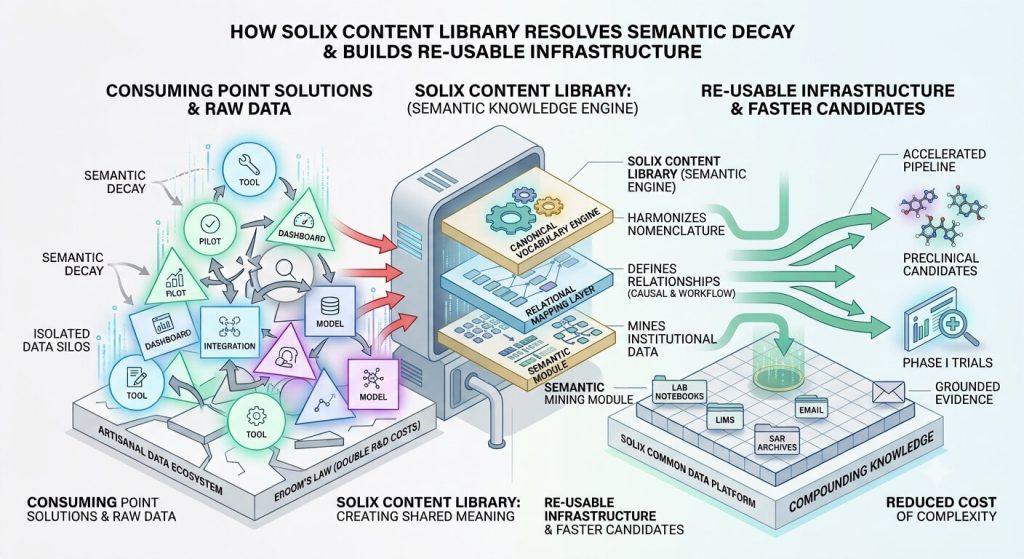
Grady would call this “architectural drift.” His diagnosis: institutions keep bolting new dashboards, integrations, and point automations onto a data model that was already wrong, rather than fixing the model itself. Nowhere is this more visible than in life sciences, where exponential gains in biology and compute have collided with what he calls an “artisanal data ecosystem” — producing not compounding knowledge but Eroom’s Law, the grim mirror image of Moore’s Law: the cost of bringing a new drug to market has roughly doubled every nine years even as computational power has exploded.
Why a Stack of Tools Cannot Fix a Broken Substrate
More than 90 percent of discovery programs never reach an IND. Roughly 70 percent of Phase II trials fail. The average cost per approved drug now sits near $2.6 billion (DiMasi et al., 2016). And the highest-signal data the industry generates — why a specific compound failed, which target program hit a wall, which trial protocol was undone by patient selection — is scattered across lab notebooks, LIMS systems, SAR archives, and email threads, never systematically mined. That is not a tooling gap. It is what Grady’s first essay calls semantic decay: the slow erosion of shared meaning as definitions diverge, workflows fork, and individuals end up holding more context than the systems do.
The Five-Layer Anatomy, Applied to Drug Discovery
Essay II gives that diagnosis a precise structure. Grady describes five layers that must exist in strict, dependent order — schema (structure of ingest), taxonomy (structure of vocabulary), workflow expertise (structure of context), ontology (structure of meaning), and intelligence (structure of learning). Each layer refines the one beneath it; skip one, or build them out of sequence, and the system doesn’t merely underperform, it fails in a specific, predictable way.
Pharma R&D supplies textbook cases of each failure mode. Schema without taxonomy produces what Grady calls “unnamable noise” — vast archives of omics, imaging, and assay results with no stable identity, so nothing aggregates cleanly across a portfolio. Taxonomy without ontology is the industry’s harmonized-vocabulary trap: two labs may agree on a compound’s name yet still be unable to explain why one program hit a toxicity cliff and the other didn’t, because naming things consistently is not the same as modeling how they relate, behave, and cause. Workflow without ontology produces what Grady terms “automated absurdity” — a fail-fast pipeline that fires cleanly through its steps with no binding sense of why a deviation at one stage should invalidate a conclusion three stages later. And intelligence layered atop any of this without grounding is the mechanism behind the industry’s AI pilot purgatory: models that hallucinate not because they are flawed, but because, in Grady’s words, they were “built on incoherence.”
Where Solix EAI Pharma Builds the Anatomy, Not Just the Architecture
This is the thesis behind Solix EAI Pharma: the five layers built natively as one system, in the order anatomy requires, rather than bolted together as disconnected tools.
Schema. Solix ingests the full spectrum of pharmaceutical dark data — electronic lab notebooks, LIMS databases, SAR archives, clinical study reports, regulatory filings, even the email trails behind program termination decisions — as typed, provenance-preserving primitives with lineage traced back to the source experiment. This is the precondition, in Grady’s terms, for the domain to become perceptible at all.
Taxonomy. The Solix Semantic Content Library performs the compression Grady describes: collapsing vendor-specific assay labels, multiple names for the same compound across programs, and inconsistent target nomenclature into a canonical vocabulary, so a query means the same thing whether it runs against this year’s data or five years of archived programs.
Workflow expertise. The modular, fail-fast AI/ML pipeline is not automation for its own sake; it encodes the tacit procedural knowledge of the domain — assay methodology, ADMET tolerances, the conditions under which a hit is real versus artifact — so the platform understands how a result was produced, not only what the result says.
Ontology. A governed AI layer binds compound, target, assay, and outcome into an actual causal structure, which is what lets a scientist ask why a specific program failed and receive an evidence-grounded answer sourced from the organization’s own historical records, rather than a plausible-sounding guess.
Intelligence. The explainable AI models and quantum-informed molecular property predictions close the loop: every new experiment, successful or failed, refines the schema, sharpens the taxonomy, updates workflow constraints, and strengthens the ontology beneath it. That recursive loop is what has compressed preclinical timelines from four-to-six years down to months and cut preclinical costs 2-3x in early deployments — gains that come from the anatomy compounding, not from any single model getting smarter in isolation.
Notably, none of this anatomy had to be built from a blank slate for life sciences. Solix EAI Pharma comes by default with the governance and federation backbone of Solix’s underlying Common Data Platform and Enterprise AI product line — federated data governance across regulated industries, sensitive data discovery and masking, and a zero-copy architecture that avoids re-ingesting or duplicating data as it moves between systems. That inheritance matters structurally, not just commercially. A schema and ontology layer that has already governed data across banking, healthcare, and insurance is a materially different claim than one built and tested for the first time on a single vertical. Anatomy that has generalized across domains has been stress-tested; anatomy built bespoke for one use case is still a hypothesis.
This pattern is not unique to Solix. McKinsey’s look at biopharma R&D redesign points to Recursion Pharmaceuticals as a live example of the same recursion — a closed-loop system unifying phenomics, omics, AI-driven chemistry, and clinical intelligence, where wet-lab results continuously retrain the models that design the next round of experiments, cutting target-to-clinical-candidate timelines to under a year. A parallel review of AI as pharma’s scientific infrastructure reaches the same conclusion from the other direction: the organizations extracting the most value from AI are not the ones with the most sophisticated individual models, but the ones that have built integrated platforms connecting data, compute, algorithms, and domain expertise into reusable infrastructure — anatomy, in other words, not just architecture.
Anatomy as Declaration
“An institution’s anatomy reveals its ambition,” Grady writes at the close of his second essay. “An incomplete anatomy reveals its fate.” For pharma organizations deciding where to place their next AI investment, the real question is no longer whether a vendor calls its product a platform. It is whether the five layers — schema, taxonomy, workflow expertise, ontology, and intelligence — exist natively, in the right order, doing the recursive work only anatomy can do. “AI will accelerate whichever architecture it is placed upon,” as Grady puts it, “which makes the architectural choice itself the most consequential decision an institution can make.” Funding another isolated tool amplifies today’s fragmentation. Funding the anatomy turns every experiment — successful or failed — into compounding institutional intelligence. Only one of those choices scales.
References
- Grady, P. “On Platforms I: What They Are And Why They Matter.” Unvarnished (Substack).
- Grady, P. “On Platforms II: The Five-Layer Anatomy That Turns Chaos Into Coherence.” Unvarnished (Substack).
- McKinsey & Company. “AI in biopharma research: A time to focus and scale.” October 2022.
- McKinsey & Company / BioSpace. “Biopharma R&D needs ‘structural redesign’ to maximize AI impact.” 2026.
- DiMasi, J.A. et al. “Innovation in the pharmaceutical industry: New estimates of R&D costs.” Journal of Health Economics, 2016.
- Sakara Digital. “AI as Scientific Infrastructure in Pharma.” arXiv:2512.21623.