AI Data Governance: Definition, Importance, and Best Practices
AI Data Governance is the framework of policies, procedures, and technologies that ensure the data used by artificial intelligence systems is managed responsibly throughout its lifecycle. It encompasses the practices for guaranteeing data quality, security, privacy, fairness, and compliance specifically for AI model training, deployment, and monitoring. Effective AI Data Governance is critical for building reliable, ethical, and high-performing AI solutions that mitigate risk and drive business value.
What is AI Data Governance?
While traditional data governance focuses on establishing general rules for an organization’s data assets, AI Data Governance is a specialized discipline that addresses the unique challenges posed by artificial intelligence and machine learning. AI systems are entirely dependent on data; their outputs, fairness, and performance are direct reflections of the data they consume. Therefore, AI Data Governance goes beyond simply managing data as a static asset. It involves active stewardship of the data throughout the entire AI lifecycle, from initial collection and preparation to model training, inference, and ongoing feedback loops.
This framework ensures that the data fueling AI initiatives is accurate, consistent, and relevant. It mandates strict protocols for data security to prevent breaches and for data privacy to comply with regulations like GDPR and CCPA. Crucially, it also focuses on ethical dimensions, such as identifying and mitigating biases within training datasets that could lead to discriminatory or unfair AI outcomes. In essence, AI Data Governance is the essential guardrail that allows organizations to innovate with AI confidently, ensuring their models are not only powerful but also principled and trustworthy.
Why is AI Data Governance Important?
Implementing a robust AI Data Governance framework is not an optional IT project; it is a foundational business imperative for any organization leveraging artificial intelligence. The risks of ungoverned AI are significant, ranging from reputational damage and financial loss to legal penalties and operational failure. A strong governance program directly mitigates these risks while unlocking the full potential of AI investments.
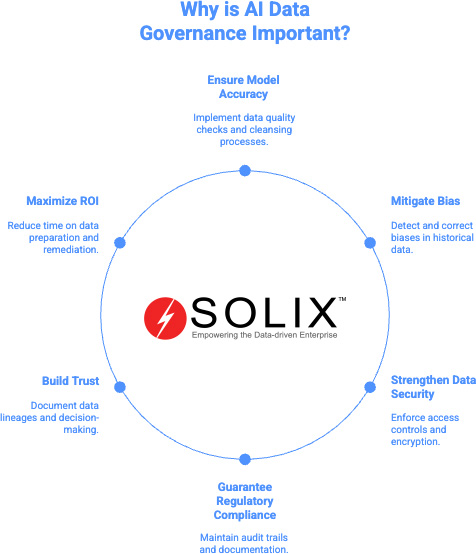
- Ensures Model Accuracy and Reliability: AI models trained on poor-quality, incomplete, or inconsistent data will produce flawed and unreliable outputs. Governance enforces data quality checks and cleansing processes, leading to more accurate predictions and insights.
- Mitigates Bias and Promotes Fairness: Historical data often contains inherent biases. AI Data Governance processes help detect, measure, and correct these biases to prevent AI systems from perpetuating or amplifying discrimination, ensuring fair treatment for all users.
- Strengthens Data Security and Privacy: AI systems often process vast amounts of sensitive information. Governance policies enforce access controls, encryption, and anonymization techniques to protect this data from unauthorized access and breaches, maintaining customer trust.
- Guarantees Regulatory Compliance: With evolving global regulations focused on AI ethics and data protection (like the EU AI Act), a governance framework provides the audit trails, documentation, and controls needed to demonstrate compliance and avoid hefty fines.
- Builds Organizational Trust and Transparency: Governed AI is explainable AI. By documenting data lineages and model decision-making processes, organizations can build trust with customers, stakeholders, and regulators, showing that their AI operates transparently and accountably.
- Maximizes ROI on AI Initiatives: Well-governed data reduces the time spent on data preparation and model remediation. It leads to more successful AI projects that deliver tangible business value, thereby maximizing the return on investment in AI technologies.
Challenges and Best Practices for Businesses
Transitioning from understanding the importance of AI Data Governance to its practical implementation presents several hurdles. Recognizing these challenges is the first step toward overcoming them with proven best practices.
Common Challenges:
- Data Silos and Fragmentation: AI-relevant data is often locked in disparate systems across the organization, making it difficult to get a unified, high-quality view for model training.
- Scale and Complexity of Data: The volume, velocity, and variety of data required for AI can overwhelm manual governance processes, leading to bottlenecks and inconsistencies.
- Identifying and Measuring Bias: Bias in data is often subtle and systemic. Without the right tools, it is incredibly challenging to detect, quantify, and remediate these biases before they are codified into AI models.
- The Explainability Gap: Many complex AI models, like deep learning networks, operate as “black boxes,” making it difficult to explain why a specific decision was made, which conflicts with regulatory and transparency requirements.
- Evolving Regulatory Landscape: Keeping pace with new and emerging AI-specific regulations across different regions and industries requires constant vigilance and adaptable governance frameworks.
Essential Best Practices:
- Start with a Framework: Do not start from scratch. Adopt or customize an established governance framework that aligns with your industry and risk tolerance.
- Establish a Cross-Functional Council: AI Governance cannot be an IT-only initiative. Form a council with members from legal, compliance, ethics, security, and business units to create balanced and enforceable policies.
- Prioritize Data Quality and Lineage: Implement automated tools to profile, cleanse, and document the lineage of data used in AI models. Knowing the origin and journey of your data is foundational to trust.
- Integrate Governance into the AI Lifecycle: Governance should not be a final checkpoint. Embed governance controls and checks into every stage of the AI lifecycle, from data ingestion to model deployment and monitoring.
- Invest in Specialized Tools: Leverage a unified platform designed for AI Data Governance to automate policy enforcement, bias detection, and lineage tracking at scale, reducing manual effort and human error.
How Solix Helps You Implement a Robust AI Data Governance Framework
Navigating the complexities of AI Data Governance requires more than just policy documents; it demands an integrated technology platform designed to enforce governance principles at scale. This is where Solix Technologies establishes its leadership. As a pioneer in cloud data management, Solix provides the foundational infrastructure necessary to build, manage, and scale trustworthy AI systems. Our expertise in structuring unstructured data lakes, ensuring data quality, and enforcing compliance makes us an indispensable partner in your AI journey.
Solix helps organizations transition from theory to practice by offering a comprehensive suite of tools that operationalize AI Data Governance:
- Solix empowers your organization with a unified platform to discover, classify, and secure all the data destined for your AI models. We understand that AI data is often scattered across on-premises systems and multiple cloud environments. Our solutions provide a single source of truth, enabling you to gain complete visibility and control over your data estate.
- With Solix, you can automate data quality and profiling processes, ensuring that only fit-for-purpose data is used to train your machine learning models. This directly enhances model accuracy and reduces the risk of “garbage in, garbage out” scenarios that plague AI projects.
- Our robust data security and privacy features, including sensitive data identification, masking, and tokenization, are built into the data pipeline. This allows you to innovate with AI while confidently protecting personal identifiable information (PII) and complying with stringent data protection laws.
- Solix simplifies the creation of a clear data lineage, mapping the journey of data from its origin to its consumption by an AI model. This transparency is crucial for debugging models, explaining AI-driven decisions to regulators, and building the audit trails required for compliance with emerging AI standards.
By choosing Solix, you are not just using the software; you are partnering with an expert in data management who can guide you in establishing a future-proof AI Data Governance strategy. We provide the enterprise-grade foundation that allows your data scientists and AI engineers to focus on innovation, secure in the knowledge that their work is built upon a governed, secure, and reliable data base.
Learn more about how Solix can be the cornerstone of your AI success by exploring our enterprise data lake and data privacy solutions.
Frequently Asked Questions (FAQs) about AI Data Governance
What is the difference between data governance and AI data governance?
Traditional data governance manages data as a corporate asset for general use, focusing on quality, security, and availability. AI Data Governance is a specialized subset that applies these principles specifically to the data used for training, testing, and operating AI models, with added emphasis on ethics, bias mitigation, and model-specific data lineage.
What are the key components of an AI data governance framework?
Key components include defined data quality standards, protocols for bias detection and fairness, robust data security and privacy controls, clear data lineage tracking, roles and responsibilities (like data stewards), and ongoing monitoring for model and data drift.
Why is data quality critical for AI and machine learning?
Data quality is the single most important factor in AI performance. Models learn patterns directly from data; if the data is inaccurate, incomplete, or inconsistent, the model’s predictions and outputs will be flawed and unreliable, leading to poor business decisions.
How does AI Data Governance help prevent AI bias?
Governance frameworks enforce processes to screen training datasets for historical biases related to race, gender, or other protected classes. It mandates the use of diverse datasets and techniques to balance data, thereby reducing the risk of the AI model making unfair or discriminatory decisions.
What role does data lineage play in AI governance?
Data lineage provides a complete, auditable trail of where data originated, how it was transformed, and which AI models used it. This is vital for model transparency, debugging errors, understanding model outcomes, and proving compliance to auditors.
How can I start implementing AI Data Governance in my organization?
Begin by identifying all data sources used for AI projects. Establish a cross-functional team, define initial data quality and ethical AI principles, and invest in a data management platform that can automate discovery, classification, and policy enforcement.
What are the consequences of poor AI Data Governance?
Consequences include inaccurate AI models that lead to bad business outcomes, regulatory fines for non-compliance, data breaches, reputational damage from biased AI, and ultimately, a failed AI strategy and wasted investment.
How does Solix Technologies support AI Data Governance?
Solix provides a comprehensive cloud data management platform that helps organizations discover, classify, secure, and govern all their structured and unstructured data. Our solutions enforce data quality, privacy, and lineage, being the core pillars of a strong AI Data Governance framework on a single, unified platform.