Data Obfuscation, Honestly: What Masking Actually Hides — and Why That's the Risk
Figure 1. Data Obfuscation Failure: The Loudest System Is Not Always the Root Cause. The reidentification is the symptom; The unaudited masking choice is the failure.
The test environment looks fine.
The data is masked.
The compliance check passed.
But the masked data is producing real results in QA.
That is the entire opening of every real data obfuscation incident I have lived through. Not a definition. Not a diagram. A wrongness that won't show up on a dashboard until you go looking for it on purpose.
This page is for the engineer who is already there.
What this actually feels like at the keyboard
I did not see a giant outage first; I saw sqlcode-first in the job log and assumed it was my normal embedded SQL errors problem. Then commands fail after the caller already moved on, and the timeline stopped matching the system I was staring at. I reached for the safe operational fix before the full picture was clear. I would try to stabilize the enterprise mainframe environment, but the ugly part is that a bad API caller can make my local evidence look guilty even when it is only absorbing the leak.
That last sentence is the whole problem. Data Obfuscation fails in a shape where the metric you can read is honest about itself and misleading about the incident. The signal is real. The pain is real. The cause of the pain is somewhere else.
The wrong assumption I'd make first
"It's a test data refresh issue. Reseed and rerun."
That's the assumption I'd reach for, because it's the one I'm fastest at fixing. Embedded sql errors has a known playbook — inspect the spooled output, isolate the failing query, refresh the test data. So I'd run the playbook. The graph would settle for an hour. I'd close the incident.
That hour of quiet is the misdiagnosis.
The partial signal — what the logs actually show
SQL Developer sees the familiar embedded SQL errors pattern, then notices the timing does not line up with the local failure.
That phrase — no single owner looks guilty — is the most honest sentence anyone has written about data obfuscation. Because the way these systems get built, every component that touches the data has plausible deniability. Each system passes its own self-check. The failure lives in the gap between the self-checks.
The fix I'd try first — and why it doesn't hold
Stabilize the enterprise mainframe environment first — cap retries, clear stuck work, or narrow the failing path — while proving whether a bad API caller is feeding the leak.
That's a real playbook. It's also where most data obfuscation failures get hidden. The local fix works for the next four hours. Then the next breach happens, and the team thinks they have a "embedded SQL errors" problem when they actually have a "the obfuscation algorithm preserves enough structure to reidentify the data downstream" problem. According to Gartner research, this pattern is one of the most under-recognized drivers of tdm / masking cost across enterprise stacks.
Why it's actually hard
The failure is not cleanly owned. SQL Developer can fix the visible symptom and still leave the leak alive somewhere else.
This is the entire degree of difficulty. Not the technology. Not the configuration. The hard part is that the system most equipped to show the problem is rarely the system that caused it. It's the system honest enough to complain. The cause lives one or two hops upstream — in a masking choice that preserved referential integrity at the cost of plausible-deniability anonymization — and nobody noticed because each individual component was inside its own SLO.
What clean would look like (so you know when you're lying to yourself)
Clean means SQL Developer can explain the chain from trigger to symptom without hand-waving across other platforms.
If your "fix" makes the failure migrate to a different system, you didn't fix it. You moved it. Apply this test after every data obfuscation incident. If the answer is "the failure moved," your post-incident action items are wrong.
How this gets misdiagnosed
The worst version is when the first fix partly works, because that convinces everyone the wrong component was the root cause.
That sentence is the entire reason this page exists. Engineers who debug data obfuscation well are not the ones who know the most about data obfuscation. They're the ones who have learned to not trust the silence. The dashboard going green is data, not victory. The first fix working is information about the symptom, not proof of the cause.
NOW — what data obfuscation actually is
Data obfuscation is the transformation of sensitive values into non-sensitive equivalents, while preserving enough structure for downstream systems to function. Masking, tokenization, and synthetic generation are forms of it. The contract is: the obfuscated data is functionally usable but cannot be reidentified.
Most data obfuscation failures are violations of that contract caused by something upstream of it. The system didn't fail. The system reported truthfully. The truth was contaminated.
Where Solix fits — honestly
Solix's Test Data Management platform makes the obfuscation choice an explicit, audited policy rather than an ad-hoc decision per engineer per project. It pins masking rules to the data classification, not to the test environment, so the obfuscation contract holds across systems.
What to do this week, if any of this sounded familiar
- Take a masked dataset. Try to reidentify one record using only the patterns in the data itself. How long does it take?
- Audit which masking algorithm each system uses. If the answer varies by team, you have a contract gap.
- Decide whether your obfuscation is protection or aesthetics. The compliance auditor will decide for you.
If the answer is yes to any of these — that's where Solix lives.
Sources cited
What you can do with Solix

Enter to win a $100 Amex Gift Card
Related Resources
Explore related resources to gain deeper insights, helpful guides, and expert tips for your ongoing success.
-
 eBook
eBookA Guide to Data Security and Data Privacy in Non-Production and Analytical Environments
Download eBook -
 Datasheet
Protect Sensitive Data Across all Non-Production and Analytics Environments
Download Datasheet -
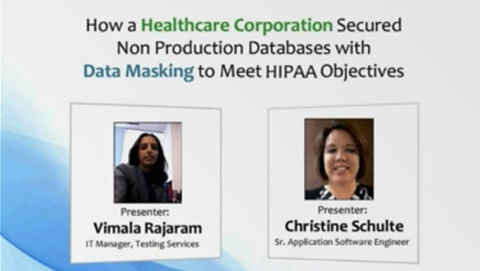 On-Demand Webinar
How a Healthcare Corporation Secured Non Production Databases with Data Masking to Meet HIPAA Objectives
Watch On-Demand Webinar
Why SOLIXCloud
SOLIXCloud offers scalable, secure, and compliant cloud archiving that optimizes costs, boosts performance, and ensures data governance.
-

Common Data Platform
Unified archive for structured, unstructured and semi-structured data.
-

Reduce Risk
Policy driven archiving and data retention
-

Continuous Support
Solix offers world-class support from experts 24/7 to meet your data management needs.
-

On-demand AI
Elastic offering to scale storage and support with your project
-

Fully Managed
Software as-a-service offering
-

Secure & Compliant
Comprehensive Data Governance
-

Free to Start
Pay-as-you-go monthly subscription so you only purchase what you need.
-

End-User Friendly
End-user data access with flexibility for format options.