AI Data Integration uses artificial intelligence (AI) and machine learning (ML) to combine data from different sources. It automates the tasks of finding, cleaning, and connecting data. This prepares the data for analysis, business intelligence, and AI models.
What is AI Data Integration?
Traditional data integration needs a lot of manual work. IT teams write complex code to connect data from systems like CRM and ERP. This method is slow, rigid, and struggles with modern data’s large volume and variety.
AI Data Integration is a fundamental shift. It adds intelligence to the entire data process. Machine learning automates the most time-consuming tasks. These smart systems can find data sources on their own. They can understand data structure and quality. They can also suggest how to connect different data fields. The system learns over time, becoming more accurate. This changes data integration from a static, manual task into a dynamic, self-improving process. It ensures that reliable data is ready for the AI and analytics tools that businesses rely on.
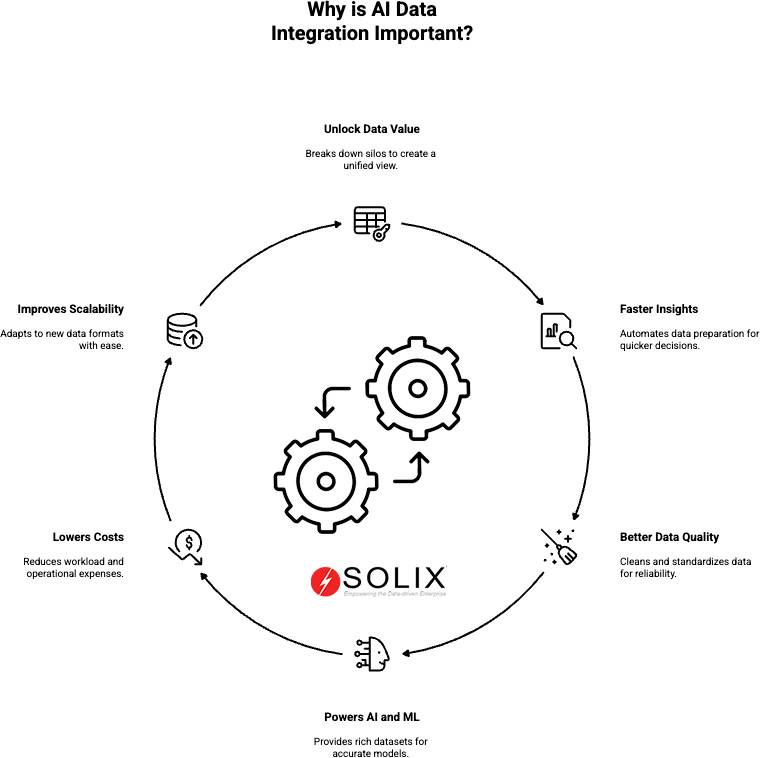
Why is AI Data Integration Important?
Today, simply moving data is not enough. Integrating it intelligently is a key competitive advantage. AI-powered integration is essential for any growing organization.
- Unlocks Data’s Value: Companies have vast amounts of unused data. AI Data Integration breaks down data silos. It brings together information from various systems and cloud apps into one clear view.
- Faster Insights: AI automates data preparation that once took months. This means decision-makers get the answers they need much quicker.
- Better Data Quality: AI finds errors, inconsistencies, and duplicates in data. It can automatically clean and standardize information. This creates a foundation of trustworthy data for analytics and AI.
- Powers AI and ML: The success of an AI project depends on its training data. AI Data Integration provides the well-prepared, rich datasets needed to build accurate machine learning models.
- Lowers Costs: Automating manual processes reduces the workload for IT teams. This frees them to work on more strategic projects, lowering operational costs.
- Improves Scalability: As data grows, old rule-based systems fail. AI-driven systems can scale and adapt to new data formats with little help, future-proofing your data strategy.
Challenges and Best Practices for Businesses
Adopting AI Data Integration can be transformative, but it’s not without its hurdles. Understanding these challenges and following proven best practices is key to a successful implementation.
Common Challenges:
- Data Silos and Complexity: Data is often locked in separate departments and systems, each with its own format. Connecting these disparate sources is a major technical challenge.
- Poor Data Quality: If the incoming data is flawed, the integrated result will be too. “Garbage in, garbage out” remains a critical risk, leading to unreliable AI models and analytics.
- Skill Gaps: There is a high demand for professionals who understand both data engineering and AI. A shortage of these skills can slow down or derail projects.
- Scalability and Cost Management: Data volumes are growing exponentially. An integration solution that cannot scale efficiently can lead to spiraling costs and performance issues.
- Data Security and Governance: Bringing all your data together creates a single point of access that must be fiercely protected. Ensuring compliance with data privacy regulations is non-negotiable.
Key Best Practices:
- Start with a Clear Strategy: Define your business goals first. What specific problem are you trying to solve? This will guide your technology choices and prevent wasted effort.
- Prioritize Data Governance: Implement strong data governance from the start. Define who owns the data, who can access it, and how it should be used. An AI-powered data catalog is essential for this.
- Focus on Data Quality at the Source: Use AI tools to profile and cleanse data as it enters the pipeline. Establishing a culture of data quality is fundamental to success.
- Choose a Scalable and Unified Platform: Avoid point solutions that create more complexity. Invest in a unified platform, like the Solix Common Data Platform, that can grow with your needs and manage the entire data lifecycle.
- Upskill Your Team: Invest in training for your existing IT and data teams. Help them develop the skills needed to manage and work with AI-driven data systems.
How Solix Helps You Master AI Data Integration
Knowing the challenges and best practices is the first step. The next is choosing a platform that is built to overcome these exact hurdles. You need a solution that is smart, scalable, and secure. The Solix Common Data Platform (CDP) does exactly this, making Solix Technologies a leader in this field.
Solix has deep experience in enterprise data management. The Solix Common Data Platform uses this expertise to solve core AI Data Integration challenges.
The platform directly addresses the challenges outlined above. It breaks down data silos by providing a unified repository for all enterprise data. Its built-in AI automates data quality processes, ensuring trusted information. The platform is designed for massive scalability, helping you manage costs as data grows. Finally, it has robust, built-in security and governance tools to ensure compliance.
The platform automates the entire data flow. Its AI-powered data catalog finds, classifies, and tags data automatically. This creates a searchable inventory of all your data. It makes data easy to find for analysts and scientists.
The Solix CDP also provides a unified space for AI applications. It supports open data formats and offers a central, secure home for all business data. This is the essential fuel for machine learning.
Solix is a leader because its solution does more than just connect data. It helps you build a strong AI Data Infrastructure. With Solix CDP, your data is not only integrated but also clean, governed, and ready to power the intelligent decisions that drive modern business.
Frequently Asked Questions (FAQs) about AI Data Integration
What is the difference between traditional data integration and AI data integration?
Traditional methods use manual, rule-based coding. AI Data Integration uses machine learning to automate tasks, making the process faster and more adaptable to complex data.
How does AI improve data quality during integration?
AI checks incoming data for errors, duplicates, and odd patterns. It can then standardize formats and suggest fixes, making the integrated data more accurate.
Can AI Data Integration handle both structured and unstructured data?
Yes. AI platforms are designed to work with many data types. This includes structured data from databases and unstructured data from documents and emails.
What role does a data catalog play in AI Data Integration?
An AI-powered data catalog acts like a smart library for your data. It automatically lists and tags all your data assets, making them easy to search and understand.
Is AI Data Integration secure?
Yes. Strong platforms like the Solix Common Data Platform have enterprise-grade security. This includes encryption and access controls to protect data.
How does AI Data Integration support machine learning projects?
It creates the clean, well-organized datasets needed to train ML models. By automating this, it speeds up the entire machine learning process.
What are the business benefits of AI-driven data integration?
Main benefits include faster insights, lower IT costs through automation, better decisions, and the ability to grow AI projects for a competitive edge.
Why is the Solix Common Data Platform a leader for AI Data Integration?
Solix CDP provides a complete, end-to-end solution. It uses AI to automate data management and governance, offering a unified base for AI projects. This makes it a top choice for businesses.