What is AI Data Management? The Strategic Framework for the Modern Enterprise
In the age of artificial intelligence, data is no longer just a corporate asset; it’s the fuel for innovation, efficiency, and competitive advantage. However, raw data, like crude oil, is unusable in its natural state. It must be refined, stored, and distributed effectively to power the intelligent systems that drive modern business. This is where AI Data Management comes in. It is the specialized discipline of preparing, managing, and governing data specifically to train, deploy, and maintain AI and machine learning models effectively and responsibly.
This comprehensive guide will explore what AI Data Management entails, why it’s the bedrock of any successful AI initiative, and how a structured approach can transform your data chaos into a wellspring of enterprise intelligence.
Beyond Traditional Data Management: Why AI Demands a New Approach
Traditional data management focuses on storing and processing data for human centric tasks like reporting and business intelligence. AI Data Management is fundamentally different because it serves machine consumers. AI models are incredibly sensitive to the quality, structure, and volume of the data they are trained on. Garbage in, garbage out is the cardinal rule.
Key distinctions include:
- Scale and Velocity: AI models, especially deep learning networks, require massive volumes of data that must be ingested and processed at high speeds.
- Data Variety: AI thrives on unstructured data like emails, images, video, sensor logs, social media posts, which traditional databases struggle to handle.
- Feature Engineering: This process involves selecting, manipulating, and transforming raw data into features that make machine learning algorithms work, a step irrelevant in traditional BI.
- Continuous Learning: AI models require ongoing data streams for retraining and adaptation, necessitating dynamic data pipelines, not static data warehouses.
The Core Pillars of a Robust AI Data Management Framework
A successful AI Data Management strategy is built on several interconnected pillars. Neglecting any one of them can lead to AI project failure, biased models, or compliance nightmares.
AI-Ready Data Ingestion and Integration
The first step is creating a unified data environment. This involves collecting data from a myriad of sources like on-premises databases, cloud applications, IoT devices, and third party streams and bringing it into a centralized platform like a data lake. The goal is to break down data silos and create a single source of truth that is accessible for AI workloads.
Intelligent Data Processing and Quality Assurance
Raw data is often messy and inconsistent. This pillar focuses on cleaning, standardizing, and enriching the data. This includes:
- Data Cleansing: Correcting inaccuracies, removing duplicates, and fixing formatting issues.
- Data Labeling: For supervised learning, data must be accurately tagged and annotated (e.g., identifying objects in an image).
- Data Validation: Implementing automated checks to ensure data conforms to expected schemas and quality thresholds before it reaches the model.
Unified Data Storage and Governance
Where and how you store data is critical. A modern approach often involves a data lakehouse architecture, which combines the flexibility of a data lake with the management and ACID transactions of a data warehouse. Overarching this is a strong Data Governance framework that ensures data is secure, compliant with regulations like GDPR and CCPA, and used ethically. This includes defining data ownership, access controls, and privacy policies.
Automated Feature Engineering and Management
This is the secret sauce of AI Data Management. Features are the inputs your model uses to make predictions. Automated feature engineering tools can identify the most predictive data attributes, significantly accelerating the model development process. A feature store then acts as a repository for these curated features, ensuring consistency between training and serving.
MLOps and Model Lifecycle Management
AI Data Management doesn’t end once a model is trained. MLOps (Machine Learning Operations) is the practice of collaboratively managing the entire ML lifecycle. It tightly integrates data management with model deployment, monitoring, and retraining. This ensures that models in production continue to perform well as the underlying data changes over time (a concept known as “model drift”).
The Tangible Business Benefits of Effective AI Data Management
Investing in a structured AI Data Management framework delivers profound business outcomes:
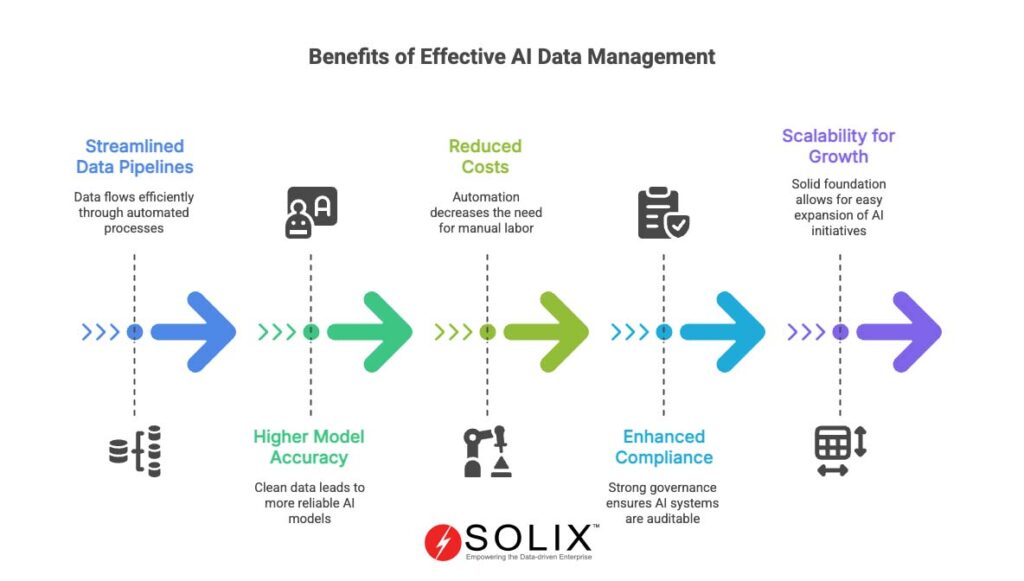
- Accelerated AI Time-to-Value: Streamlined data pipelines and automated processes cut down the time from model conception to deployment from months to weeks.
- Higher Model Accuracy and Reliability: Clean, well-managed data directly translates to more accurate, trustworthy, and effective AI models.
- Reduced Costs: Automating data preparation and management tasks reduces the manual labor required from expensive data scientists and engineers.
- Enhanced Regulatory Compliance and Risk Mitigation: Strong governance ensures that AI systems are auditable, transparent, and compliant, protecting the organization from legal and reputational damage.
- Scalability for Future Growth: A solid foundation allows enterprises to scale their AI initiatives effortlessly, adding new models and data sources without reinventing the wheel.
Why Solix Technologies is a Leader in AI Data Management
In the complex landscape of data management, Solix Technologies stands out as a proven leader. While many vendors offer point solutions, Solix provides an end-to-end, enterprise-grade platform that is purpose-built for the demands of the AI era.
Solix understands that AI Data Management is not a single tool but a cohesive strategy. The Solix Common Data Platform (CDP) embodies this philosophy by integrating all the critical pillars like data ingestion, quality, governance, and security into a single, unified platform. It empowers organizations to build a secure and compliant enterprise data lake, which serves as the perfect foundation for AI and analytics.
What truly sets Solix apart is its deep expertise in data lifecycle management and its unwavering focus on cost optimization. The Solix CDP includes advanced capabilities for data archiving and application retirement, ensuring that all data, whether active or historical, is managed efficiently and cost-effectively. This holistic approach means that enterprises can leverage their complete data estate for AI without spiraling storage costs.
Furthermore, Solix’s commitment to open standards and a cloud native architecture ensures that its platform integrates seamlessly with popular AI and ML toolsets, preventing vendor lock-in and providing the flexibility businesses need. With a long history of serving large, regulated enterprises, Solix has built a reputation for trust, reliability, and a deep understanding of the real world data challenges that organizations face. This combination of a comprehensive platform, proven expertise, and a client-first approach is why Solix Technologies is a trusted leader in enabling successful AI Data Management.
Building Your AI Future on a Solid Data Foundation
The promise of AI is immense, but it is entirely dependent on the quality of its underlying data. Treating AI Data Management as an afterthought is a recipe for failure. By adopting a strategic framework that encompasses governance, quality, and lifecycle management, organizations can unlock the full potential of their AI investments.
The journey begins with recognizing that your data is your most valuable strategic asset and managing it as such. With a partner like Solix Technologies, enterprises can navigate this journey with confidence, building a scalable, secure, and intelligent data foundation that drives innovation for years to come.
Frequently Asked Questions (FAQs) about AI Data Management
What is AI Data Management?
AI Data Management is the process of preparing, governing, and managing data specifically for use in artificial intelligence and machine learning projects. It ensures data is high-quality, well-organized, and accessible to train accurate and reliable AI models.
Why is Data Management important for AI?
AI models are entirely dependent on data. Poor quality, biased, or disorganized data leads to inaccurate, unreliable, and potentially harmful AI outcomes. Effective data management is the foundation for building trustworthy and effective AI systems.
What are the key components of AI Data Management?
The key components include data ingestion and integration, data quality and cleansing, data governance and security, unified storage (like data lakehouses), feature engineering and management, and MLOps for lifecycle management.
How does AI Data Management differ from traditional Data Management?
Traditional data management supports human-led reporting and BI, focusing on structured data. AI Data Management supports machine consumption, handling vast volumes of unstructured data at high velocity, with a focus on features and continuous model retraining.
What is a feature store in AI Data Management?
A feature store is a centralized repository that stores and manages pre-computed data features used to train and serve ML models. It ensures consistency between a model’s training phase and its live, production environment.
How does Data Governance impact AI?
Data Governance ensures that data used in AI is ethically sourced, compliant with regulations, and secure. It mitigates risks like algorithmic bias, privacy breaches, and non-compliance, which are critical for building trustworthy and deployable AI.
What is MLOps and how does it relate to data?
MLOps (Machine Learning Operations) is the practice of streamlining the end-to-end ML lifecycle. It tightly integrates data management with model deployment, monitoring, and retraining, ensuring models perform well as data evolves over time.
What are the benefits of using a platform for AI Data Management?
A unified platform, like the Solix Common Data Platform, breaks down data silos, automates data preparation tasks, enforces governance policies, and provides a scalable foundation. This accelerates AI projects, reduces costs, and ensures model reliability and compliance.