ALCOA Data Integrity is a foundational framework of principles Attributable, Legible, Contemporaneous, Original, and Accurate that ensures all data, particularly in regulated industries like life sciences and healthcare, is trustworthy, reliable, and compliant with global regulations such as FDA 21 CFR Part 11 and EU GMP Annex 11.
What is ALCOA Data Integrity?
ALCOA is an acronym that originated from the U.S. Food and Drug Administration (FDA) to define the attributes of data quality that are essential for demonstrating product efficacy and ensuring patient safety. It has since become the global gold standard for data integrity, adopted by regulatory bodies worldwide. The concept dictates that for data to be considered reliable and valid for regulatory decision making, it must adhere to these five core principles. Over time, the framework has been expanded to ALCOA+, which includes additional criteria such as Complete, Consistent, Enduring, and Available, further strengthening the requirements for robust data governance.
At its heart, ALCOA is not merely a checklist for auditors; it is a cultural and operational mindset. It moves beyond simple data entry to encompass the entire data lifecycle from creation and processing to archiving and retrieval. In an era where data drives critical decisions, from drug approval to medical device manufacturing, the ALCOA framework provides the necessary guardrails to ensure that this data is a true and reliable asset, not a liability. It is the cornerstone of Good Clinical Practice (GCP), Good Manufacturing Practice (GMP), and Good Laboratory Practice (GLP).
Why is ALCOA Data Integrity Important?
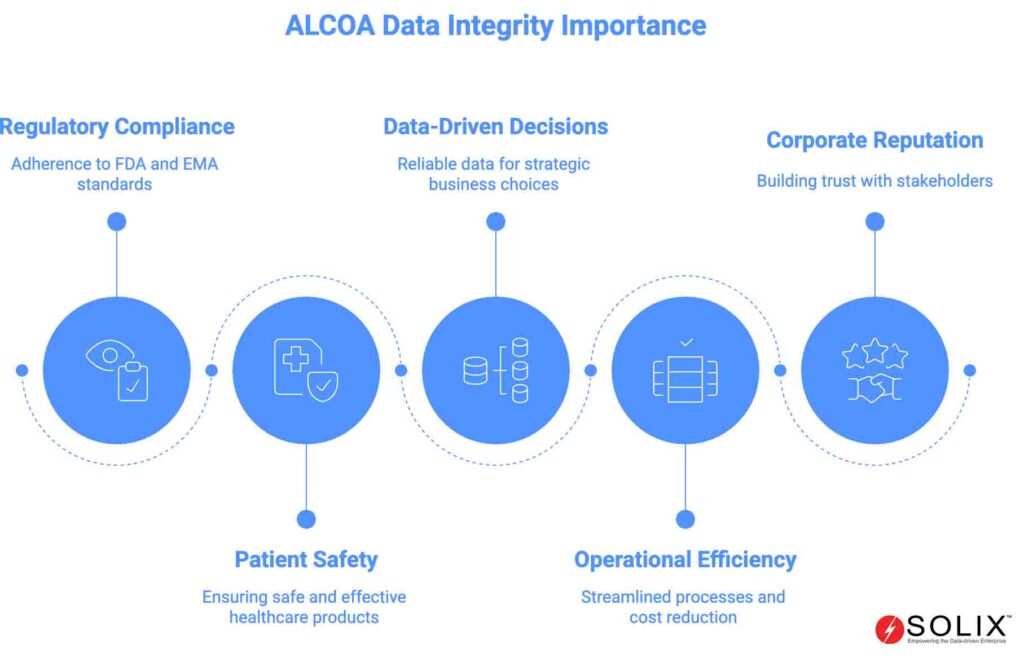
The importance of ALCOA data integrity cannot be overstated. It is the critical link between raw data and confident decision making, impacting everything from regulatory compliance to patient health and business viability.
- Regulatory Compliance and Audit Success: Regulatory agencies like the FDA and EMA conduct rigorous inspections. Demonstrating adherence to ALCOA principles is non negotiable. Failure to do so can result in Form 483 observations, Warning Letters, product recalls, and even criminal prosecution.
- Patient Safety and Public Health: In the life sciences sector, inaccurate or unreliable data can lead to the approval of ineffective or unsafe drugs and medical devices. ALCOA compliant data is the first line of defense in protecting patient safety and ensuring public trust in healthcare products.
- Data-Driven Decision Making: Business leaders and scientists rely on data to make critical decisions about research directions, manufacturing processes, and market strategies. If the underlying data is flawed, every decision based on it is compromised, leading to financial losses and strategic missteps.
- Operational Efficiency and Cost Reduction: Poor data integrity leads to errors, rework, and investigations. By ensuring data is accurate and complete from the outset, organizations can streamline operations, reduce waste, and avoid the significant costs associated with correcting data related issues and responding to regulatory actions.
- Corporate Reputation and Trust: A company known for its commitment to data integrity builds strong trust with regulators, investors, partners, and the public. Conversely, a high profile data integrity failure can cause irreparable damage to a brand’s reputation and market value.
A Deep Dive into the ALCOA+ Principles
To fully grasp the requirements of data integrity, it is essential to understand each component of the ALCOA and ALCOA+ framework in detail.
The Core ALCOA Principles:
- Attributable: Data must clearly show who created it, when it was created, and who has modified it since. This creates a clear and unbroken audit trail. In practice, this means every action on a data record must be linked to a unique user identity, typically managed through secure login credentials and electronic signatures.
- Legible: Data must be readable and understandable throughout its entire retention period. It must be permanent and resistant to fading or degradation. This applies to both electronic data, ensuring it remains readable despite software upgrades, and paper based data, requiring indelible ink and proper storage to prevent deterioration.
- Contemporaneous: Data must be recorded at the time the activity is performed. It cannot be back dated or pre dated. Delays in data entry increase the risk of errors, memory lapses, and intentional falsification. Electronic systems with time stamping capabilities are ideal for enforcing this principle.
- Original: The first or source capture of the data must be preserved. This is the “record of truth.” If a certified copy is made, the process for creating that copy must be validated and documented. Relying on transcribed data or preliminary notes instead of the original record is a common pitfall.
- Accurate: Data must be correct, truthful, and free from errors. It must reflect the actual observation or measurement. The processes for data collection and handling must be designed and validated to minimize the risk of inaccuracies.
The Expanded ALCOA+ (CCEA) Principles:
- Complete: All data, including any repeat or reanalysis performed, must be present. This includes data from all phases of a process and metadata that provides context. No data should be omitted or deleted without a validated, documented justification.
- Consistent: The data should be presented in a chronological sequence, with all dates and times following a consistent format. The sequence of events should be logical and verifiable, with no unexplained gaps or inconsistencies in the timeline.
- Enduring: Data must be recorded on durable media, whether electronic or paper, and must be securely stored for the entire required retention period. This involves robust backup, archive, and disaster recovery plans to prevent data loss.
- Available: Data must be readily accessible for review, audit, or inspection throughout its required retention period. It should be easily retrievable and readable, without being locked in obsolete systems or formats.
Challenges and Best Practices for Businesses
Implementing and maintaining ALCOA data integrity is fraught with challenges, especially for organizations relying on legacy systems, manual processes, or a mix of paper and electronic records.
Common Data Integrity Challenges:
- Legacy Systems and Data Silos: Older systems may not have the technical controls to enforce ALCOA principles. Data trapped in silos across different departments makes it difficult to achieve a single, complete view of the truth.
- Manual Data Entry and Paper Based Processes: These are inherently prone to human error, making it difficult to ensure accuracy, legibility, and contemporaneous recording. The audit trail for paper is fragile and difficult to maintain.
- Lack of a Data Integrity Culture: If employees do not understand the “why” behind data integrity rules, they may see them as bureaucratic hurdles. This can lead to shortcuts, such as using scribble sheets or back dating entries.
- Inadequate Training and Resources: Staff may not be fully trained on the specific requirements of ALCOA or the proper use of data systems. Without proper resources, data governance becomes an afterthought.
- Weak Audit Trails and Security: Systems without robust, immutable audit trails fail the “Attributable” principle. Weak user access controls can allow unauthorized changes, compromising data integrity.
- Managing Massive Volumes of Data: The sheer scale of data generated by modern enterprises makes manual governance and review processes impractical and ineffective.
Essential Best Practices for Compliance:
- Foster a Culture of Quality: Leadership must champion data integrity from the top down. Every employee should understand their role in maintaining data quality and the critical impact it has on the business and patients.
- Invest in Modern, Fit for Purpose Technology: Move away from paper and legacy systems towards modern cloud based platforms that have ALCOA principles built into their design, with features like electronic signatures, automated audit trails, and role based access control.
- Implement Robust Data Governance: Establish clear policies, procedures, and standards for data management across its entire lifecycle. Assign data owners and stewards who are accountable for data quality.
- Provide Continuous and Role Based Training: Training should not be a one time event. Provide ongoing education on ALCOA principles, data governance policies, and the proper use of your specific data systems.
- Conduct Regular Internal Audits and Risk Assessments: Proactively identify and address gaps in your data integrity framework before a regulatory inspection finds them. Use risk based approaches to prioritize the most critical data and processes.
- Ensure System Validation: Any computerized system used to manage regulated data must be validated to ensure it performs consistently and as intended, and that it maintains data integrity.
How Solix Helps You Achieve and Maintain ALCOA Data Integrity
Navigating the complex landscape of data integrity requires more than just intent; it requires a partner with the expertise, technology, and vision to transform your data governance. Solix Technologies, as a leader in enterprise data management solutions, is uniquely positioned to be that partner. Our deep understanding of the regulatory environment and our robust, secure cloud platform provide a comprehensive foundation for achieving and sustaining ALCOA compliance.
Solix demonstrates its leadership by addressing the core challenges head on with a purpose built approach. While many vendors offer point solutions, Solix provides an integrated ecosystem that manages the entire data lifecycle in a compliant manner. Our solutions are architected with regulatory standards like FDA 21 CFR Part 11 as a core requirement, not an afterthought. This proactive design philosophy, combined with our extensive experience serving clients in highly regulated industries, establishes Solix as an authoritative voice and a trusted provider in the data integrity space.
Here’s how the Solix Common Data Platform (CDP) empowers your organization:
- Enforces Attributability with Secure Audit Trails: The Solix platform automatically captures a detailed, immutable audit trail for every data action. We implement robust user access controls and support electronic signatures, creating a crystal clear chain of custody that definitively answers who did what, when, and why.
- Guarantees Data Legibility, Endurance, and Availability: Solix ensures your data remains readable and accessible for the long term. Our secure data archiving solutions protect against data degradation and technology obsolescence. With powerful search and retrieval capabilities, your data is always available for internal review or regulatory inspection, meeting the “Enduring” and “Available” principles with ease.
- Promotes Contemporaneous Recording: By providing user friendly interfaces for data entry and integration with operational systems, Solix helps streamline processes, encouraging staff to record data in real time. This reduces the temptation and opportunity for delayed entries, reinforcing good data practices.
- Safeguards Original and Accurate Records: The platform is designed to preserve original data and prevent unauthorized alterations. Through validation rules and controlled processes, the Solix CDP minimizes the risk of errors at the point of entry, ensuring the accuracy and authenticity of your primary records.
- Ensures Completeness and Consistency: Solix helps break down data silos by providing a unified repository for all your structured and unstructured regulated data. This holistic view ensures completeness. Furthermore, by managing data within a centralized platform, we help enforce consistent data formats and a logical sequence of events.
- Simplifies Compliance and Reduces Risk: With Solix, you can automate many of the burdensome tasks associated with compliance. Our platform helps you manage retention policies, prepare for eDiscovery, and respond efficiently to audits. This not only reduces the risk of regulatory findings but also significantly lowers the cost and complexity of compliance.
By partnering with Solix, you are not just buying software; you are adopting a strategic framework for data integrity excellence. We empower you to move from a reactive stance of fearing audits to a proactive position of confidence, knowing your data is managed with the highest standards of quality, security, and compliance. Let us help you build a foundation of trust in your data.
Frequently Asked Questions (FAQs) about ALCOA data integrity
What does ALCOA stand for?
ALCOA is an acronym that stands for Attributable, Legible, Contemporaneous, Original, and Accurate. These are the five core principles for ensuring data integrity in regulated industries.
What is the difference between ALCOA and ALCOA+?
ALCOA refers to the five original principles. ALCOA+ is an expanded framework that adds four more criteria: Complete, Consistent, Enduring, and Available, providing a more comprehensive set of guidelines for data governance.
Why is the ‘Attributable’ principle so important?
The Attributable principle is crucial because it creates an audit trail. It ensures that every piece of data can be traced back to the individual who created or modified it, establishing accountability and transparency.
What is an example of a data integrity failure?
A common example is using a scribble sheet (a temporary paper note) to record data during an experiment with the intention of transcribing it later. This violates the Contemporaneous and Original principles and is a major red flag for auditors.
How does electronic data capture help with ALCOA?
Electronic systems can be configured with built in controls like automated time stamping, user specific logins, immutable audit trails, and data validation checks, which automatically enforce many of the ALCOA principles and reduce human error.
What industries require ALCOA compliance?
While most critical in life sciences (pharmaceuticals, biologics, medical devices), ALCOA principles are also highly relevant in other regulated sectors like aerospace, automotive, and food and beverage, where data quality is paramount.
Who is responsible for data integrity in a company?
Data integrity is a shared responsibility. It starts with senior management’s commitment to a quality culture but extends to every employee who creates, processes, reviews, or manages data as part of their job function.
How can we improve our company’s data integrity culture?
Improving culture requires leadership endorsement, continuous and practical training, providing the right tools that make compliance easy, and encouraging open reporting of data errors without fear of punitive action.