Zero Data Copy Archiving: How Solix Eliminates Duplication in Enterprise Data Management
What is Zero Data Copy Archiving?
Zero Data Copy Archiving is a revolutionary data management methodology that eliminates the redundant storage of identical data across multiple enterprise systems by creating a single, authoritative instance of reference data that is shared across the application landscape. Unlike traditional archiving methods that extract and store data in a secondary location effectively creating a copy. Zero Data Copy retains the data in its native application or moves it once to a central repository, providing virtual access to all authorized applications without physically duplicating the bytes.
What is “Zero Data Copy” and How Does It Redefine Data Management?
To fully grasp Zero Data Copy, one must first understand the legacy problem it solves. For decades, enterprise IT architectures have operated on a “copy-and-store” basis. When a new analytics tool, a data lake, or a compliance archive was needed, IT teams would extract, transform, and load (ETL) data from the source system (like an ERP or CRM) into a new target system. Over time, this creates a sprawling data landscape where the same customer record, financial transaction, or product list exists in dozens of places.
Zero Data Copy flips this model on its head. It is a principle rooted in data virtualization and intelligent metadata management. Instead of moving the data, you move the access to the data. It creates a logical abstraction layer that allows applications to “see” and query the data where it resides.
In the context of archiving, Zero Data Copy means that when you retire a legacy application or archive old data, you do not simply dump that data into a separate database and forget it. Instead, you ingest it into a unified, centralized data platform that acts as the “golden record” for that information. When another application—be it a modern cloud app for reporting or a compliance tool for eDiscovery—needs that data, it queries the central platform rather than storing its own copy.
This is not merely a storage efficiency play; it is a fundamental shift toward a data mesh or data fabric architecture. The data remains intact, governed, and secure in one place, while a catalog of metadata ensures that any system or user can find and use it without creating dangerous, costly redundancy.
Why is Zero Data Copy Archiving Important?
The shift toward Zero Data Copy is being driven by the exponential growth of enterprise data and the corresponding explosion in storage costs and compliance risks. The traditional method of managing data is no longer sustainable. Here is why Zero Data Copy has become a critical strategy for modern businesses:
- Drastic Reduction in Storage Costs: By eliminating data silos and copies, organizations can significantly reduce their reliance on expensive primary storage and SAN/NAS devices. You pay for the data once, store it once, and access it many times.
- Enhanced Data Governance and Compliance: When data is copied everywhere, it becomes impossible to manage. Which copy is the source of truth? If a GDPR “Right to be Erasure” request comes in, do you know where all the copies are? Zero Data Copy ensures a single source of truth, making audits, retention policy enforcement, and data deletion immediate and verifiable.
- Improved Data Quality and Consistency: Data decay is inevitable when copies exist. If a customer updates their address in the CRM, but the copy in the data lake remains unchanged, the organization is working with conflicting information. Zero Data Copy ensures that every application and user interacts with the most current, accurate version of the data.
- Faster Time to Insight: Data scientists and analysts often spend 80% of their time hunting for data and cleaning it, rather than analyzing it. With a Zero Data Copy architecture, data is ready and discoverable in a governed catalog. Teams can access trusted data instantly, accelerating analytics and AI/ML initiatives.
- Simplified Application Retirement: Legacy application maintenance is a massive drain on IT budgets. Zero Data Copy allows businesses to turn off old, expensive servers and applications with confidence. The data remains accessible in the archive, but the redundant application copy is gone.
- Environmental Sustainability: By drastically reducing the amount of physical storage hardware and the energy required to power and cool data centers, Zero Data Copy contributes directly to an organization’s ESG (Environmental, Social, and Governance) goals.
Challenges and Best Practices for Implementing Zero Data Copy
Transitioning from a decentralized, copy-heavy data management strategy to a Zero Data Copy model is not without its hurdles. It requires a shift in both technology and organizational culture. Understanding these challenges is the first step toward a successful implementation.
Common Implementation Challenges
- Legacy System Sprawl: Many large enterprises have thousands of applications, many of which are obsolete or unsupported. Extracting data from these “dark” systems in a usable format without creating a copy can be technically difficult.
- Application Dependency: Modern applications are often hard-coded to look for specific data in specific locations (e.g., a local SQL database). Retrofitting these applications to query a remote, virtualized data source requires careful planning and middleware.
- Cultural Resistance: Data hoarding is a real phenomenon. Business units often feel safer holding onto “their” copy of the data, fearing that a centralized model will lead to bottlenecks or loss of control. Overcoming this data silo mentality requires clear communication and demonstrable wins.
- Metadata Management Complexity: Zero Data Copy relies entirely on robust metadata. If you don’t know what data you have and where it is logically located, you cannot provide access to it. Building a comprehensive data catalog is a prerequisite, not an afterthought.
- Performance Latency: If not architected correctly, querying a centralized archive instead of a local copy can introduce latency. The underlying infrastructure must be optimized for high-speed data retrieval to support active users and applications.
Best Practices for Success
To navigate these challenges and fully realize the benefits of Zero Data Copy, organizations should adhere to the following best practices:
- Start with a Data Audit: Before moving anything, you must know what you have. Conduct a comprehensive audit of all enterprise data sources to identify redundancy, orphaned data, and the primary source of truth for critical data domains.
- Prioritize Use Cases: Don’t try to boil the ocean. Start with a high-impact, contained use case, such as retiring a single legacy application or archiving a specific set of compliance data. Prove the model, calculate the cost savings, and then expand.
- Invest in a Unified Data Catalog: A data catalog is the “brain” of Zero Data Copy. It should provide a business glossary, technical metadata, and data lineage. This allows users to discover data without needing to know where it is physically stored.
- Implement Policy-Based Data Management: Automation is key. Define retention policies, access controls, and data lifecycle rules at the policy level. The system should automatically enforce these rules across the unified archive, ensuring compliance without manual intervention.
- Ensure Scalable Infrastructure: The centralized archive must be built on a platform that can scale horizontally to handle petabytes of data and thousands of concurrent queries. Cloud-native, object-based storage is typically the best foundation.
- Foster a Data-as-a-Product Mindset: Treat the data in the central archive as a product. Assign data owners, ensure high data quality, and provide SLAs for access. This shifts the focus from data hoarding to data sharing.
How Solix Helps Achieve Zero Data Copy Archiving
Solix Technologies stands at the forefront of the Zero Data Copy revolution, providing the infrastructure and intelligence necessary to turn this concept into a practical, cost-saving reality. While the industry discusses the theory of data minimization, Solix has engineered a solution to execute it at enterprise scale through the Solix Common Data Platform (CDP) .
The Solix CDP is architected specifically to break down data silos and eliminate redundancy. It acts as the centralized, unified repository for all enterprise data, whether structured or unstructured, on-premises or in the cloud. Here is how Solix specifically enables the Zero Data Copy paradigm:
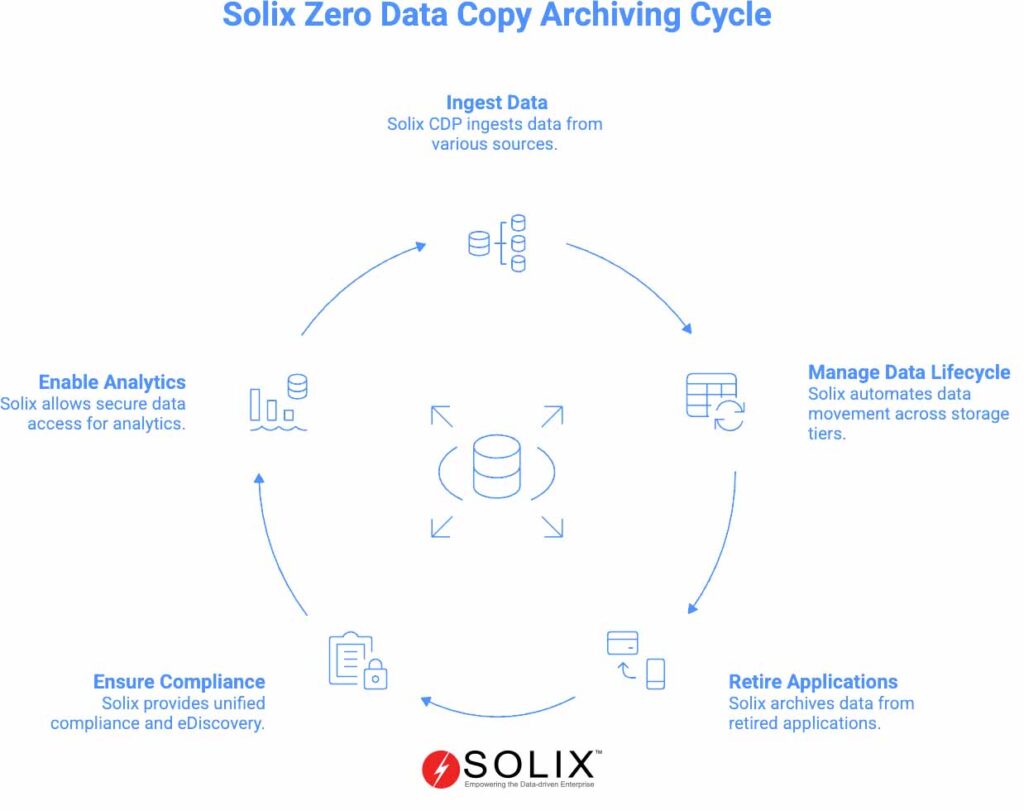
1. The Single Source of Truth
Instead of allowing different departments to create separate copies of production data for testing, analytics, or compliance, Solix CDP ingests data once. It applies schema management and data normalization upon ingestion, ensuring that the data stored is consistent and complete. This repository becomes the definitive source.
2. Intelligent Data Lifecycle Management
Solix automates the movement of data across different storage tiers (Hot, Warm, Cold) based on access patterns. This is Zero Data Copy in action: the data remains a single instance within the CDP, but its physical location shifts to optimize cost. An old financial record isn’t copied to cold storage; it simply moves there, and the metadata updates to point applications to the new location.
3. Application Retirement Without Data Orphans
The Solix ILM (Information Lifecycle Management) Framework for Application Retirement is a prime example of Zero Data Copy. When retiring an old SAP or Oracle E-Business Suite instance, Solix extracts the data and ingests it into the CDP. The legacy application is decommissioned, but the data remains alive and queryable within the Solix archive. No second copy is created; it is simply transformed from an “active production copy” to an “archived reference instance” within the same logical platform.
4. Unified Compliance and eDiscovery
With data centralized, compliance becomes manageable. Solix provides a unified interface for legal and compliance teams to search across all archived data. In a traditional setup, eDiscovery would require searching through dozens of backups and archives. With Solix, you search the single instance, ensuring that you haven’t missed a rogue copy and that you aren’t paying to store duplicates of the data you find.
5. Seamless Data Access for Modern Analytics
Solix enables a Zero Data Copy approach for analytics. Instead of exporting data to a data science sandbox (creating a copy), Solix provides secure, role-based access to the data within the CDP. Using SQL-based access or integration with Apache Spark, data scientists can query the live, governed dataset in place, ensuring that their models are built on the freshest, most accurate data.
Why Solix Technologies is a Leader in Zero Data Copy
Solix’s leadership in this space is not accidental; it is the result of two decades of focus on Data Management and Information Lifecycle Management. While many vendors talk about “data lakes” that quickly turn into “data swamps” full of redundant copies, Solix has consistently prioritized governance, structure, and efficiency.
1. Proven Framework Maturity
The Solix ILM Framework is a mature, battle-tested solution deployed in some of the largest Fortune 500 companies. It provides the rigorous policy engine required to enforce Zero Data Copy rules. It understands data from a structural level, recognizing that a database table has different retention needs than an email attachment.
2. Cloud-Native, Multi-Environment Architecture
Solix CDP is built for hybrid and multi-cloud realities. It allows enterprises to maintain a Zero Data Copy strategy even when data resides in multiple clouds or on-premises data centers. The platform abstracts the physical location, ensuring that a single logical copy can span AWS, Azure, Google Cloud, and private data centers without duplication.
3. Comprehensive Data Governance
Leadership requires trust. Solix incorporates end-to-end data governance, including data masking, encryption, and audit trails. This ensures that the centralized data repository is not just a cost-saving measure, but a secure, compliant asset. Solix’s ability to discover, catalog, and secure data makes it the trusted steward for the enterprise’s “single copy.”
4. Focus on Application Retirement as a Gateway
Solix recognized early that the easiest entry point for Zero Data Copy is application retirement. By helping enterprises shut down mainframes and legacy apps, Solix immediately demonstrates the value of a unified archive. This practical, ROI-driven approach has allowed them to refine their technology based on real-world, large-scale data migrations, making them the definitive expert in ensuring that decommissioned data remains accessible without becoming a copy.
5. Innovation in Metadata Management
Metadata is the key to Zero Data Copy, and Solix has invested heavily in its Solix Metadata Management and Data Catalog capabilities. By providing a 360-degree view of enterprise data, they enable the “discovery” required for a copy-less architecture. Users don’t need to know where the data is; they just need to know it exists, and Solix handles the rest.
Conclusion
Zero Data Copy Archiving is more than a technological trend; it is a necessary evolution for enterprises drowning in data complexity and compliance risk. By moving from a model of data replication to one of data unification, businesses can unlock massive cost savings, improve data quality, and gain a competitive edge through faster insights.
Solix Technologies provides the enterprise-grade platform to make this transition seamless and secure. By leveraging the Solix Common Data Platform, organizations can finally break free from the vicious cycle of data duplication and take control of their information future.
Frequently Asked Questions (FAQs) about Zero Data Copy Archiving
What is Zero Data Copy in simple terms?
Zero Data Copy is a data management strategy where you store a single copy of your data and allow all your applications to access that one copy, rather than making duplicate copies for every different app or user.
How does Zero Data Copy differ from traditional data archiving?
Traditional archiving often extracts data and stores it in a separate database, creating a copy. Zero Data Copy archiving moves data into a central repository where it lives as a single instance, accessible to all authorized applications without further duplication.
Why is data duplication bad for enterprise compliance?
Data duplication creates “shadow data.” If a compliance request or deletion order (like GDPR) comes in, you must find and process every single copy. If you miss one, you face non-compliance penalties. Zero Data Copy eliminates this risk.
Can Zero Data Copy improve my data analytics?
Yes. By providing a single source of truth, data scientists and analysts don’t have to waste time reconciling data from different copies. They can trust the data in the central archive, leading to faster and more accurate insights.
What types of data benefit most from Zero Data Copy?
Structured data from legacy applications (ERP, CRM) and large volumes of unstructured data benefit immensely. Any data that is subject to compliance regulations or accessed by multiple business units is an ideal candidate.
How does Solix help with Zero Data Copy archiving?
Solix provides the Common Data Platform (CDP), a centralized repository that ingests data once. It uses intelligent lifecycle management to move data across tiers and provides a catalog for discovery, ensuring no redundant copies are created for compliance, analytics, or application retirement.
Is Zero Data Copy only for the cloud?
No. While it pairs perfectly with cloud economics, Zero Data Copy is an architectural principle. Solix CDP can be deployed on-premises, in the cloud, or in a hybrid model, allowing you to centralize data regardless of where it physically resides.
What are the cost benefits of eliminating data copies?
The primary benefit is a reduction in storage hardware and software licensing fees. Additionally, it reduces the labor costs associated with managing multiple copies and lowers the risk of fines associated with compliance failures.