
As the race to bring life saving therapies to market accelerates, the pharmaceutical industry is pushing the boundaries of biology while learning to harness an unprecedented explosion of data. Spanning multi‑omics, clinical trial data, legacy LIMS, and real‑world evidence, this deluge of information is as staggering as it is full of untapped insights.
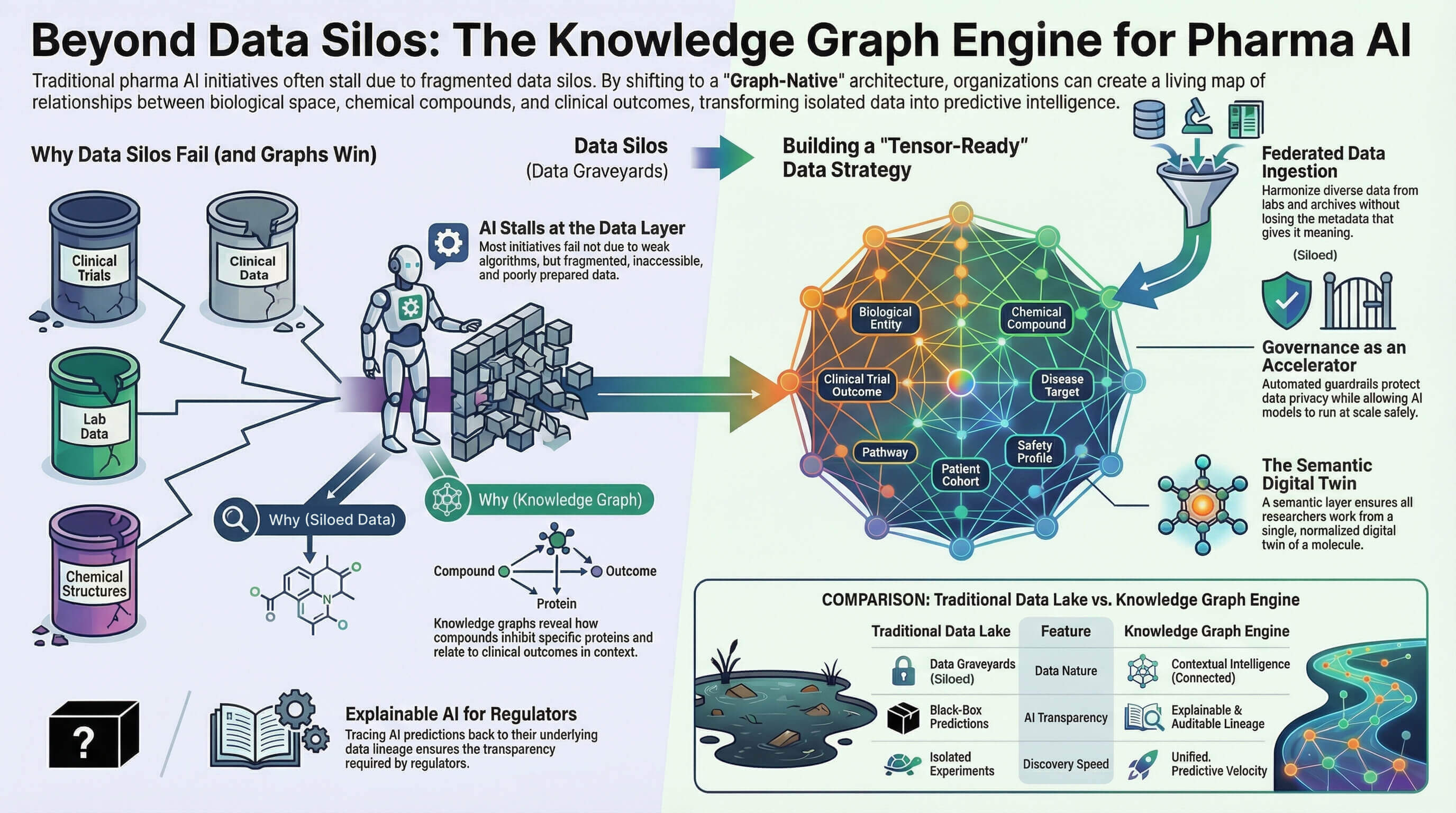
But here is the hard truth: Most AI initiatives in pharma stall not because the algorithms are weak, but because the underlying data is fragmented, slow to access, and poorly prepared to create meaningful insights.
To solve this, the industry is rapidly shifting toward a Graph-Native way of working with data. A pharmaceutical knowledge graph is not just another database; it is a living map of the relationships that connect biological space, chemical space, and clinical outcomes.
Why the “Graph-Native” Approach Changes Everything
Traditional data lakes often become “data graveyards”, places where information is stored but rarely understood. A graph-native architecture, like the one powering the Solix EAI Pharma platform, focuses on contextual intelligence.
- Supercharge from “What” to “Why”: instead of merely listing that Compound A exists, a knowledge graph reveals that Compound A inhibits Protein X, which is associated with Condition Y and was previously tested in Clinical Trial Z with defined adverse events. This brings correlation and causation together in a single, navigable context.
- Build “Transparency” and “Trust” with Explainable AI: Black‑box AI is a liability in regulated industries. Knowledge graphs let researchers trace the full lineage of a prediction back to its underlying data, delivering the explainability and auditability regulators demand
- Go beyond “Data Advantage” to true “Predictive Velocity”: By visualizing hidden connections across previously siloed datasets, teams can uncover drug repurposing opportunities or emerging safety signals far earlier than would be possible with traditional, isolated analyses.
The 3 Pillars of a “Tensor-Ready” Data Strategy
For AI to be effective, your data must be “tensor-ready”, meaning it is standardized, harmonized, and semantically ready for machine learning. This requires three critical steps:
1. Federated Data Ingestion
Pharma R&D happens in fragments. Your data management platform should ingest raw data from diverse sources (including lab instruments, operational data, and archived data) without losing the metadata that gives that data meaning.
2. Governance as an Accelerator, Not a Roadblock
Many see “Data Governance” as a set of rules that slows down research. In reality, automated governance enables: grounding the truth, guardrails for protecting data privacy and validating the outcomes, is what allows AI models to run at scale without risking compliance breaches.
3. The Semantic Layer
This is where being “Graph-Native” comes to life. A semantic layer normalizes scientific concepts into unique entities, ensuring that a researcher in Boston and a data scientist in Basel are working from the same digital twin of a molecule.
The Solix Advantage: Democratizing Pharma AI
At Solix, we believe that advanced AI shouldn’t be reserved only for the industry’s biggest players. Our Solix Common Data Platform (CDP) provides the “Operating System” for your data fabric, enabling:
- Fail-Fast Pipelines: Identify unpromising candidates early to redirect resources toward winners.
- Secure Collaboration: Maintain data sovereignty while enabling cross-functional teams across geographies to query clinical and operational data in real-time.
- Legacy Modernization: Decommission expensive legacy systems while keeping their historical data “AI-active.”
Summary: The Path to Faster Discovery
The future of pharmaceutical innovation isn’t just about more data; it’s about better connections. By leveraging a graph-native insight framework, organizations can transform their R&D from a series of isolated experiments into a unified, intelligent engine.
Ready to see how a Knowledge Graph can accelerate your R&D? Explore Solix EAI Pharma or Schedule a Demo today.

Murali Krishnam
VP - Product Strategy, Enterprise Pharma AI
DISCLAIMER: THE CONTENT, VIEWS, AND OPINIONS EXPRESSED IN THIS BLOG ARE SOLELY THOSE OF THE AUTHOR(S) AND DO NOT REFLECT THE OFFICIAL POLICY OR POSITION OF SOLIX TECHNOLOGIES, INC., ITS AFFILIATES, OR PARTNERS. THIS BLOG IS OPERATED INDEPENDENTLY AND IS NOT REVIEWED OR ENDORSED BY SOLIX TECHNOLOGIES, INC. IN AN OFFICIAL CAPACITY. ALL THIRD-PARTY TRADEMARKS, LOGOS, AND COPYRIGHTED MATERIALS REFERENCED HEREIN ARE THE PROPERTY OF THEIR RESPECTIVE OWNERS. ANY USE IS STRICTLY FOR IDENTIFICATION, COMMENTARY, OR EDUCATIONAL PURPOSES UNDER THE DOCTRINE OF FAIR USE (U.S. COPYRIGHT ACT § 107 AND INTERNATIONAL EQUIVALENTS). NO SPONSORSHIP, ENDORSEMENT, OR AFFILIATION WITH SOLIX TECHNOLOGIES, INC. IS IMPLIED. CONTENT IS PROVIDED "AS-IS" WITHOUT WARRANTIES OF ACCURACY, COMPLETENESS, OR FITNESS FOR ANY PURPOSE. SOLIX TECHNOLOGIES, INC. DISCLAIMS ALL LIABILITY FOR ACTIONS TAKEN BASED ON THIS MATERIAL. READERS ASSUME FULL RESPONSIBILITY FOR THEIR USE OF THIS INFORMATION. SOLIX RESPECTS INTELLECTUAL PROPERTY RIGHTS. TO SUBMIT A DMCA TAKEDOWN REQUEST, EMAIL INFO@SOLIX.COM WITH: (1) IDENTIFICATION OF THE WORK, (2) THE INFRINGING MATERIAL’S URL, (3) YOUR CONTACT DETAILS, AND (4) A STATEMENT OF GOOD FAITH. VALID CLAIMS WILL RECEIVE PROMPT ATTENTION. BY ACCESSING THIS BLOG, YOU AGREE TO THIS DISCLAIMER AND OUR TERMS OF USE. THIS AGREEMENT IS GOVERNED BY THE LAWS OF CALIFORNIA.
-
 White Paper
Enterprise Information Architecture for Gen AI and Machine Learning
Download White Paper -

-

-
