Unleash Your Data’s Potential with AI Data Cataloging
AI Data Cataloging is the next-generation process of automatically discovering, classifying, organizing, managing, and enriching an organization’s data assets using artificial intelligence (AI) and machine learning (ML) technologies. It transforms a traditional, often manual data catalog into a dynamic, intelligent system that provides context, lineage, and trust to data, empowering users to find, understand, and use data effectively for analytics and business intelligence.
What is AI Data Cataloging?
At its core, a data catalog is a centralized inventory of an organization’s data. It acts as a map and a dictionary, helping users locate data and understand its meaning. Traditional data catalogs rely heavily on manual input for tagging, classifying, and documenting data. This is a slow, error-prone, and unsustainable process in the face of modern data volumes.
AI Data Cataloging revolutionizes this concept by infusing automation and intelligence. It uses a suite of AI/ML techniques to scan and profile data across disparate sources. These sources include data warehouses, data lakes, cloud storage, and business applications. The AI doesn’t just list the data; it comprehends it. It can automatically infer schemas, identify data types, detect sensitive information like PII (Personally Identifiable Information), suggest business glossary terms, and profile data quality.
This creates a living, breathing catalog that learns and adapts as your data landscape evolves. It dramatically reduces the time-to-insight and ensures data is used correctly and securely. The result is a powerful system that connects people to the data they need with confidence.
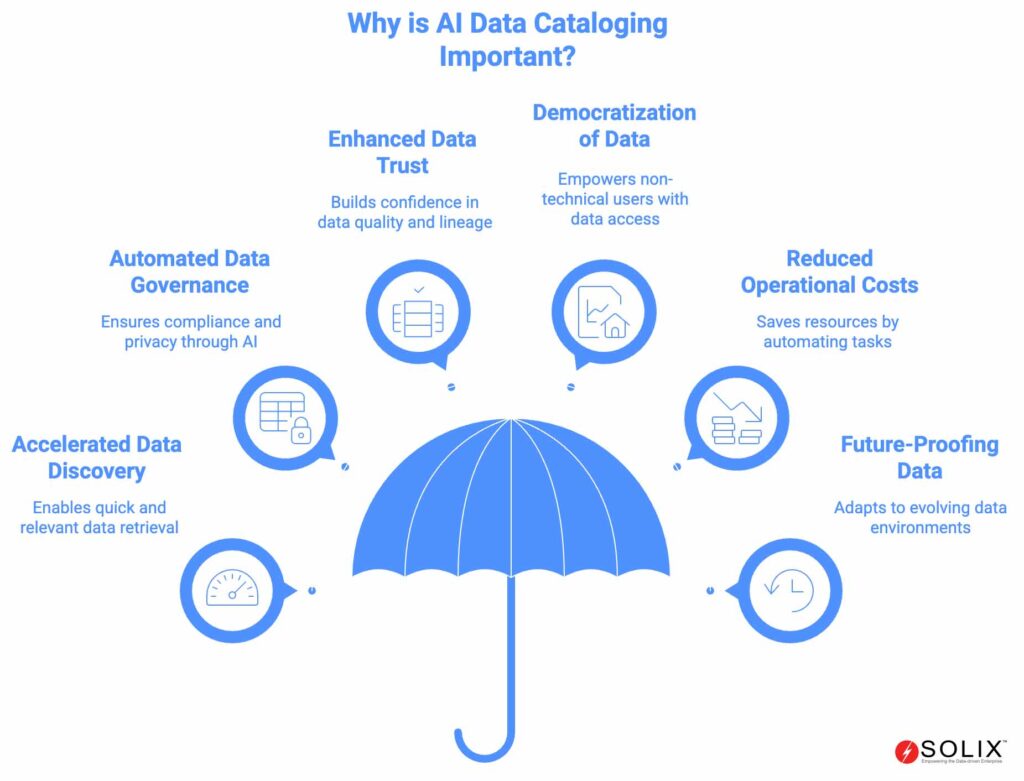
Why is AI Data Cataloging Important?
In today’s data-driven economy, the ability to leverage data is a key competitive differentiator. However, most organizations are drowning in data but starving for insights. AI Data Cataloging is the critical bridge that turns raw data into a trusted, strategic asset. Its importance is underscored by several key benefits:
- Accelerated Data Discovery and Time-to-Insight: Users can find the right data in minutes, not days. AI-powered semantic search allows users to search using business terms, not just technical column names. It works similar to a modern web search engine, delivering relevant results based on intent and context.
- Automated Data Governance and Compliance: AI models can be trained to automatically identify and tag sensitive data. This includes credit card numbers, health records, and other personal information. This automation is crucial for enforcing data privacy regulations like GDPR, CCPA, and HIPAA. It simplifies audit reporting and reduces compliance risk.
- Enhanced Data Trust and Quality: An AI catalog automatically profiles data and highlights quality issues. It can find duplicates, outliers, or missing values. This process builds trust in the data used for critical business decisions. The catalog also provides transparency into data lineage, showing the data’s origin and every transformation it undergoes.
- Democratization of Data for Self-Service Analytics: Business analysts and non-technical users can independently find and use trusted data. They no longer need to constantly rely on IT or data engineers. This fosters a true data culture and unlocks the potential of citizen data scientists across the organization.
- Reduced Operational Costs: Automating tedious tasks delivers significant cost savings. It frees up highly-skilled data engineers and stewards to focus on higher-value strategic initiatives. This leads to improved operational efficiency and a better return on talent.
- Future-Proofing the Data Estate: Data ecosystems grow more complex every day. Hybrid and multi-cloud environments are the new normal. An AI-driven catalog is essential for maintaining a unified, searchable view of all data assets. It ensures the organization can adapt to new data sources and technologies with agility.
Key Challenges and Best Practices for Businesses
Implementing an AI data catalog is a strategic journey, not just a IT project. Organizations often face several hurdles on the path to success. Understanding these challenges and adhering to proven best practices is crucial for maximizing the return on investment.
Common Challenges:
- Cultural Resistance and Change Management: Shifting from a siloed, manual data management culture to a collaborative, automated one can be difficult. Users may be hesitant to trust the AI or change their established workflows.
- Data Quality at Scale: While AI can identify quality issues, the initial state of an organization’s data can be poor. Cleaning and standardizing vast amounts of legacy data before it can be effectively cataloged is a significant undertaking.
- Integrating Disparate Data Sources: Modern enterprises have data everywhere—in SaaS applications, on-premises databases, and across multiple cloud platforms. Connecting to all these sources and handling different data formats consistently is a technical challenge.
- Defining Business Glossary and Taxonomy: The AI needs a foundation of business terms to learn from. Getting stakeholders to agree on a common business vocabulary and data definitions can be a time-consuming political and organizational task.
- Ensuring Ongoing Governance and Maintenance: An AI catalog is not a “set it and forget it” solution. It requires ongoing oversight from data stewards to refine AI models, manage user access, and ensure the business glossary remains relevant.
Essential Best Practices:
- Start with a Clear Business Use Case: Do not boil the ocean. Begin with a high-priority business problem, such as improving customer analytics or streamlining regulatory reporting. This provides a clear goal, demonstrates quick value, and secures stakeholder buy-in.
- Secure Executive Sponsorship: A successful catalog initiative requires top-down support. An executive sponsor can champion the project, allocate resources, and help overcome cultural resistance across departments.
- Focus on Data Governance from Day One: Weave data governance principles into the fabric of your catalog project. Define data stewardship roles and responsibilities early. Use the AI’s capabilities to automate policy enforcement, making governance an enabler, not a barrier.
- Prioritize Data Literacy and User Training: Invest in training programs for different user groups. Show business users how to find data easily. Train data stewards on how to manage the catalog. Foster a community where data is shared and discussed openly.
- Choose a Platform, Not Just a Tool: Select a solution that can scale with your needs and integrate with your existing data infrastructure. A platform approach, like the Solix Common Data Platform, ensures that cataloging is part of a larger, cohesive data management strategy, not just another point solution. Learn more about Solix’s approach to enterprise data governance.
How Solix Helps You Unlock the Power of Your Data with AI
While the value of AI Data Cataloging is clear, its successful implementation requires a robust platform built for the scale and complexity of the modern enterprise. This is where Solix Technologies establishes its leadership. Solix doesn’t just provide a tool; it offers an end-to-end data management framework where AI-powered cataloging is a core component of a larger, more powerful ecosystem.
Solix Technologies is a leader in this space because its solutions are built on a foundation of enterprise-grade security, scalability, and deep industry expertise. The Solix Common Data Platform (CDP) is engineered to handle the most demanding data environments. It ensures that AI cataloging functions seamlessly across petabytes of data, both on-premises and in the cloud. Solix understands that a catalog must be part of a unified strategy to manage data throughout its entire lifecycle.
How Solix Helps:
The Solix Common Data Platform (CDP) integrates advanced AI Data Cataloging capabilities to directly address the challenges of data discovery, governance, and utility. Our approach ensures that your investment in a catalog delivers immediate and long-term value.
- Intelligent, Automated Data Discovery and Classification: Solix CDP automatically scans and profiles data across your entire estate. Its AI engines go beyond basic classification to understand business context. The system automatically links data assets to your business glossary and identifies sensitive information with high accuracy. This lays the groundwork for proactive data governance from the moment data is ingested.
- Seamless Integration with End-to-End Data Management: Unlike standalone cataloging tools, Solix embeds cataloging within a comprehensive platform. This platform includes data lakehouse capabilities, application archiving, and information lifecycle management. This means the catalog is not a separate silo but the intelligent brain of your entire data operations. It provides context for data from its active life through to its archival state, creating a single source of truth.
- Robust Data Governance and Compliance Automation: With Solix, governance is not an afterthought. The AI catalog is the enforcement point for your data policies. It automatically applies retention rules, manages access controls, and helps enforce privacy mandates. This significantly reduces compliance risk and builds a foundation of trust. Learn more about how Solix empowers enterprise data governance.
- Empowering a Data-Driven Culture: Solix provides a user-friendly, portal-like experience for business users. With features like natural language search and curated data marketplace offerings, we break down barriers between data and its consumers. This enables true self-service analytics and empowers every user to make decisions based on trusted, well-understood data.
By choosing Solix, you are not just implementing a catalog. You are partnering with a leader to build a secure, compliant, and intelligent data foundation that drives innovation and growth. The Solix Common Data Platform provides the unified framework needed to overcome implementation challenges and turn your data into your greatest asset.
Frequently Asked Questions (FAQs) about AI Data Cataloging
What is the difference between a data catalog and an AI data catalog?
A traditional data catalog relies on manual processes for documenting and tagging data, which is slow and difficult to scale. An AI data catalog uses machine learning to automate these tasks, including data discovery, classification, lineage tracking, and quality assessment, making it far more efficient and accurate.
How does AI improve data discovery?
AI enables semantic search, allowing users to find data using business terms rather than technical jargon. It also uses pattern recognition to automatically suggest relevant datasets and identify relationships between different data assets that would be missed manually.
Can AI data cataloging help with data privacy compliance?
Yes, absolutely. AI models can be trained to automatically detect and classify sensitive personal data (PII/SPI) across the entire data landscape. This is fundamental for complying with regulations like GDPR, CCPA, and HIPAA, as it allows for automated policy enforcement and streamlined audit reporting.
What is data lineage and how does AI automate it?
Data lineage shows the full lifecycle of data—its origins, how it moves, and how it is transformed over time. AI automates lineage tracking by analyzing data processing scripts, ETL jobs, and SQL queries to map these flows visually, providing transparency and impact analysis.
Is AI data cataloging only for large enterprises?
No. While large enterprises with vast data volumes see immediate benefits, organizations of all sizes struggle with data sprawl and governance. AI data cataloging brings efficiency and accuracy to data management for any company looking to become more data-driven.
How does an AI data catalog handle data quality?
AI data catalogs automatically profile data to identify quality issues such as inconsistencies, duplicates, missing values, and outliers. They can assign data quality scores and monitor these metrics over time, alerting stewards to emerging problems.
What are the key features to look for in an AI data catalog platform?
Look for automated discovery and profiling, business glossary management, AI-powered sensitive data identification, automated data lineage, collaborative capabilities for data stewards, a user-friendly search interface, and robust security and access controls.
How does Solix’s approach to AI data cataloging differ from others?
Solix integrates AI data cataloging as a native component of its end-to-end Common Data Platform. This provides a unified experience for cataloging, governance, archiving, and analytics, ensuring data is managed consistently throughout its lifecycle rather than being treated as a standalone point solution.