Data Nulling

What is Data Nulling?

Data Nulling is a data masking technique that replaces sensitive information with a placeholder value, typically a null character or a generic representation like “XYZ.” This removes the original data, leaving behind a structurally similar but meaningless version. This means the data is completely removed from the dataset, making it impossible for unauthorized users to access it.

However, it is imperative to acknowledge that null values may induce unpredictable behavior in applications, making them suboptimal for comprehensive application testing. Executing analytical or reporting functions on masked data is inherently challenging due to the intrinsic limitations of null values. This is because null values can skew the results of analytical queries.

How Data Nulling Works?

The basic methodology behind Data Nulling involves systematically and precisely replacing sensitive data fields with null values, rendering the original information inaccessible while preserving the structural integrity of the dataset.

  • Identification of Sensitive Data: The process commences with identifying sensitive data elements within a dataset. These could include personally identifiable information (PII), financial data, or confidential information requiring protection.
  • Mapping and Cataloging: Once identified, the sensitive data elements are meticulously mapped and cataloged. This step ensures a comprehensive understanding of the dataset’s composition and aids in the precise application of nulling.
  • Substitution with Null Values: Nulling is executed by systematically replacing the identified sensitive data fields with void values. This substitution ensures the original data is irretrievable while maintaining the overall structure and relationships within the dataset.

Benefits of Data Nulling

Data Nulling offers benefits that align with the multifaceted landscape of data security, compliance, and confidentiality. Here are a few key advantages associated with the data masking technique.

  • Mitigate Data Breach: Nulling is a formidable defense mechanism against internal and external threats by nullifying sensitive data fields. It diminishes breach risks and secures non-production and production settings from unauthorized access to critical data.
  • Data Privacy Compliance: It ensures compliance with data protection regulations, such as GDPR, PCI DSS, HIPAA, LGPD, PIPL, etc. Irreversibly substituting sensitive data with null values aligns with anonymization principles, bolstering compliance frameworks and reducing legal risks.
  • Utility and Security: It balances data utility and security by making sensitive data unrecoverable. This enables realistic testing and analytical studies and provides organizations with data usability and confidentiality without compromising.
  • Dynamic and Static Masking: It seamlessly integrates dynamic and static data masking. Dynamically, it substitutes null values in runtime for enhanced real-time security, and in static masking, it ensures uniformity between non-production and production environments.

Limitations

While Data Nulling is a valuable data masking technique with notable advantages, it is essential to recognize its limitations and potential drawbacks. Here are some of the disadvantages associated with the masking technique.

  • Loss of Data Context: One significant drawback of nulling is the potential loss of data context. The presence of null values may skew analytical results, affecting the accuracy of queries and potentially leading to misinterpretation of data trends.
  • Impact on Testing Application: Introducing null values may disrupt application behavior remarkably if not handled gracefully. This can lead to unexpected errors, hindering comprehensive testing, especially where realistic scenarios are vital.
  • Incompatible for Complex Relationships: In certain instances, the system may face intricate data relationship constraints or limitations. Replacing sensitive fields with null values may disrupt dependencies and hinder masking effectiveness and utility in such scenarios.

Use Cases

Data Nulling finds application in various scenarios where protecting sensitive information is paramount. Apart from the limitation mentioned above, here are some notable use cases illustrating the practical implementation of nulling:

  • Testing Environments: It is widely used in development and testing contexts to thwart unauthorized access to datasets by replacing sensitive data with null values, allowing the organization to create realistic, secure testing environments.
  • Analytical Research: It nullifies sensitive data, enabling researchers to perform analyses without risking the exposure of sensitive data in healthcare, finance, and research. Sometimes, null values may skew the analytical result, leading to unexpected errors.
  • Data Sharing: It facilitates secure data sharing by replacing sensitive fields with null values. This ensures that external collaborators can work with the dataset without being exposed to confidential information, fostering collaboration without compromising data security.
  • Development Environments: It preserves data relationships while masking sensitive information, providing developers with realistic datasets for testing purposes. This ensures that applications undergo thorough testing without compromising data integrity.

In conclusion, Data Nulling is a sophisticated technique within the broader spectrum of data masking in the evolving data security and privacy landscape. Its ability to render sensitive information irretrievable while maintaining the utility of datasets positions it as a valuable asset in non-production and analytical environments. By implementing masking techniques like Data Nulling, businesses can enhance their data management practices, mitigate risks, and uphold the integrity of their systems in today’s dynamic digital landscape.

FAQ

Can Data Nulling be applied to various compliance regulations?

You can tailor Data Nulling to comply with regulatory requirements such as GDPR, PCI DSS, HIPAA, LGPD, and PIPL. It ensures you can conduct compliance testing without compromising actual sensitive data.

Are there any limitations or drawbacks to using Data Nulling?

One limitation of Data Nulling is that it may not fully replicate the complexity of real-world data scenarios. Additionally, extensive nulling could impact the performance of certain applications or systems.
Data Substitution

What is Data Substitution?

Data Substitution Masking, or substitution cipher, is a traditional method of encrypting or encoding a message. It achieves this by replacing each letter in the plaintext with another letter or symbol. This masking technique systematically replaces original letters or characters with alternative ones based on a pre-established key or rules.

The process’s reversibility depends on the specific algorithm or rule and the key or mapping used. If the key or mapping is known, the process can be reversed, allowing the original plaintext message to be recovered from the masked or encrypted message.

How Data Substitution Works?

It replaces genuine data with fictitious but contextually relevant values and ensures the masked data retains usability while protecting the sensitive information it represents, though the process involves several key steps:

  • Identification of Sensitive Data Elements: The first step is identifying the specific data elements containing sensitive information. This can include personally identifiable information (PII) such as names, addresses, social security numbers, or financial details.
  • Selection of Substitution Values: Once the sensitive data elements are identified, fictitious but realistic values replace the original information. These substitute values must be contextually appropriate, ensuring the masked data remains meaningful and applicable for testing or analysis.
  • Context-Aware Replacement: Context awareness is crucial in data masking, in which the replacement values align with the original data’s format, structure, and relationships to maintain realism. For example, substituting names must mimic the format and distribution.
  • Randomization and Variation: It often involves randomization and variation in selecting substitute values to enhance security. This prevents patterns from emerging in the masked data, making it more challenging for unauthorized individuals to deduce the original information.
  • Dynamic Masking Rules: Dynamic masking rules offer customizable data masking based on criteria or business needs, ensuring flexibility in adapting the strategy to various sensitive data types.
  • Logging and Auditing: It often includes logging and auditing features for transparency. These document the masking process, recording original and substituted values, entities involved, and timestamps, aiding organizations in tracking and reviewing data transformations.

Types of Data Substitution

Various substitution data masking techniques are employed in the enterprise data security landscape, each serving a distinct purpose, and are listed below:

  • Character Replacement: This technique involves replacing each character in the original data with a different character or symbol. For instance, a basic form of character replacement might include substituting each letter with a corresponding number or symbol.
  • Randomization: Unlike using a fixed substitution pattern, randomization entails replacing characters with random symbols or characters. This adds an extra challenge for attackers attempting to reverse the transformation.
  • Alphabetic Substitution: Here, letters in the original text are replaced with other letters or symbols, often utilizing a predefined cipher. Examples commonly encountered encompass ciphers such as the Caesar cipher or Atbash cipher.
  • Numeric Substitution: Numeric characters are substituted with other numeric characters in this technique. For example, a straightforward numeric substitution might involve shifting digits by a fixed value, such as replacing ‘1’ with ‘7’, ‘3’ with ‘2’, and so forth.
  • Symbol Substitution: Non-alphanumeric characters, like punctuation marks or special symbols, can be substituted with other symbols to introduce a layer of complexity to the masked data.

Benefits of Data Substitution

  • Realism Preservation: It is pivotal in preserving data privacy and security realism. This technique ensures that masked data remains authentic, a critical factor for effective testing and analysis across diverse scenarios.
  • Privacy Compliance: Replacing sensitive data with anonymized substitutes effectively protects privacy while aligning with regulatory standards, ensuring adherence to data protection regulations such as GDPR.
  • Mitigate Threats: Strategically substituting sensitive data significantly reduces the likelihood of internal threats, such as unauthorized access, and external threats, like cyberattacks, seeking to exploit confidential information.

Challenges of Substitution Masking

Though Substitution Masking offers basic protection, it doesn’t match the security level of robust encryption for highly sensitive data. Modern computational power allows for the relatively easy cracking of simple substitution ciphers through techniques like frequency analysis. In frequency analysis, analysts analyze the frequency of each letter in the ciphertext to deduce the substitution key.

More secure encryption methods, such as the Vigenère cipher or contemporary cryptographic algorithms like the Advanced Encryption Standard (AES), have been developed to address the vulnerabilities of basic substitution ciphers. These advanced techniques provide enhanced security, making them more suitable for safeguarding sensitive information in today’s digital landscape.

Use Cases of Substitution Masking

With its ability to balance data usability and confidentiality, substitution data masking finds application across a spectrum of use cases. Here’s an extensive investigation into its varied uses:

  • Non-Production Environments: It is crucial for software development to have realistic test data in non-production environments. It seamlessly replaces sensitive information with contextually relevant values, ensuring realistic testing scenarios while maintaining data security.
  • Analytical Settings: It is invaluable for organizations engaged in data analysis and business intelligence. It allows analysts to work with datasets that retain the characteristics of actual production data, enabling accurate insights while adhering to data privacy and security protocols.
  • Data Warehousing: This technique is vital in securing data repositories for organizations managing large-scale data warehouses. It allows for the creation of anonymized datasets for analytical purposes while maintaining the confidentiality of the original information.
  • Production Environments: It is vital in production environments to ensure continuous compliance with data privacy regulations and integration with existing security measures. It substitutes sensitive information with realistic values, safeguarding operations effectively.

In conclusion, Substitution Masking is essential for safeguarding sensitive information by replacing identifiable elements with alternative representations. Its key features, including robust encryption methods and controlled access protocols, underscore its effectiveness in enhancing data security. As organizations navigate digital complexities, implementing Substitution Masking is crucial for confidentiality and integrity in data management strategies.

FAQs

What types of sensitive data can be masked using Substitution Data Masking?

Organizations can apply it to various types of sensitive data, including personally identifiable information (PII), financial records, and healthcare data.

Can Substitution Data Masking impact data analysis and business intelligence processes?

No, it retains data usability for analysis and business intelligence while protecting sensitive information.

Can organizations integrate Substitution Data Masking with existing data management systems?

Substitution Data Masking can seamlessly integrate with existing data management systems, facilitating easy implementation and adoption.

Tokenization

What is Tokenization?

Tokenization is a masking technique that substitutes sensitive data with randomly generated tokens. These tokens are devoid of any meaningful information and are meaningless without the corresponding mapping system held in a secure vault. The vault is a secure repository linking the tokens to their original data.

The token can access the original sensitive information but cannot decrypt it. It is more secure than normal masking but more complex to implement. This enterprise security solution enhances data privacy and security by ensuring that sensitive details remain shielded from unauthorized access, minimizing data breaches.

How Tokenization Works?

Tokenization is a sophisticated data security method that goes beyond the surface of merely replacing sensitive information with random tokens. Understanding how the masking technique works is crucial for appreciating its effectiveness in protecting data.

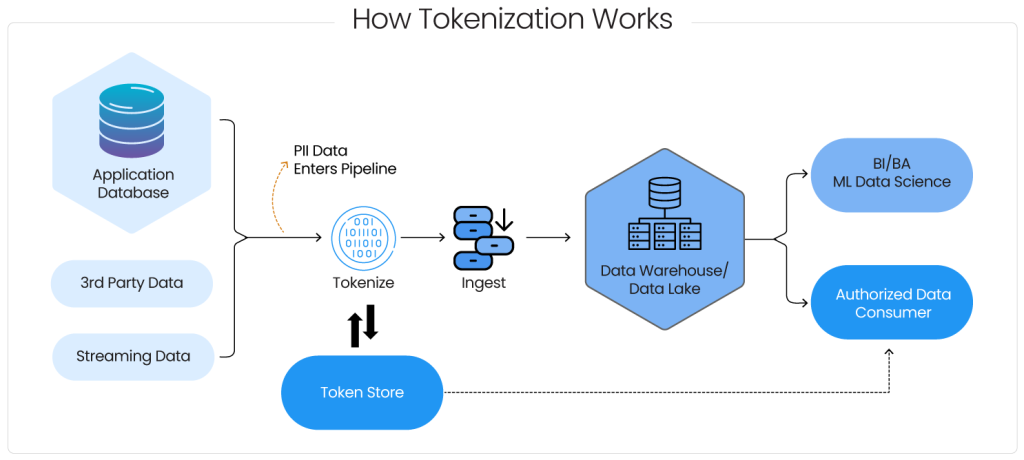
How Tokenization Works?

Pictorial representation of how Tokenization works

  • Data Input: The process is initiated by intercepting sensitive data and creating a secure checkpoint before entering storage or processing systems. This ensures a controlled environment for implementing data masking techniques.
  • Token Generation: Once intercepted, sensitive data undergoes tokenization. The tokenizing system uses complex algorithms to generate unique tokens unrelated to the original data and lacking any discernible pattern. The tokenizing system typically employs cryptographic techniques to ensure token randomness and uniqueness.
  • Token Repository: The generated tokens are stored in a secure repository called the tokenization vault, mapping each token to its original data. Access is restricted to authorized personnel, safeguarding the correlation between tokens and sensitive data.
  • Secure Transmission and Storage: The tokenized data, being non-sensitive, can be transmitted and stored with reduced security concerns. Even in a security breach, the compromised tokens are worthless without the corresponding mapping stored securely in the vault.
  • Token Retrieval: Authorized users can retrieve the original data by accessing the vault when required. This process, known as de-tokenization, involves reversing the process and recovering the original sensitive information.

Benefits of Tokenization

Tokenization offers a range of advantages that make it a cornerstone in safeguarding sensitive information. Understanding the benefits is crucial for organizations to fortify their data security and privacy measures.

  • Enhanced Security: It significantly enhances data security by replacing sensitive information with tokens. Even if intercepted, these tokens are meaningless without access to the corresponding vault, providing a robust defense against unauthorized access.
  • Compliance Assurance: It aids organizations in achieving and maintaining compliance with stringent data protection regulations such as GDPR, PCI DSS, HIPAA, LGPD, PIPL, etc. It ensures that sensitive data is handled consistently with legal and regulatory requirements.
  • Secure Transmission and Storage: Tokenized data, being non-sensitive and lacking identifying information, can be transmitted and stored with reduced security concerns. This strengthens enterprise security, mitigating data transmission and storage risks.
  • Customizable Access Control: It enables organizations to implement customizable access controls. This ensures that only authorized personnel with explicit permissions can access sensitive information, protecting personally identifiable information (PII) from unauthorized disclosure.

Use Cases

It finds versatile applications across various industries and scenarios. Below are critical use cases highlighting the masking technique’s effectiveness in safeguarding sensitive data.

  • Development and Testing: It acts as a pivotal tool in preserving the realism of datasets without compromising privacy in the non-production environment. It allows developers and testers to work with representative data without using actual sensitive information.
  • Research and Analytics: It facilitates ethical and privacy-conscious research practices, ensuring the extraction of valuable insights without exposing raw, identifiable information.
  • Healthcare Data Protection: In the healthcare sector, where patient records and medical information are pseudonymized to uphold privacy standards while allowing authorized healthcare professionals to access relevant data for treatment and research, tokenization is widely employed.
  • Financial Transactions: In the financial industry, it masks personal financial information, such as credit card numbers or account details, to reduce the risk of identity theft and financial fraud while maintaining the functionality of transactional systems.

In conclusion, Tokenization is a pivotal technique within data masking, offering a robust layer of security by replacing sensitive data with randomized tokens. Core features like tokenization-vault, uniqueness, and scalability ensure comprehensive protection of sensitive information across various applications and platforms. Embracing Tokenization signifies a proactive approach toward safeguarding data integrity and privacy in today’s ever-evolving digital landscape.

FAQs

Is tokenization reversible, or can the original data be retrieved from tokens?

Typically, tokenization irreversibly ensures that the original data cannot reconstructed from tokens alone. This minimizes the risk of data exposure, even if intercepting the tokens, enhancing security.

Can organizations use tokenization for all types of sensitive data, including personally identifiable information (PII) and payment card data?

Yes, tokenization, a versatile method, can apply to various types of sensitive data, including PII and payment card data. It provides a robust security measure against unauthorized access and data breaches.

Can organizations seamlessly integrate tokenization into their existing systems and workflows?

Yes, tokenization solutions integrate seamlessly with existing systems and workflows. They often offer APIs and software development kits (SDKs) for easy implementation across various platforms and applications.

Pseudonymization

What is Pseudonymization?

Pseudonymization is a sophisticated data masking technique that replaces or encrypts sensitive information with pseudonyms or aliases, rendering it more secure and privacy-compliant, such as GDPR, PCI DSS, HIPAA, LGPD, PIPL, etc. A pseudonym is a fictitious identifier that can stand in for a real person or entity.

This technique itself is considered reversible, but the level of reversibility depends on the specific method used to create the pseudonym. Its reversibility, achievable through a key or mapping, enables the recovery of the original data. It encompasses techniques like tokenization, encryption, and Format-Preserving Encryption (FPE).

How does Pseudonymization work?

The inner workings of Pseudonymization revolve around the intricate process of transforming identifiable data into pseudonyms or encrypted values, safeguarding sensitive information while ensuring the reversible nature of the transformation. Here’s a detailed exploration of how it operates within the broader context of data security and privacy:

  • Identification of Sensitive Data: Organizations must identify specific sensitive information within their datasets before implementing the masking. This may include personally identifiable information (PII), protected health information, social security numbers, etc.
  • Selection of Technique: Masking with pseudonyms can be achieved through various methods, each offering unique advantages. Common methods include tokenization, encryption, redaction, etc. The choice depends on the data’s specific requirements and the organization’s security and privacy goals.
  • Application of Masking Rules: The sensitive data is transformed once the technique is chosen. This step ensures that the original data becomes obscured, reducing the risk of unauthorized access or exposure.
  • Secure Key or Mapping System: A secure key or mapping system maintains the process’s reversibility according to the masking technique. This system correlates the mapping keys back to the original data, allowing only authorized users to retrieve the genuine information.
  • Integration into Data Processes: It is then seamlessly integrated into various data processes, such as analytics, testing, or research, where the transformed data can be used without compromising individual privacy.

Benefits of Pseudonymization

Here’s an in-depth exploration of its benefits, considering various other data masking techniques and privacy considerations.

  • Enhanced Data Privacy: Substituting sensitive data with pseudonyms or encrypted values could reduce the risk of unauthorized access and exposure to data. This proactive measure can align with data privacy regulations and strengthen organizations’ compliance frameworks.
  • Preserved Data Utility: Unlike anonymization, which may render data unusable by deleting or blurring it, pseudonymization maintains data usability. This enables access to meaningful datasets while upholding security and privacy standards in various environments.
  • Regulatory Compliance: It aids enterprises in achieving and maintaining regulatory compliance, such as GDPR, by actively addressing the requirements for the responsible handling of sensitive data.
  • Flexible Data Usage: Organizations can utilize pseudonymized data for analytics, testing, and research, maintaining individual privacy. This flexibility enables businesses to derive valuable insights while upholding ethical data practices.

Use Cases

With its versatile applications, pseudonymized data finds relevance across various industries and scenarios, providing a robust solution to balance data utility and individual privacy. The following use cases highlight the practical applications of it in different domains:

  • Health and Finance sector: It secures patient records, enabling secure analyses and fortifying confidentiality in the health sector. Similarly, in finance, it protects client PII for secure transactions, fraud detection, and regulatory compliance.
  • Testing and Development: Pseudonymizing sensitive data during testing helps organizations maintain confidentiality and conduct efficient testing without exposing actual PII, reducing risks of f handling sensitive information in development environments.
  • Research and Analytics: It facilitates ethical and privacy-compliant research and analytics across diverse industries. Research institutions and data analysts can utilize pseudonymized datasets to derive meaningful insights without compromising individual privacy.
  • Pseudonymization Across Sectors: It is vital across sectors. In HR, it secures workforce data. In education, it protects student information while improving services. Governments employ it for transparent analysis. In e-commerce, it ensures customer privacy for personalized experiences.

In summary, Pseudonymization is crucial in modern data management, bridging the gap between privacy and utility. Its versatile applications across industries underscore its importance in complying with regulations while enabling valuable insights. As organizations strive for responsible data handling, it is a fundamental pillar, ensuring the balance between confidentiality and analytical capabilities in an increasingly data-driven world.

FAQs

How does pseudonymization differ from anonymization?

Unlike anonymization, which irreversibly removes all identifying information, pseudonymization substitutes identifiable data with artificial identifiers, allowing for potential reidentification through additional information held separately.

What are the key challenges in implementing pseudonymization?

One significant challenge is ensuring an effective balance between privacy protection and data usability. Maintaining secure storage and management of the pseudonyms and corresponding identifying information is also crucial.

Can pseudonymized data be reversed back to its original form?

In some cases, yes. While pseudonymization obscures direct identification, it’s not irreversible. Access to the pseudonymization key or additional information makes it possible to reassociate the pseudonyms with their original identifiers.

How does pseudonymization contribute to GDPR compliance?

Pseudonymization is recognized as a privacy-enhancing technique under the General Data Protection Regulation (GDPR). It enables organizations to fulfill data protection obligations while maintaining data utility, facilitating compliance with GDPR requirements.

Data Masking

What is Data Masking?

Data Masking is a pivotal technique, also known as data obfuscation, data encryption, or data anonymization, designed to protect sensitive information by replacing, encrypting, or scrambling original data with fictitious or pseudonymous data. This digital veil ensures data privacy and security, rendering data unreadable while preserving functionality.

Masking data can be reversible or irreversible, depending on the technique used. For example, encryption can be reversible if the encryption key is available, allowing the original data to be restored. However, techniques like tokenization and anonymization may be irreversible since the original data is not retained.

Common Data Masking Approaches

  • Static Data Masking: Static masking involves applying different masking techniques to sensitive data before it’s stored or transmitted, typically during data migration or database refreshes.
  • Dynamic Data Masking: Refers to real-time masking applied to sensitive data as it’s accessed, often implemented in database systems to protect data without altering the underlying data.
  • On-the-Fly Data Masking: It encompasses static and dynamic masking, referring to the application of masking techniques either permanently or in real-time as data is processed, transmitted, or accessed.

Different Data Masking Techniques

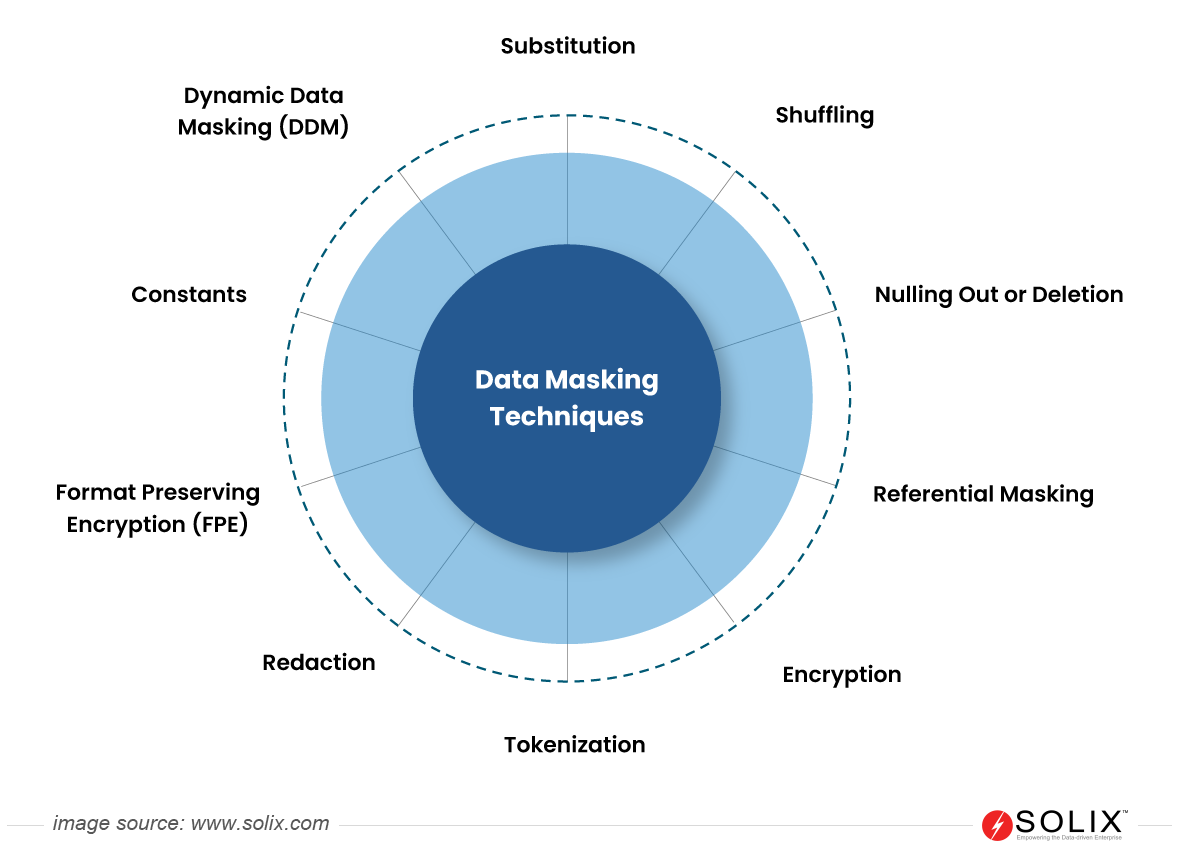
Enhancing enterprise security involves implementing various Data Masking techniques such as tokenization, encryption, anonymization, redaction, Format-Preserving Encryption (FPE), substitution, shuffling, noise addition, hashing, nulling, referential masking, partial data exposure, and data swizzling. These masking techniques are integral components that fortify data security protocols, ensuring a comprehensive and resilient defense against potential internal and external threats.

Data Masking Techniques

Different types of data masking techniques

Key Benefits of Data Masking

By obfuscating real data with realistic but fictitious information, masking enables organizations to mitigate external and internal threats, fortify enterprise security, unleash business value, enhance customer trust, and stringent data privacy regulations like GDPR, CCPA, PIPEDA, LGPD, DPDP, and industry privacy regulations like PCI DSS, GLBA, FedRAMP, FERPA, HIPAA, and among others. By maintaining data realism, masking allows for continued use in development, testing, and analytics, fostering innovation while preserving confidentiality.

Benefits of data masking

Key benefits of data masking

Use cases of Data Masking

Across industries, organizations utilize masking techniques to safeguard sensitive information in various scenarios. Here are a few instances where masking is used.

  • Risk Mitigation: Minimize the impact of potential data breaches.
  • Data Sharing: Share data subsets in a secure, compliant manner.
  • Software Testing: Enable thorough testing without security breaches.
  • Data Analytics and Reporting: Generate insights without compromising privacy.
  • Compliance: Adhere to data protection regulations (GDPR, HIPAA, PCI-DSS, CCPA).
  • User Training: Provide realistic training environments without sensitive data exposure.
  • Collaborate with third parties: Maintain data control while collaborating with third parties.
  • Test – Development Environments: Create datasets safely without exposing production data.

In conclusion, Data Masking is indispensable for protecting sensitive information without compromising data usability. By concealing confidential data with realistic yet fictitious substitutes, organizations can mitigate the risk of data breaches while ensuring compliance with stringent privacy regulations. Ultimately, It empowers businesses to securely share and utilize data for various purposes, safeguarding privacy and utility in today’s digital landscape.

FAQ

What is Data Masking?

Data Masking is a technique used to conceal sensitive information within a database, replacing it with fictitious but realistic data to protect confidentiality.

Is Data Masking reversible?

Data Masking can be reversible or irreversible based on the techniques used. For example, redaction is reversible, as it permanently masks the data, while techniques like encryption are reversible.

Can Data Masking be automated?

Yes, Data Masking can be automated using specialized software tools that streamline the masking process. Automation helps ensure consistency, scalability, and efficiency in masking techniques across large datasets and diverse environments.

Can data masking impact database performance?

Yes, data masking can impact database performance, particularly if complex masking algorithms are used or if the masking process is applied to large datasets. Performance considerations should be carefully evaluated during implementation.