IDPC

What is IDPC?

The Italian Data Protection Code, IDPC (Legislative Decree No. 196 of 2003), also known as the Privacy Code, safeguards the processing of personal data in Italy. It establishes data collection, use, storage, and disclosure principles and grants individuals the right to control their information. The GDPR became directly applicable in all EU member states, including Italy, in May 2018. However, Italy passed a decree to harmonize the IDPC with the GDPR.

Overview of IDPC

  • Law: Italian Data Protection Code
  • Region: Italy
  • Signed On: 30-06-2003
  • Effective Date: 01-01-2004
  • Industry: All industries that do business with Italian residents

Personal Data Under the IDPC

The Code defines personal data broadly, encompassing any information relating to an identified or identifiable natural person. Here’s a breakdown of what the Code considers personal data:

  • Direct identifiers: This includes information that can directly identify an individual, such as name, identification number, address, phone number, and email address.
  • Indirect identifiers: Examples include location data (GPS coordinates, IP address), online identifiers (cookies, usernames), and physical, physiological, genetic, mental, economic, cultural, or social identity specifics.

The Code offers additional protection for specific categories of personal data deemed more sensitive. This “special category data” includes information revealing racial or ethnic origin, political opinions, religious or philosophical beliefs, trade union membership, genetic data, biometric data for identification purposes, and data concerning health.

Data Protection Principles

The act was built on core principles like adherence to the law, fairness, transparency, limitations on purposes, minimizing data, ensuring accuracy, restricting storage, maintaining integrity, and preserving confidentiality. Adhering to these principles ensures the lawful and ethical handling of personal data.

Rights Under the IDPC

Individuals in Italy possess various rights under the Data Protection Code, including access, rectification, erase, restrict processing, object to processing, and data portability. Individuals gain authority over their personal information through these rights, allowing them to assert control over how their data is handled.

Who Needs to Comply with the IDPC?

The Italian Data Protection Code applies broadly and transcends specific industries. Any organization that processes the personal data of Italian residents must comply with the Code, regardless of industry or location. Here’s a breakdown of which entities are required to comply with the act:

  • Companies: This includes all for-profit businesses, large or small.
  • Non-Profit Organizations: Charities, NGOs, and other non-profits must comply if they handle Italian resident data.
  • Government Agencies: Public sector entities also need to adhere to the Code when processing the personal information of Italian citizens.

Noncompliance Fines

The Italian Data Protection Code imposes significant fines for non-compliance. The maximum fine under the Code reaches €3 million. The Code utilizes a two-tiered system for determining fines. This means the specific penalty amount depends on the severity of the violation. Here’s a breakdown of the structure:

  • Lower Tier: For less severe infringements, fines can range from a warning to a maximum of €250,000.
  • Higher Tier: More severe violations, such as unlawful processing of sensitive data or failure to implement appropriate security measures, can incur a maximum fine of €3 million.
  • GDPR Interaction: “It’s vital to note that the Italian Data Protection Code complements the GDPR, which imposes hefty fines for violations, up to €20 million or 4% of global annual turnover.

Compliance Authority

The Italian Data Protection Authority (Garante per la protezione dei dati personali) is responsible for enforcing the Code. They can investigate complaints, issue fines, and order corrective actions.

In conclusion, understanding and adhering to the Italian Data Protection Code is essential for organizations operating within Italy’s jurisdiction to ensure personal data’s lawful and ethical handling. Conducting regular audits, providing ongoing staff training on data protection practices, and implementing robust data governance practices, like data masking, can significantly aid compliance efforts.

FAQ

How does the Italian Data Protection Code align with the GDPR?

The Italian Data Protection Code aligns closely with the GDPR, supplementing its provisions to ensure comprehensive data protection within Italy’s legal framework. Both regulations share similar principles and rights, providing a unified approach to safeguarding personal data.

How does the Italian Data Protection Code handle data transfers outside the EU?

The Italian Data Protection Code permits data transfers to countries outside the EU only if adequate safeguards exist, such as standard contractual clauses, binding corporate rules, or the recipient country’s adequacy status.

Are there any exemptions for small businesses under the Italian Data Protection Code?

While the Code applies to all organizations processing personal data, certain obligations may be tailored to a business’s size and complexity, ensuring proportionate compliance efforts.
EU Cookie Law

What is EU Cookie Law?

The ePrivacy Directive (officially the Privacy and Electronic Communications Directive—PEC) or EU Cookie Law is a regulation established by the European Union (EU) to safeguard data privacy in the electronic communications sector. It governs how organizations handle user data collected electronically, including email, phone calls, browsing activity, and cookies. The directive, often called the Cookie Law, is known for its website cookie usage regulations.

Overview of EU Cookie Law

  • Law: Privacy and Electronic Communications Directive (PEC) / EU Cookie Law
  • Region: European Economic Area (EEA)
  • Signed On: 12-07-2002
  • Effective Date: 31-06-2003
  • Industry: Any industry that utilizes electronic communication

Personal Data Under the EU Cookie Law

The ePrivacy Directive applies to a broad definition of “personal data.” Any information that can be used to directly or indirectly identify an individual falls under its protection. Here’s a breakdown of what it encompasses:

  • Direct identifiers: This includes information that can definitively pinpoint a person, such as their name, address, phone number, and email address.
  • Indirect identifiers: These are data that, when combined with other information, could identify an individual. This includes location data (IP address, GPS coordinates), device identifiers (cookie IDs, unique device identifiers), and online identifiers (usernames, social media profiles).
  • Traffic data: Information related to a user’s communication activities, such as the date, time, duration, source, and destination of a phone call or email.

Data Protection Principles

The Cookie law outlines several core principles for data protection, including:

  • Accuracy: Personal data must be precise and regularly updated.
  • Fairness and transparency: Data collection must be lawful and transparent to the user.
  • Purpose limitation: Data can only be collected for specified, legitimate purposes and cannot be further processed in an incompatible manner.
  • Data minimization: The amount of data collected must be adequate, relevant, and limited to what is necessary for the purposes for which it is processed.
  • Storage limitation: Store data only for the duration necessary for processing purposes. Process personal data to guarantee proper security and confidentiality.

Rights Under the EU Cookie Law

It grants individuals various rights regarding their data, including:

  • The right to access their data.
  • The right to rectification of inaccurate personal data.
  • The right to the erasure of their data.
  • The right to object to the handling of their data.

Who Needs to Comply?

The ePrivacy Directive applies broadly to any organization operating within the EAA or offering services to EAA residents. This encompasses a wide range of entities involved in electronic communication, including website owners, app developers, social media platforms, email marketing companies, and even data processors working on behalf of controllers targeting the EAA.

Noncompliance Fines

The ePrivacy Directive enforces compliance through hefty fines for violations. The penalty’s severity depends on the nature of the offense and the specific EAA member state handling the case. Here’s a breakdown of noncompliance fines:

  • Significant fines: EAA member states can impose substantial financial penalties for non-compliance with the ePrivacy Directive. These fines can reach millions of euros, with some high-profile cases exceeding €100 million.
  • Varied by member state: The exact fine amount can differ depending on the specific EAA member state where the violation occurs. Each member state has enforcement mechanisms and may have varying fine scales based on the offense’s severity.

Compliance Authority

Each EU member state has its designated National Data Protection Authority (DPA). These independent bodies enforce the ePrivacy Directive within their respective countries.

In conclusion, the ePrivacy Directive safeguards user privacy in the digital age. Organizations can achieve compliance by implementing robust data governance practices, including data minimization, user consent for cookie usage, and clear data collection and processing communication.

FAQ

What exactly constitutes electronic communications under the ePrivacy Directive?

Electronic communications encompass various forms of communication transmitted via electronic means, including emails, text messages, voice calls, and internet browsing activities. It also includes metadata associated with these communications, such as timestamps and location data.

Are there any exemptions for small businesses under the ePrivacy Directive?

While the ePrivacy Directive does not specifically exempt small businesses, specific provisions may apply differently based on the size and nature of the business. However, all organizations that handle electronic communications data must comply with the directive’s privacy and protection requirements.

How does the ePrivacy Directive interact with the General Data Protection Regulation (GDPR)?

The ePrivacy Directive complements the GDPR by providing specific rules and requirements for protecting privacy and confidentiality in electronic communications. Both regulations aim to safeguard individuals’ rights and freedoms concerning the processing of personal data, with the GDPR serving as a more comprehensive framework.

Colorado Privacy Act

What is the Colorado Privacy Act?

The Colorado Privacy Act (CPA) is a state-level privacy law designed to safeguard the personal data of Colorado residents. It sets stringent regulations for businesses handling personal information, emphasizing transparency, data security, and individual rights. Organizations must comply with data protection principles, facilitate individual rights, and face significant fines for noncompliance, ensuring robust protection of personal information.

Overview of the Colorado Privacy Act

  • Law: Colorado Privacy Act
  • Region: Colorado
  • Signed On: 07-07-2021
  • Effective Date: 01-07-2023
  • Industry: All industries that do business in Colorado

Personal Data Under the CPA

The Colorado Privacy Act (CPA) defines personal data broadly, encompassing any information that can be used to identify or is reasonably linkable to a specific individual. This includes a wide range of data points, categorized as follows:

  • Identifiers: Any form of identification, including names, aliases, physical addresses, distinct personal markers, online handles, email addresses, account names, social security numbers, driver’s license numbers, passport details, or comparable identifiers.
  • Commercial Data: This category captures information about a person’s purchasing habits and tendencies, like records on personal possessions, acquired goods, or services.
  • Biometric Data: Physiological, biological, or behavioral characteristics that can be used to identify a specific individual (e.g., fingerprints, facial recognition, iris scans, voice recordings).
  • Geolocation Data: Approximate or precise geographic location information.
  • Electronic records: This includes personal information, such as call recordings, videos, or social media posts where the individual can be identified.
  • Employment Information: Information about a person’s job history, performance evaluations, or other work-related data.

Data Protection Principles

The act was built on key data protection principles, such as transparency, purpose limitation, data minimization, security, integrity, and accountability. Businesses must adhere to these principles when collecting, processing, and storing personal data.

Rights Under the Colorado Privacy Act

Under the act, Colorado residents are granted several rights regarding their data, including access, correct, delete, and opt-out of the sale of their information. Businesses are obligated to facilitate these rights upon request.

Who Needs to Comply with the CPA?

It applies to businesses that conduct business in Colorado or target Colorado residents and meet certain thresholds regarding collecting and processing personal data. This includes both personal data controllers and processors if they meet one or both of the following criteria:

  • Data Processing Thresholds: The business “processes” the personal data of at least 100,000 Colorado residents in a calendar year.
  • Data Sale and Revenue Generation: The business derives revenue from the sale of personal data of at least 25,000 Colorado residents in a calendar year.

Noncompliance Fines

It doesn’t specify a set fine amount for non-compliance. It treats fines as civil, not criminal. This means the intention of the violation isn’t considered as heavily as in a criminal case. The penalties can range from $2,000 per violation per consumer to a maximum of $500,000. Here’s a breakdown of the potential fines:

  • Minimum: $2,000 per violation
  • Per Consumer: The fine applies to consumers whose data rights were violated.
  • Maximum Cap: Total penalties cannot exceed $500,000 for a single incident.

Compliance Authority for the CPA

The Colorado Attorney General’s office enforces the CPA and ensures compliance with its provisions. Businesses must prepare to cooperate with investigations and audits conducted by the Attorney General’s office to demonstrate compliance.

In conclusion, the Colorado Privacy Act (CPA) establishes comprehensive regulations for protecting the personal data of Colorado residents. To comply with the CPA, organizations should prioritize transparency, data security, and respect for individual privacy rights. Implementing robust data protection measures and policies like data masking is essential to meeting the CPA’s requirements and safeguarding personal information effectively.

FAQ

What makes the Colorado Privacy Act (CPA) unique compared to other privacy laws?

The CPA introduces a universal opt-out mechanism for targeted advertising, distinct from other privacy laws. It empowers Colorado residents to opt out of the processing of personal data for such purposes, enhancing control over their online experiences.

Are there any exemptions under the Colorado Privacy Act (CPA) for small businesses?

Yes, small businesses with fewer than 25,000 Colorado residents’ data or less than 50% of gross revenue from selling personal data are exempt from certain CPA obligations. However, they must still comply with core privacy principles and individual rights.

Can individuals request access to their data under the Colorado Privacy Act (CPA)?

Yes, individuals have the right to request access to their data held by businesses subject to the CPA. Upon receiving a verified request, businesses must provide a copy of the requested information and details on its processing within a specified timeframe.

Are there any cross-border data transfer restrictions under the Colorado Privacy Act (CPA)?

The Colorado Privacy Act (CPA) doesn’t explicitly address cross-border data transfers. There are no specific requirements or prohibitions outlined in the law. However, the CPA does emphasize data security and responsible data handling. This indirectly impacts cross-border transfers.

Data Protection Act (DPA 2018)

What is DPA 2018?

The Data Protection Act 2018 (DPA 2018) is pivotal legislation in the United Kingdom, aligning with GDPR principles to safeguard personal data. It emphasizes transparency, individual control, and robust security measures for personal data processing and outlines key components such as data protection principles, individual rights, stronger security, and enforcement measures.

Overview of DPA 2018

  • Law: Data Protection Act 2018
  • Region: United Kingdom
  • Signed On: 23-05-2018
  • Industry: Any organization processing personal data, regardless of the specific industry sector

Personal Data Under The DPA 2018

If a piece of information can be used, directly or indirectly, to identify a particular individual, it likely falls under the scope of personal data protected by the DPA 2018.

  • Direct identifiers: Name, address, phone number, email address, ID numbers
  • Indirect identifiers: Information that can identify a person when combined with other pieces. This could include location data, IP address, browsing history (tied to an individual), and physical attributes.
  • Biometric data: Data that can be used for unique identification, like fingerprints, DNA, or facial recognition data.
  • Data revealing personal characteristics: Information about your race, ethnicity, religion, political opinions, sexual orientation, health data, and even your economic or social situation.

Data Protection Principle

  • Lawfulness and transparency: Processing must be legal, fair, and transparent to individuals.
  • Purpose limitation: Data must be collected and used only for specified, explicit, and legitimate purposes.
  • Data minimization: Processing must be limited to what is necessary for the intended purpose.
  • Accuracy and accountability: Data must be accurate and up-to-date, and controllers must be accountable for its protection.
  • Storage limitation: Data must be kept only for the minimum period necessary.
  • Integrity and confidentiality:  Implement appropriate technical and organizational measures to ensure data security.

Rights Under DPA 2018

  • Right to access personal data
  • Right to rectification (correction of inaccurate data)
  • Right to erasure (data deletion under certain circumstances)
  • Right to restrict processing
  • Right to data portability (requesting data in a transferable format)
  • Right to object to automated decision-making

Who Needs To Comply DPA 2018?

The UK Data Protection Act 2018 (DPA 2018) applies broadly across all sectors, with minimal exceptions. It does not target specific industries but rather focuses on the specific actions of processing personal data. This means any organization, regardless of its sector, must comply with the DPA 2018 if they:

Organizations operating within the UK:

  • Businesses of all sizes: This includes private companies, sole traders, and public sector organizations like government agencies and universities.
  • Non-profit organizations: Charities, community groups, and other non-profit entities handling personal data must comply.

Organizations outside the UK:

  • Companies offering goods or services to UK residents: Even if your organization isn’t physically located in the UK if you target UK residents with your offerings, you must adhere to DPA 2018.
  • Companies monitoring the behavior of UK residents online: This includes tracking activity on websites, social media platforms, or mobile apps used by UK residents.

Individuals:

  • While the Act primarily targets organizations, specific provisions apply to individuals processing personal data for non-domestic purposes or in a professional capacity outside their primary job role.

Exceptions

The DPA 2018, despite its rigorous regulatory framework, provides exemptions and clarifications tailored to specific contexts, including considerations for national security law, enforcement legal proceedings, journalism, artistic expression, and personal activities conducted outside any professional or commercial scope.

Regulatory Penalties

DPA 2018 empowers the Information Commissioner’s Office (ICO) to impose substantial fines upon non-compliance. These fines can reach a staggering £17.5 million, or 4% of an organization’s global annual turnover, whichever is higher. This signifies the Act’s seriousness in holding organizations accountable for protecting personal data.

In conclusion, the Data Protection Act 2018 is pivotal in upholding individuals’ rights and imposing responsibilities on organizations to adhere to stringent data protection principles. Compliance with this legislation is crucial for fostering trust, mitigating risks, and preserving personal data integrity. Implementing robust data protection measures, like data masking solutions, is essential for navigating regulatory complexities and safeguarding against potential breaches.

FAQ

What if I only process limited personal data, Am I exempt?

The DPA 2011 doesn’t have a strict data volume exemption. Depending on the data’s sensitivity and use, processing even a small amount of personal data can bring you under the DPA’s scope.

How does the DPA 2018 impact government organizations and public authorities?

The DPA 2018 applies equally to government organizations and public authorities. It holds them accountable for processing personal data in compliance with data protection principles and ensures transparency and fairness in governmental data handling.

Does DPA 2108 provide any exemptions for government bodies?

If a public authority holds personal data that isn’t organized electronically (think handwritten notes in a file), the DPA 2018 might not apply.

How does the DPA 2018 address children’s data protection?

The DPA 2018 includes specific provisions for protecting children’s data, requiring organizations to obtain parental consent for processing children’s data in certain circumstances and implementing measures to safeguard children’s privacy rights online.

CPRA

What is CPRA?

The California Privacy Rights Act (CPRA) is the stricter sibling of the CCPA. It expands consumer rights regarding their data under the CCPA. The CPRA expands upon the California Consumer Privacy Act (CCPA) with enhanced rights for consumers, heightened transparency requirements, and the establishment of a dedicated enforcement agency, the California Privacy Protection Agency (CPPA). It essentially strengthens Californians’ data privacy protections.

Overview of CPRA

  • Law: California Privacy Rights Act
  • Region: California
  • Signed into Law: 03-11-2020
  • Effective Date: 01-07-2023
  • Industry: All industries that do business in California

Personal Data Under The CPRA

The CPRA inherits the CCPA’s definition of personal information as any information that identifies, relates to, describes, is capable of being associated with, or could reasonably be linked with a particular consumer or household.

The CPRA introduces a new category – “sensitive personal information.” This includes data revealing a Californian’s Social Security Number, precise geolocation, race, religion, sexual orientation, health data, etc.

Key Components Of CPRA

  • Expanded consumer rights: CPRA builds upon the CCPA by broadening existing rights (like access and deletion) and introducing new ones, such as
    • Right to correction
    • Right of access to specific information
    • Right to know the length of data retention
    • Right to opt-out of sale and sharing of personal data
    • Right to limit the use of sensitive information for specific purposes
  • Stricter enforcement: The act establishes the California Privacy Protection Agency (CPPA) with the authority to investigate violations and enforce penalties, including fines of up to $7,500 per violation for intentional violations involving children’s data.

Data Protection Principle

The California Privacy Rights Act goes beyond simply granting Californians rights over their data. It establishes core data protection principles that all businesses collecting personal information from California residents must adhere to. The below-mentioned principles aim to build trust and ensure responsible data handling:

  • Transparency
  • Accountability
  • Purpose limitation
  • Data minimization
  • Data security and privacy
  • Non-discrimination against CPRA rights
  • Enforcement of California Privacy Protection Agency (CPPA)

Rights Under CPRA

  • Right to Know: Access collected personal information.
  • Right to Delete: Request erasure of personal data.
  • Right to Correct: Instruct businesses to correct inaccurate information.
  • Right to Opt-Out of Sharing: Prevent businesses from selling or sharing personal information.
  • Right to Limit: Consumers can limit using sensitive information for specific purposes, like advertising.

Who Needs To Comply?

The California Privacy Rights Act applies to a broader range of businesses than most data privacy laws, making it crucial for organizations to understand their compliance obligations. Here’s a breakdown of who needs to comply with the act. For-profit businesses doing business in California that meet at least one of the following thresholds

  • Annual gross revenue exceeding $25 million.
  • Engage in purchasing, receiving, or selling personal information from 50,000 or more California residents, households, or devices.
  • Earn more than 50% of their annual revenue from selling or sharing consumers’ personal information (regardless of revenue size).
  • If an entity uses third-party vendors that handle Californian data, ensure the same to comply with the act.

Exceptions

  • Non-profit organizations
  • Businesses with less than $25 million in annual revenue and less than 100,000 California residents’ data
  • Individuals and households

Regulatory Penalties

The California Privacy Rights Act comes with teeth, and failing to comply can bite your business financially. Below are outlines of potential fines:

  • Intentional Violations: Up to $7,500 per violation for each Californian affected.
  • Unintentional Violations: Up to $2,500 per violation for each Californian affected.
  • Children’s Data: Violations concerning individuals under 16 incur escalated fines.

Compliance Authority For CPRA

The California Privacy Protection Agency (CPPA) enforces CPRA and ensures compliance with its provisions. The CPPA has the authority to investigate complaints, conduct audits, and impose fines and penalties for violations of CPRA.

How to avoid CCPA Fines?

  • Adhere to data subject rights
  • Implement robust data inventory
  • Prioritize strong security practices
  • Draft a clear data governance policy
  • Implement robust data access controls

In conclusion, the California Privacy Rights Act (CPRA) marks a crucial advancement in data privacy, granting Californians unprecedented authority over their data. While adhering to its regulations may seem daunting, understanding the core principles and key requirements is crucial for any business operating in the state. By implementing robust data governance practices, leveraging data masking solutions, and staying informed about evolving compliance expectations, you can navigate the CPRA landscape with confidence.

FAQ

What is the California Privacy Rights Act (CPRA)?

CPRA is a privacy law enhancing the CCPA, providing additional consumer rights, and stricter regulations, and establishing the California Privacy Protection Agency.

When does CPRA come into effect?

January 1, 2023.

What are the new updates on the consumer rights under the CPRA?

CPRA grants consumers rights such as the right to correct inaccurate information, limit data sharing, and restrict sensitive data processing.

Is CPRA applicable to all businesses?

CPRA applies to businesses that collect personal information from California residents and meet specific revenue or data processing thresholds.

CCPA

What is CCPA?

The California Consumer Privacy Act (CCPA) s a state statute that enhances consumer privacy rights and regulates the collection, use, and sale of personal information by businesses operating in California. The CCPA is California’s answer to the European Union’s GDPR. It grants consumers the right to access, delete, correct, etc, to provide transparency and accountability in data practices.

Overview of CCPA

  • Law: California Consumer Privacy Act
  • Region: California
  • Signed On: 28-06-2018
  • Effective Date: 01-01- 2020
  • Industry: All industries that do business in California

Personal Data Under The CCPA

The CCPA defines personal information as any information that identifies a data subject and those that could reasonably be linked with a particular data subject.

Direct Identifiers: Name, address, email, phone number, social security number, driver’s license number, passport number, online identifier, etc.
Indirect Identifiers: IP address, browsing history, purchase records, geolocation data, health data, biometric data, audio recordings, educational information, employment information, inferences drawn from collected data (e.g., spending habits, political views), and other details that, when combined, could identify a person.

Key Components Of CCPA

The California Consumer Privacy Act (CCPA) is built upon several essential components, which collectively establish its comprehensive data protection framework. These components encompass

  • Data Subject Rights
  • Data Protection Principles
  • Compliance Requirements
  • Data Request Handling
  • Enforcement
  • Privacy Policy Updates

Data Protection Principle

The data protection principles of the California Consumer Privacy Act (CCPA) revolve around the following fundamental tenets:

  • Purpose Limitation: PII collected must be used only for the specific purposes disclosed to the consumer during collection. Businesses cannot use it for unrelated purposes without additional consent.
  • Data Minimization: Businesses can only collect reasonably necessary PII for their stated purposes. Collecting excessive or irrelevant data raises privacy concerns and increases compliance risks.
  • Data Security: Businesses must implement reasonable security measures to protect PII from unauthorized access, disclosure, alteration, or destruction. These measures include encryption, access controls, regular security assessments, and more.
  • Transparency: Businesses must be transparent about the PII they collect, its purposes, and any third parties with whom data is shared. They also need mechanisms for consumers to exercise their rights and address concerns.
  • Accountability: Businesses are accountable for complying with CCPA requirements, including responding to consumer requests and ensuring third-party service providers adhere to the law.

Rights Under CCPA

The CCPA empowers Californians with various rights regarding their PII:

  • Right to Inform
  • Right to Access
  • Right to Deletion
  • Right to Correct
  • Right to Limit Use
  • Right to Opt-Out of Sale
  • Right to Non-discrimination

Who Needs To Comply

The CCPA applies to businesses that:

  • Do business in California.
  • Collect the PII of California residents.
  • Have an annual gross revenue surpassing $25 million.
  • Buy or sell the PII of 50,000 or more California residents annually.
  • Derive 50% or more of their gross revenue from selling California residents’ PII.

Exceptions

The CCPA, while aiming for comprehensive data privacy protection, does include several exceptions:

  • Business-to-Business Communications: This policy doesn’t apply to personal information collected for business-to-business communications, which means interactions between businesses rather than between companies and individuals.
  • Employee Data: Information about employees, collected and used solely within the context of the employment relationship, falls outside the CCPA’s scope. However, data collected about job applicants falls under CCPA protections.
  • Publicly Available Information: PII already available from public records is exempt from CCPA regulations.
  • Financial Institutions: Information governed by specific federal laws, such as the Fair Credit Reporting Act (FCRA) or Gramm-Leach-Bliley Act (GLBA), is exempt from certain CCPA provisions.
  • Research: Scientific, historical, or statistical research activities can be exempt from CCPA’s deletion requirement under specific conditions, like informed consent and public interest justification.
  • Vehicle Ownership Information: The Driver’s Privacy Protection Act (DPPA) supersedes the CCPA for information like vehicle ownership shared between dealerships and manufacturers for warranty or recall purposes.
  • Healthcare Sector: In protected health information (PHI) matters, the California Confidentiality of Medical Information Act (CMIA) precedes the CCPA.
  • Law Enforcement Activities: Personal information collected and used for law enforcement purposes is outside the CCPA’s scope.

Regulatory Penalties

The CCPA imposes two types of fines for non-compliance:

Per-Violation Fines: Intentional Violations: $7,500 per violation, with no set maximum. This means the penalties can quickly multiply depending on the number of affected individuals and violations.
Unintentional Violations: $2,500 per offense, capped at $2,500 per data breach event. This emphasizes the importance of preventative measures to avoid unintentional errors.
Consumer Lawsuits: Statutory Damages: $100-$750 per affected consumer per occurrence or actual damages incurred (whichever is higher). This empowers individuals to seek direct compensation for privacy violations.
Injunctive Relief: Courts can impose orders to stop unlawful activity and prevent future harm.

Compliance Authority For CCPA

The primary compliance authority for the California Consumer Privacy Act is the California Attorney General’s Office (CAO). The California Privacy Protection Agency started operating in July 2023. However, the CPPA focuses primarily on rulemaking and education, taking over most of these responsibilities from the CAO. The CAO maintains its enforcement authority under the CCPA and other ongoing legal duties. Therefore, while the CPPA plays a growing role in CCPA compliance, the California Attorney General’s Office remains the primary enforcement authority for the act.

In conclusion, understanding and adhering to CCPA regulations are paramount for businesses operating in California or handling the personal information of California residents. Data masking techniques, like data anonymization, data encryption, and data redaction, can significantly reduce the risk of non-compliance and data breaches by obscuring sensitive PII within development, testing, and analytics environments. This minimizes the exposure of sensitive information like personally identifiable information (PII), financial records, protected health information, social security numbers, etc, simplifying CCPA compliance and enhancing data security and privacy.

Pseudonymization

What is Pseudonymization?

Pseudonymization is a sophisticated data masking technique that replaces or encrypts sensitive information with pseudonyms or aliases, rendering it more secure and privacy-compliant, such as GDPR, PCI DSS, HIPAA, LGPD, PIPL, etc. A pseudonym is a fictitious identifier that can stand in for a real person or entity.

This technique itself is considered reversible, but the level of reversibility depends on the specific method used to create the pseudonym. Its reversibility, achievable through a key or mapping, enables the recovery of the original data. It encompasses techniques like tokenization, encryption, and Format-Preserving Encryption (FPE).

How does Pseudonymization work?

The inner workings of Pseudonymization revolve around the intricate process of transforming identifiable data into pseudonyms or encrypted values, safeguarding sensitive information while ensuring the reversible nature of the transformation. Here’s a detailed exploration of how it operates within the broader context of data security and privacy:

  • Identification of Sensitive Data: Organizations must identify specific sensitive information within their datasets before implementing the masking. This may include personally identifiable information (PII), protected health information, social security numbers, etc.
  • Selection of Technique: Masking with pseudonyms can be achieved through various methods, each offering unique advantages. Common methods include tokenization, encryption, redaction, etc. The choice depends on the data’s specific requirements and the organization’s security and privacy goals.
  • Application of Masking Rules: The sensitive data is transformed once the technique is chosen. This step ensures that the original data becomes obscured, reducing the risk of unauthorized access or exposure.
  • Secure Key or Mapping System: A secure key or mapping system maintains the process’s reversibility according to the masking technique. This system correlates the mapping keys back to the original data, allowing only authorized users to retrieve the genuine information.
  • Integration into Data Processes: It is then seamlessly integrated into various data processes, such as analytics, testing, or research, where the transformed data can be used without compromising individual privacy.

Benefits of Pseudonymization

Here’s an in-depth exploration of its benefits, considering various other data masking techniques and privacy considerations.

  • Enhanced Data Privacy: Substituting sensitive data with pseudonyms or encrypted values could reduce the risk of unauthorized access and exposure to data. This proactive measure can align with data privacy regulations and strengthen organizations’ compliance frameworks.
  • Preserved Data Utility: Unlike anonymization, which may render data unusable by deleting or blurring it, pseudonymization maintains data usability. This enables access to meaningful datasets while upholding security and privacy standards in various environments.
  • Regulatory Compliance: It aids enterprises in achieving and maintaining regulatory compliance, such as GDPR, by actively addressing the requirements for the responsible handling of sensitive data.
  • Flexible Data Usage: Organizations can utilize pseudonymized data for analytics, testing, and research, maintaining individual privacy. This flexibility enables businesses to derive valuable insights while upholding ethical data practices.

Use Cases

With its versatile applications, pseudonymized data finds relevance across various industries and scenarios, providing a robust solution to balance data utility and individual privacy. The following use cases highlight the practical applications of it in different domains:

  • Health and Finance sector: It secures patient records, enabling secure analyses and fortifying confidentiality in the health sector. Similarly, in finance, it protects client PII for secure transactions, fraud detection, and regulatory compliance.
  • Testing and Development: Pseudonymizing sensitive data during testing helps organizations maintain confidentiality and conduct efficient testing without exposing actual PII, reducing risks of f handling sensitive information in development environments.
  • Research and Analytics: It facilitates ethical and privacy-compliant research and analytics across diverse industries. Research institutions and data analysts can utilize pseudonymized datasets to derive meaningful insights without compromising individual privacy.
  • Pseudonymization Across Sectors: It is vital across sectors. In HR, it secures workforce data. In education, it protects student information while improving services. Governments employ it for transparent analysis. In e-commerce, it ensures customer privacy for personalized experiences.

In summary, Pseudonymization is crucial in modern data management, bridging the gap between privacy and utility. Its versatile applications across industries underscore its importance in complying with regulations while enabling valuable insights. As organizations strive for responsible data handling, it is a fundamental pillar, ensuring the balance between confidentiality and analytical capabilities in an increasingly data-driven world.

FAQs

How does pseudonymization differ from anonymization?

Unlike anonymization, which irreversibly removes all identifying information, pseudonymization substitutes identifiable data with artificial identifiers, allowing for potential reidentification through additional information held separately.

What are the key challenges in implementing pseudonymization?

One significant challenge is ensuring an effective balance between privacy protection and data usability. Maintaining secure storage and management of the pseudonyms and corresponding identifying information is also crucial.

Can pseudonymized data be reversed back to its original form?

In some cases, yes. While pseudonymization obscures direct identification, it’s not irreversible. Access to the pseudonymization key or additional information makes it possible to reassociate the pseudonyms with their original identifiers.

How does pseudonymization contribute to GDPR compliance?

Pseudonymization is recognized as a privacy-enhancing technique under the General Data Protection Regulation (GDPR). It enables organizations to fulfill data protection obligations while maintaining data utility, facilitating compliance with GDPR requirements.

Data Masking

What is Data Masking?

Data Masking is a pivotal technique, also known as data obfuscation, data encryption, or data anonymization, designed to protect sensitive information by replacing, encrypting, or scrambling original data with fictitious or pseudonymous data. This digital veil ensures data privacy and security, rendering data unreadable while preserving functionality.

Masking data can be reversible or irreversible, depending on the technique used. For example, encryption can be reversible if the encryption key is available, allowing the original data to be restored. However, techniques like tokenization and anonymization may be irreversible since the original data is not retained.

Common Data Masking Approaches

  • Static Data Masking: Static masking involves applying different masking techniques to sensitive data before it’s stored or transmitted, typically during data migration or database refreshes.
  • Dynamic Data Masking: Refers to real-time masking applied to sensitive data as it’s accessed, often implemented in database systems to protect data without altering the underlying data.
  • On-the-Fly Data Masking: It encompasses static and dynamic masking, referring to the application of masking techniques either permanently or in real-time as data is processed, transmitted, or accessed.

Different Data Masking Techniques

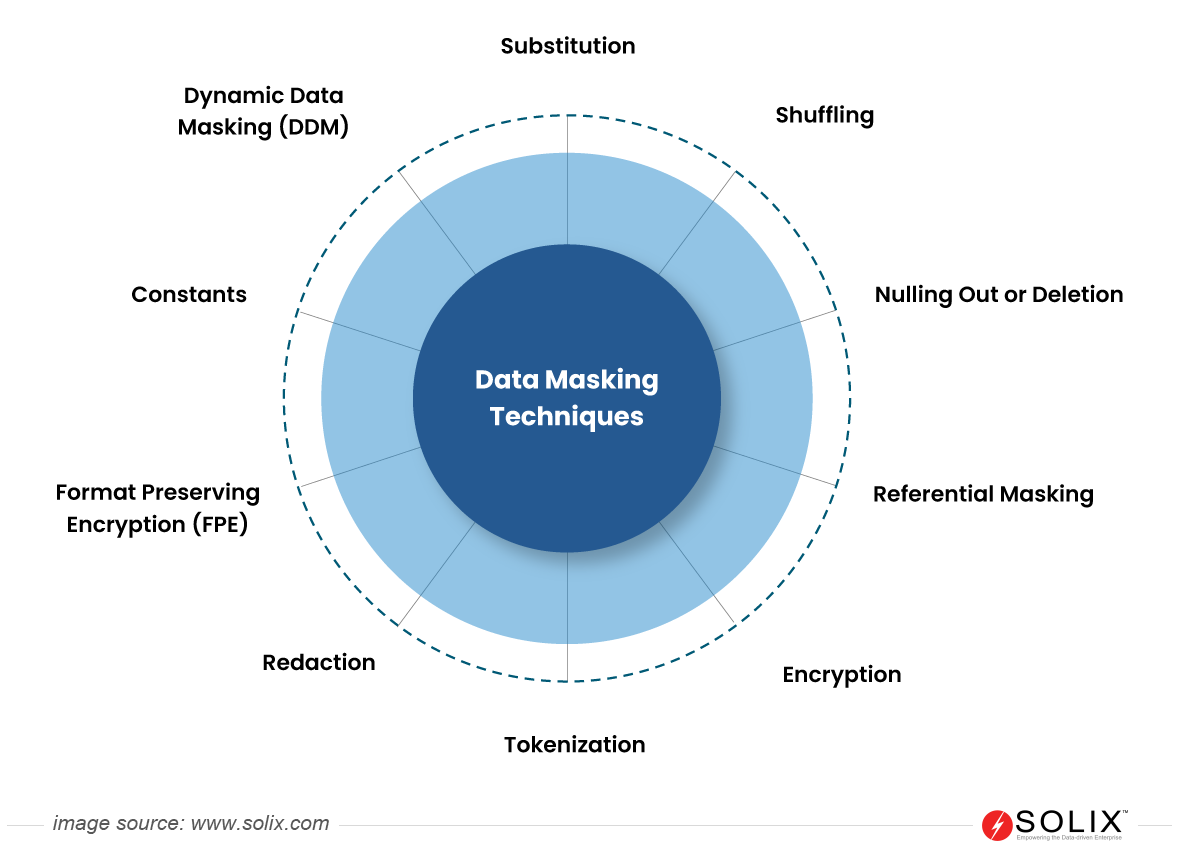
Enhancing enterprise security involves implementing various Data Masking techniques such as tokenization, encryption, anonymization, redaction, Format-Preserving Encryption (FPE), substitution, shuffling, noise addition, hashing, nulling, referential masking, partial data exposure, and data swizzling. These masking techniques are integral components that fortify data security protocols, ensuring a comprehensive and resilient defense against potential internal and external threats.

Data Masking Techniques

Different types of data masking techniques

Key Benefits of Data Masking

By obfuscating real data with realistic but fictitious information, masking enables organizations to mitigate external and internal threats, fortify enterprise security, unleash business value, enhance customer trust, and stringent data privacy regulations like GDPR, CCPA, PIPEDA, LGPD, DPDP, and industry privacy regulations like PCI DSS, GLBA, FedRAMP, FERPA, HIPAA, and among others. By maintaining data realism, masking allows for continued use in development, testing, and analytics, fostering innovation while preserving confidentiality.

Benefits of data masking

Key benefits of data masking

Use cases of Data Masking

Across industries, organizations utilize masking techniques to safeguard sensitive information in various scenarios. Here are a few instances where masking is used.

  • Risk Mitigation: Minimize the impact of potential data breaches.
  • Data Sharing: Share data subsets in a secure, compliant manner.
  • Software Testing: Enable thorough testing without security breaches.
  • Data Analytics and Reporting: Generate insights without compromising privacy.
  • Compliance: Adhere to data protection regulations (GDPR, HIPAA, PCI-DSS, CCPA).
  • User Training: Provide realistic training environments without sensitive data exposure.
  • Collaborate with third parties: Maintain data control while collaborating with third parties.
  • Test – Development Environments: Create datasets safely without exposing production data.

In conclusion, Data Masking is indispensable for protecting sensitive information without compromising data usability. By concealing confidential data with realistic yet fictitious substitutes, organizations can mitigate the risk of data breaches while ensuring compliance with stringent privacy regulations. Ultimately, It empowers businesses to securely share and utilize data for various purposes, safeguarding privacy and utility in today’s digital landscape.

FAQ

What is Data Masking?

Data Masking is a technique used to conceal sensitive information within a database, replacing it with fictitious but realistic data to protect confidentiality.

Is Data Masking reversible?

Data Masking can be reversible or irreversible based on the techniques used. For example, redaction is reversible, as it permanently masks the data, while techniques like encryption are reversible.

Can Data Masking be automated?

Yes, Data Masking can be automated using specialized software tools that streamline the masking process. Automation helps ensure consistency, scalability, and efficiency in masking techniques across large datasets and diverse environments.

Can data masking impact database performance?

Yes, data masking can impact database performance, particularly if complex masking algorithms are used or if the masking process is applied to large datasets. Performance considerations should be carefully evaluated during implementation.