VCDPA

What is VCDPA?

The Virginia Consumer Data Protection Act 2021 (VCDPA) is a regulation giving Virginia residents control over their data, like the right to delete, access, and rectify personal information collected by certain businesses. It sets forth obligations for businesses regarding consumer data, with exceptions for HIPAA and FERPA-regulated information. Virginia is the second state after California to implement comprehensive data privacy legislation.

Overview of VCDPA

  • Law: Virginia Consumer Data Protection Act
  • Region: Virginia
  • Signed Date: 02-03-2021
  • Effective Date: 01-01-2023
  • Industry: All industries that do business in Virginia

Personal Data Under the VCDPA

The Virginia Consumer Data Protection Act (VCDPA) defines “personal data” comprehensively, similar to other consumer privacy laws like the California Consumer Privacy Act (CCPA). Here’s a breakdown of the type of data typically covered by VCDPA.

  • Basic Identifiers: Basic information like name, address, phone number, email address, IP address, or unique online identifiers (cookies, device IDs).
  • Demographic Data: Date of birth, gender, marital status, and information about dependents.
  • Commercial Information: Purchase history, browsing behavior linked to an individual, and loyalty program data.
  • Geolocation Data: Information about an individual’s physical location, such as GPS coordinates, if precise enough to identify a specific location.
  • Sensory Data: Voice recordings, fingerprints, or other biometric data used for identification purposes.
  • Internet Activity Data: Browsing history, search queries, and information about a consumer’s interactions with a website or online service.

Key Components

VCDPA establishes guidelines for collecting, using, and sharing personal data by Virginia businesses. Key components include definitions of personal data, requirements for data protection assessments, mandates for data processing limitations like data minimization, purpose limitation, data security measures, and provisions for consumer rights regarding their personal information like rights to access, correct, delete, portability, and opt-out of data sale and targeted advertising.

Who Needs to Comply?

The VCDPA applies to any business that falls under the following criteria:

  • Conduct business in Virginia or target products/services to Virginia residents. This includes online and offline businesses, regardless of physical location.
  • Control or process personal data of at least 100,000 Virginia residents during a calendar year: This threshold applies to the total number of Virginia residents whose data is processed, even if it’s not the core business activity.
  • Control or process personal data of at least 25,000 Virginia residents and derive over 50% of gross revenue from selling personal data: This includes situations where businesses primarily deal with smaller datasets but rely heavily on data sales for income.

Exceptions

  • Non-profit organizations, certain financial institutions, healthcare providers, entities, or data subject to Title V of the Gramm-Leach-Bliley Act (GLBA), which largely regulates banks, other financial institutions, and government agencies, are exempt from the VCDPA.
  • Deidentified data (data where all identifying information has been removed) may be exempt under specific conditions.
  • The exemption also includes entities or business associates governed by HIPAA’s privacy, security, and breach notification rules;

Noncompliance Fines

  • Per violation: Up to $7,500 per violation. This means individual instances of non-compliance, such as failing to provide access to data upon request or neglecting to implement reasonable security measures, can incur hefty fines.
  • Continuing violations: An additional $750 per day for each day of a continuing violation. This can quickly escalate the financial impact of non-adherence, especially for persistent issues.
  • Maximum limit: The total penalty for any violation cannot exceed $2.5 million.

Compliance Authority

The Virginia Attorney General (AG) is solely responsible for enforcing the VCDPA. This means the AG’s office can investigate potential violations, issue warnings and directives to non-compliant businesses, and seek injunctions to halt illegal data practices.

In conclusion, the Virginia Consumer Data Protection Act (VCDPA) represents a significant step towards enhancing consumer data privacy rights and imposing obligations on businesses to protect personal information. Companies can mitigate compliance risks and build trust with their customers by understanding the critical components of VCDPA, respecting consumer rights, and implementing effective data security solutions such as data masking.

FAQ

What is the Virginia Consumer Data Protection Act (VCDPA), and to whom does it apply?

VCDPA is a state-level privacy law in Virginia, USA that protects consumer data. It applies to businesses that control or process the personal data of Virginia residents who meet certain criteria, regardless of their physical location.

What are the critical rights granted to consumers under the VCDPA?

The VCDPA grants consumers rights such as the right to access their data, correct inaccuracies, delete data under certain circumstances, and opt out of the sale of their data. These rights empower consumers to have more control over their personal information.

How does the VCDPA compare to other privacy laws, such as the GDPR or CCPA?

While the VCDPA shares similarities with the GDPR and CCPA in terms of its focus on consumer rights and data protection, it also has unique provisions and requirements tailored to the Virginia legal landscape and business environment.
LGPD

What is LGPD?

The LGPD (Lei Geral de Proteção de Dados), or the Brazilian General Data Protection Law, is comprehensive legislation that safeguards the privacy and security of individuals in Brazil. It is Brazil’s equivalent to the EU’s GDPR and is designed to regulate the collection, use, processing, and storage of personal data by organizations in Brazil.

Overview of LGPD

  • Law: Brazilian General Data Protection Law
  • Region: Brazil
  • Signed into Law: 14-08-2018
  • Effective Date: 18-08-2020
  • Industry: All industries that do business in Brazil

Personal Data Under The LGPD

LGPD protects two data types in Brazil: personal and sensitive.

  • Personal Data: This information can directly or indirectly pinpoint a specific individual. Examples of personal data include name, email address, phone number, physical address, and IP address.
  • Sensitive Personal Data: This special category of personal data deserves a higher level of protection due to its sensitive nature. Sensitive personal data includes information about racial or ethnic origin, religious beliefs, political opinions, trade union membership, affiliation with religious, philosophical, or political organizations, health data or sexual life, and genetic or biometric data.

Data Protection Principle

The law outlines eight fundamental principles governing data processing:

  • Transparency: Be clear and specific about the data collection and processing purpose.
  • Purpose limitation: Collect and process data only for the stated purposes and avoid further processing that is incompatible with those purposes.
  • Data minimization: Collect and process only the minimum personal data necessary for the intended purpose.
  • Accuracy: Ensure data accuracy and completeness, rectifying errors promptly.
  • Security: Implement adequate technical and organizational measures to protect data from unauthorized access, accidental destruction, or alteration.
  • Retention limitation: Retain data only for the necessary period to fulfill the processing purpose unless required by law.
  • Data transfer: Ensure secure and responsible transfers of personal data outside Brazil, complying with legal requirements.
  • Accountability: Demonstrate compliance with the principles and be accountable for personal data processing.

Rights Under LGPD

  • Right to access
  • Right to rectification
  • Right to erasure
  • Right to portability
  • Right to object
  • Right to information about automated decision-making

Who Needs To Comply with LGPD?

Organizations based in Brazil

  • Non-profit organizations
  • Public and private entities
  • Businesses of various scales, ranging from small startups to expansive corporations

Foreign organizations

  • Companies offering services or products to individuals in Brazil, even if they have no physical presence in the country
  • Data processors working on behalf of Brazilian organizations

Key Exceptions

  • Processing for journalistic, artistic, or academic purposes, subject to specific conditions.
  • Security incident exemption for non-personal data or low risk.
  • Specific rules for public authorities and anonymized data processing.

Compliance Authority For LGPD

As of February 2024, the National Data Protection Authority (ANPD) still needs to be fully operational and enforce the LGPD. However, it plays a crucial role in promoting compliance by:

  • Developing and publishing guidelines and directives related to data protection practices.
  • Educating organizations and individuals about their rights and obligations under the LGPD.
  • Conducting public consultations on legislative changes and regulatory updates.
  • Preparing for future enforcement responsibilities.

Regulatory Penalties

Financial penalties:

  • Maximum fine: BRL 50 million (approx. USD 9.1 million) per violation.
  • Alternative fine: Up to 2% of an organization’s gross annual revenue for the preceding financial year, whichever is higher.
  • Multiple violations: Repeated offenses can result in cumulative fines, significantly impacting an organization’s bottom line.

Non-financial Penalties

  • Data processing suspension: The ANPD can temporarily or permanently restrict data processing activities.
  • Data deletion: The ANPD can order the deletion of illegally collected or processed data.
  • Contractual penalties: Non-compliance can trigger contractual penalties with partners and clients.

In conclusion, LGPD (Lei Geral de Proteção de Dados) marks a pivotal development in Brazil’s data protection landscape, mirroring global efforts to fortify individuals’ privacy rights in an increasingly digital world. By aligning with transparency, accountability, and data subject rights principles, LGPD fosters trust between businesses and consumers and underscores the nation’s commitment to upholding robust data protection standards. Organizations can ensure compliance with LGPD while maintaining data usability for legitimate purposes by implementing data security solutions like data masking.

FAQ

How does LGPD define personal data?

LGPD defines personal data as any information related to an identified or identifiable individual, including but not limited to name, identification numbers, location data, and online identifiers.

Does LGPD apply to data processing activities outside Brazil?

Yes, LGPD applies to the processing of personal data carried out in Brazil, regardless of where the data controller is located, if the data processing activities are directed at individuals in Brazil, or if the data is collected in Brazil.

When did LGPD come into effect?

September 18, 2020.

CPRA

What is CPRA?

The California Privacy Rights Act (CPRA) is the stricter sibling of the CCPA. It expands consumer rights regarding their data under the CCPA. The CPRA expands upon the California Consumer Privacy Act (CCPA) with enhanced rights for consumers, heightened transparency requirements, and the establishment of a dedicated enforcement agency, the California Privacy Protection Agency (CPPA). It essentially strengthens Californians’ data privacy protections.

Overview of CPRA

  • Law: California Privacy Rights Act
  • Region: California
  • Signed into Law: 03-11-2020
  • Effective Date: 01-07-2023
  • Industry: All industries that do business in California

Personal Data Under The CPRA

The CPRA inherits the CCPA’s definition of personal information as any information that identifies, relates to, describes, is capable of being associated with, or could reasonably be linked with a particular consumer or household.

The CPRA introduces a new category – “sensitive personal information.” This includes data revealing a Californian’s Social Security Number, precise geolocation, race, religion, sexual orientation, health data, etc.

Key Components Of CPRA

  • Expanded consumer rights: CPRA builds upon the CCPA by broadening existing rights (like access and deletion) and introducing new ones, such as
    • Right to correction
    • Right of access to specific information
    • Right to know the length of data retention
    • Right to opt-out of sale and sharing of personal data
    • Right to limit the use of sensitive information for specific purposes
  • Stricter enforcement: The act establishes the California Privacy Protection Agency (CPPA) with the authority to investigate violations and enforce penalties, including fines of up to $7,500 per violation for intentional violations involving children’s data.

Data Protection Principle

The California Privacy Rights Act goes beyond simply granting Californians rights over their data. It establishes core data protection principles that all businesses collecting personal information from California residents must adhere to. The below-mentioned principles aim to build trust and ensure responsible data handling:

  • Transparency
  • Accountability
  • Purpose limitation
  • Data minimization
  • Data security and privacy
  • Non-discrimination against CPRA rights
  • Enforcement of California Privacy Protection Agency (CPPA)

Rights Under CPRA

  • Right to Know: Access collected personal information.
  • Right to Delete: Request erasure of personal data.
  • Right to Correct: Instruct businesses to correct inaccurate information.
  • Right to Opt-Out of Sharing: Prevent businesses from selling or sharing personal information.
  • Right to Limit: Consumers can limit using sensitive information for specific purposes, like advertising.

Who Needs To Comply?

The California Privacy Rights Act applies to a broader range of businesses than most data privacy laws, making it crucial for organizations to understand their compliance obligations. Here’s a breakdown of who needs to comply with the act. For-profit businesses doing business in California that meet at least one of the following thresholds

  • Annual gross revenue exceeding $25 million.
  • Engage in purchasing, receiving, or selling personal information from 50,000 or more California residents, households, or devices.
  • Earn more than 50% of their annual revenue from selling or sharing consumers’ personal information (regardless of revenue size).
  • If an entity uses third-party vendors that handle Californian data, ensure the same to comply with the act.

Exceptions

  • Non-profit organizations
  • Businesses with less than $25 million in annual revenue and less than 100,000 California residents’ data
  • Individuals and households

Regulatory Penalties

The California Privacy Rights Act comes with teeth, and failing to comply can bite your business financially. Below are outlines of potential fines:

  • Intentional Violations: Up to $7,500 per violation for each Californian affected.
  • Unintentional Violations: Up to $2,500 per violation for each Californian affected.
  • Children’s Data: Violations concerning individuals under 16 incur escalated fines.

Compliance Authority For CPRA

The California Privacy Protection Agency (CPPA) enforces CPRA and ensures compliance with its provisions. The CPPA has the authority to investigate complaints, conduct audits, and impose fines and penalties for violations of CPRA.

How to avoid CCPA Fines?

  • Adhere to data subject rights
  • Implement robust data inventory
  • Prioritize strong security practices
  • Draft a clear data governance policy
  • Implement robust data access controls

In conclusion, the California Privacy Rights Act (CPRA) marks a crucial advancement in data privacy, granting Californians unprecedented authority over their data. While adhering to its regulations may seem daunting, understanding the core principles and key requirements is crucial for any business operating in the state. By implementing robust data governance practices, leveraging data masking solutions, and staying informed about evolving compliance expectations, you can navigate the CPRA landscape with confidence.

FAQ

What is the California Privacy Rights Act (CPRA)?

CPRA is a privacy law enhancing the CCPA, providing additional consumer rights, and stricter regulations, and establishing the California Privacy Protection Agency.

When does CPRA come into effect?

January 1, 2023.

What are the new updates on the consumer rights under the CPRA?

CPRA grants consumers rights such as the right to correct inaccurate information, limit data sharing, and restrict sensitive data processing.

Is CPRA applicable to all businesses?

CPRA applies to businesses that collect personal information from California residents and meet specific revenue or data processing thresholds.

Sequential Masking

What is Sequential Masking?

Sequential data masking, also known as serial masking, is a technique of masking data elements individually, one after another. In contrast to parallel masking, which processes multiple elements simultaneously, this approach works in a step-by-step fashion, applying a chosen masking algorithm (e.g., tokenization, character substitution) to each data element in the order they appear within the dataset.

How Sequential Masking Work?

Unlike parallel masking, which thrives on simultaneous processing, this technique follows a more systematic approach, akin to an assembly line transforming sensitive information into a veil of anonymity. Let’s delve into the heart of this step-by-step process:

  • Defining the Target: The journey begins with identifying the data elements needing masking treatment. Once the target areas are pinpointed, the desired level of anonymization is determined. This decision shapes the approach you’ll take later.
  • Choosing the Right Tool: Next comes the selection of your anonymization weapon: the masking algorithm. Depending on the data type and your chosen level of protection, options like tokenization, character substitution, FPE, etc, become your tools of choice.
  • The Individual Treatment: Now, the real work begins. Imagine a conveyor belt moving each data element forward, one at a time. As each component arrives at the “masking station,” the chosen algorithm springs into action.
  • The Final Output: Once the element receives its anonymized makeover, it moves to its designated storage space, ready to join its fellow masked companions. The conveyor belt keeps rolling, processing each element individually until the entire dataset has been transformed.

Comparison: Sequential And Parallel Masking

Ultimately, the choice between sequential and parallel masking depends on your needs, data size, and processing requirements. By understanding the intricacies of each approach, you can select the technique that best ensures the security and privacy of your data while meeting your efficiency demands.

Feature Serial Data Masking Parallel Data Masking
Task Handling Executes tasks one after another Executes tasks simultaneously
Resources Simple Requires complex algorithms
Advantages Simpler to manage, easier to debug Faster execution, better for large tasks
Disadvantages Slower execution, inefficient for multiple tasks More complex to manage, potential for race conditions

Benefits of Serial Masking

While parallel masking often steals the spotlight with its speed and scalability, sequential data masking holds distinct advantages that shouldn’t be overlooked. Here’s a deeper dive into these benefits to help you make an informed choice for your data anonymization needs:

  • Simplicity and Ease of Use: It is simpler than its counterpart and offers clear implementation. Its stepwise method is user-friendly and often available in various data masking tools. It is an excellent choice for users who might not have extensive technical expertise or complex needs.
  • Transparency and Control: It provides clear visibility into the masking process, tracking transformations for each data point. This transparency and control are crucial for regulatory compliance or audit purposes, ensuring accountability and data protection.
  • Debugging and Testing: This sequential approach is ideal for debugging and testing. Identifying unexpected outcomes or anonymization issues is simpler than dissecting parallel masking due to clarity in pinpointing elements and causes.
  • Suitable for small datasets: It is often more efficient than parallel masking, requiring less complex infrastructure and resources. Due to lower overhead and resource utilization, it’s attractive for organizations with limited budgets or less demanding masking needs.

Limitations

While sequential data masking offers an enticing blend of simplicity and ease of use, its reliance on a one-by-one approach presents several limitations that need careful consideration, especially when dealing with large-scale data anonymization tasks. Here’s a closer view of the limitations:

  • Scalability Bottleneck: Serial masking thrives on individual processing, which becomes its Achilles heel when faced with massive datasets, leading to significant processing delays and potential performance bottlenecks.
  • Inefficiency for Real-Time Needs: Its systematic approach struggles in real-time scenarios like data streaming or dynamic access control. Its element-by-element continuous data flow hinders real-time processing, compromising the timeliness of sensitive information protection.
  • Resource Intensity: Although seemingly simple, large datasets can paradoxically become resource-intensive. Each element requires individual processing and storage, increasing memory and CPU usage.
  • Limited Adaptability: Sequential masking’s rigid, one-at-a-time nature limits its adaptability to complex masking requirements. Applying different masking strategies to various data elements within the same dataset becomes cumbersome and challenging to manage efficiently.
  • Potential Security Risks: It offers basic anonymization but might introduce unintended vulnerabilities with large datasets. Robust mitigation strategies like noise addition or differential privacy might be necessary to address these risks adequately.

Use Cases

Despite its limitations, sequential masking shines in scenarios with smaller datasets or when simplicity and transparency are crucial. However, other techniques like parallel masking offer better scalability and efficiency for large-scale data anonymization or real-time processing needs.

  • Testing and Development: It helps developers and QA teams use realistic data sets, simulate production environments, and ensure thorough testing while upholding data privacy and security. This practice safeguards sensitive information, meeting stringent standards.
  • Business Intelligence and Analytics: Seial Masking facilitates the creation of realistic yet anonymized datasets, enabling analysts to derive meaningful insights and trends without risking the exposure of confidential data.
  • Training and Education: It is instrumental in these scenarios by providing realistic data for educational exercises, ensuring students and trainees learn and practice with authentic information while maintaining data privacy.
  • External Collaborations: It allows businesses to share information securely with external entities or third-party vendors for collaborative projects. It ensures that external parties receive realistic data while sensitive details remain protected.
  • Compliance Data Regulations: It is a vital tool in achieving data protection regulations like GDPR by safeguarding sensitive information and ensuring that sensitivity is appropriately anonymized.

In conclusion, sequential masking is a pivotal strategy for safeguarding sensitive data. Its dynamic features, from value replacement to statistical enhancements, underscore its versatility in protecting confidentiality without sacrificing data utility. As businesses navigate the complex data security landscape, leveraging sequential masking ensures a robust defense mechanism, fostering trust and compliance in an ever-evolving digital environment.

FAQ

Is Sequential Masking suitable for large datasets?

No, it is scalable and efficient for masking large volumes of data.

What types of data can be masked sequentially?

Sequential Masking is a versatile technique that can be applied to various types of data, including structured and unstructured data and different data formats commonly encountered in diverse analytical tasks.

Is Sequential Masking reversible?

Yes, original data can be recovered using the reverse process.

Is Sequential Masking suitable for real-time data analysis scenarios?

While Sequential Masking can be adapted for real-time analysis, the computational overhead of dynamically adjusting data disclosure levels may pose challenges in high-throughput or latency-sensitive applications.

Parallel Data Masking

What is Parallel Data Masking?

Parallel Data Masking is a method that simultaneously manipulates multiple data elements in the data masking workflows. This Palarallization is achieved by distributing the masking process across multiple threads or processors, significantly accelerating the masking cycle. Parallelizing the workloads eases the masking process and ensures seamless data transformation without compromising output quality.

Traditional masking methods may encounter bottlenecks when dealing with substantial volumes of information, leading to prolonged processing times. In contrast, this masking technique divides the workload, allowing multiple tasks to be executed simultaneously.

How Parallel Data Masking Works?

In contrast to serial masking, parallel masking is renowned for its expeditious and efficient safeguarding of extensive datasets, making it particularly well-suited for big data analytics and real-time data security applications. Let’s delve into the intricate workings of this powerful technique:

  • Data Partitioning: The initial step involves dividing the dataset into smaller, manageable chunks. This partitioning allows simultaneous processing on multiple cores or processors.
  • Masking Algorithm Distribution: A chosen data masking algorithm (e.g., tokenization, character substitution) is distributed across the available processing units.
  • Concurrent Masking: Each processing unit independently applies the masking algorithm to its assigned data chunk, masking multiple data elements simultaneously.
  • Data Reassembly: Once individual parts are masked, the processed chunks are reassembled to form the final, anonymized dataset.

Comparison: Sequential And Parallel Masking

Here’s a breakdown of serial and parallel approaches:

Feature Serial Data Masking Parallel Data Masking
Processing One data element at a time Multiple data elements simultaneously
Implementation Simpler Requires specialized algorithms
Efficiency (large datasets) Slower and less efficient Faster and more efficient
Security Analysis Focus Common approaches More complex approaches

Benefits of Parallel Data Masking

Parallel masking emerges as a game-changer for handling massive datasets in data security. Simulating multiple data elements offers advantages over traditional serial masking, particularly speed, scalability, and real-time protection. Let’s explore this masking technique’s benefits:

Unleashing Scalability

  • Large Dataset: Processing terabytes or even petabytes of data one element at a time can be painfully slow. Masking data parallel leverages the power of multiple cores or processors, drastically reducing processing times.
  • Growing Datasets: It seamlessly scales to accommodate ever-growing datasets, making it the perfect fit for big data environments where traditional methods struggle.

Boosting Agility

  • Real-Time Masking: Its concurrent processing makes real-time masking a reality, ensuring sensitive information remains hidden even in dynamic environments like streaming applications.
  • Faster Development Cycles: Testing and development processes often involve repeated data masking. Parallelizing the workloads can significantly accelerate these cycles, accelerating development timelines and improving overall efficiency.

Additional Advantages

  • Cost Savings The reduced processing time translates to lower infrastructure costs, especially when dealing with large datasets. Remember, time is money, and parallel masking saves both.
  • Improved Resource Utilization: Parallelizing the workloads efficiently utilizes available processing power, freeing up resources for other tasks and allowing you to do more with the same hardware.

Limitations

While parallel masking offers impressive processing speed and scalability for large datasets, it has a few limitations. Understanding these potential drawbacks is crucial for making informed decisions when choosing this technique for data protection.

Complexity and Security Challenges

  • Algorithmic Adaptation: Traditional data masking algorithms designed for serial processing might not translate well to parallel environments. Adapting or developing algorithms for parallel execution requires specialized expertise and careful security considerations.
  • Increased Attack Surface: The distributed nature of parallel processing introduces additional attack vectors for potential adversaries. Thorough security assessments and mitigation strategies are essential to identify and address these vulnerabilities.
  • Security Analysis Complexity: Existing security analysis models built for serial masking might not directly apply to parallel environments. Developing new models or adapting existing ones requires significant effort and expertise.

Potential Data Leakage

  • Data Disclosure: Although individual data elements might be masked, combining and statistically analyzing multiple masked elements across parallel operations could reveal sensitive information. Implementing robust noise addition or differential privacy techniques can mitigate this risk.
  • Reassembly Errors: Errors during data partitioning, processing, or reassembly could expose sensitive information. Rigorous data integrity checks and error-handling mechanisms are crucial to prevent such vulnerabilities.

Other Considerations

  • Hardware Requirements: Implementing parallel masking requires specialized hardware, such as multi-core processors or GPUs, which can be costly and resource-intensive.
  • Limited Suitability for Small Datasets: The overhead of parallel processing might outweigh the benefits for smaller datasets, making serial masking a more efficient choice.
  • Technical Expertise: Successfully implementing and maintaining parallel masking requires specialized technical knowledge and skills, which might only be available in some organizations.

Use Cases

Parallel Data Masking, with its ability to anonymize massive datasets simultaneously, unlocks exciting possibilities across various domains. Let’s explore some critical use cases where this multi-threaded approach shines:

  • Big Data Analytics: In healthcare, finance, and social sciences, valuable insights often reside within vast, sensitive datasets. Parallel masking enables secure knowledge extraction by efficiently anonymizing large-scale data, preserving critical patterns while safeguarding individual privacy.
  • Cloud Masking: Parallelizing the workloads empowers organizations to efficiently anonymize sensitive data before entering cloud environments, mitigating privacy risks and compliance concerns associated with cloud storage and processing.
  • Dynamic Data Masking: It allows on-the-fly data masking based on user roles, permissions, or specific security policies. This ensures that only authorized users see the necessary level of detail, safeguarding sensitive information in real-time.
  • Regulatory Compliance: With its efficient scalability, parallel masking empowers organizations to comply with regulations like GDPR, CCPA, etc, by effectively masking large datasets while adhering to complex compliance requirements.
  • Data Sharing and Collaboration: It facilitates secure data sharing for collaborative research projects by efficiently anonymizing datasets, enabling researchers to leverage combined data insights while safeguarding individual privacy.

In conclusion, Parallel Data Masking is a beacon of efficiency and data security effectiveness. Its ability to swiftly and securely protect vast datasets, particularly in big data analytics and real-time security, makes it an invaluable asset for organizations navigating the complexities of modern data protection. As the digital landscape evolves, adopting advanced techniques like parallel masking becomes not just a choice but a strategic imperative for safeguarding sensitive information.

FAQ

Can Parallel Masking be applied to structured and unstructured data?

Parallel Masking can be applied to structured and unstructured data types, including databases, documents, and multimedia files, making it versatile for various data masking needs.

Is Parallel Masking suitable for real-time data masking applications?

Yes, Parallel Masking can be applied in real-time data masking scenarios. This allows organizations to anonymize data on the fly as it enters the system, ensuring continuous protection of sensitive information.

What are the hardware and software requirements for implementing Parallel Masking?

Implementing Parallel Masking requires hardware with multiple processing units (such as multi-core CPUs or GPU clusters) and software frameworks that support parallel processing, such as Apache Spark or Hadoop.

Data Nulling

What is Data Nulling?

Data Nulling is a data masking technique that replaces sensitive information with a placeholder value, typically a null character or a generic representation like “XYZ.” This removes the original data, leaving behind a structurally similar but meaningless version. This means the data is completely removed from the dataset, making it impossible for unauthorized users to access it.

However, it is imperative to acknowledge that null values may induce unpredictable behavior in applications, making them suboptimal for comprehensive application testing. Executing analytical or reporting functions on masked data is inherently challenging due to the intrinsic limitations of null values. This is because null values can skew the results of analytical queries.

How Data Nulling Works?

The basic methodology behind Data Nulling involves systematically and precisely replacing sensitive data fields with null values, rendering the original information inaccessible while preserving the structural integrity of the dataset.

  • Identification of Sensitive Data: The process commences with identifying sensitive data elements within a dataset. These could include personally identifiable information (PII), financial data, or confidential information requiring protection.
  • Mapping and Cataloging: Once identified, the sensitive data elements are meticulously mapped and cataloged. This step ensures a comprehensive understanding of the dataset’s composition and aids in the precise application of nulling.
  • Substitution with Null Values: Nulling is executed by systematically replacing the identified sensitive data fields with void values. This substitution ensures the original data is irretrievable while maintaining the overall structure and relationships within the dataset.

Benefits of Data Nulling

Data Nulling offers benefits that align with the multifaceted landscape of data security, compliance, and confidentiality. Here are a few key advantages associated with the data masking technique.

  • Mitigate Data Breach: Nulling is a formidable defense mechanism against internal and external threats by nullifying sensitive data fields. It diminishes breach risks and secures non-production and production settings from unauthorized access to critical data.
  • Data Privacy Compliance: It ensures compliance with data protection regulations, such as GDPR, PCI DSS, HIPAA, LGPD, PIPL, etc. Irreversibly substituting sensitive data with null values aligns with anonymization principles, bolstering compliance frameworks and reducing legal risks.
  • Utility and Security: It balances data utility and security by making sensitive data unrecoverable. This enables realistic testing and analytical studies and provides organizations with data usability and confidentiality without compromising.
  • Dynamic and Static Masking: It seamlessly integrates dynamic and static data masking. Dynamically, it substitutes null values in runtime for enhanced real-time security, and in static masking, it ensures uniformity between non-production and production environments.

Limitations

While Data Nulling is a valuable data masking technique with notable advantages, it is essential to recognize its limitations and potential drawbacks. Here are some of the disadvantages associated with the masking technique.

  • Loss of Data Context: One significant drawback of nulling is the potential loss of data context. The presence of null values may skew analytical results, affecting the accuracy of queries and potentially leading to misinterpretation of data trends.
  • Impact on Testing Application: Introducing null values may disrupt application behavior remarkably if not handled gracefully. This can lead to unexpected errors, hindering comprehensive testing, especially where realistic scenarios are vital.
  • Incompatible for Complex Relationships: In certain instances, the system may face intricate data relationship constraints or limitations. Replacing sensitive fields with null values may disrupt dependencies and hinder masking effectiveness and utility in such scenarios.

Use Cases

Data Nulling finds application in various scenarios where protecting sensitive information is paramount. Apart from the limitation mentioned above, here are some notable use cases illustrating the practical implementation of nulling:

  • Testing Environments: It is widely used in development and testing contexts to thwart unauthorized access to datasets by replacing sensitive data with null values, allowing the organization to create realistic, secure testing environments.
  • Analytical Research: It nullifies sensitive data, enabling researchers to perform analyses without risking the exposure of sensitive data in healthcare, finance, and research. Sometimes, null values may skew the analytical result, leading to unexpected errors.
  • Data Sharing: It facilitates secure data sharing by replacing sensitive fields with null values. This ensures that external collaborators can work with the dataset without being exposed to confidential information, fostering collaboration without compromising data security.
  • Development Environments: It preserves data relationships while masking sensitive information, providing developers with realistic datasets for testing purposes. This ensures that applications undergo thorough testing without compromising data integrity.

In conclusion, Data Nulling is a sophisticated technique within the broader spectrum of data masking in the evolving data security and privacy landscape. Its ability to render sensitive information irretrievable while maintaining the utility of datasets positions it as a valuable asset in non-production and analytical environments. By implementing masking techniques like Data Nulling, businesses can enhance their data management practices, mitigate risks, and uphold the integrity of their systems in today’s dynamic digital landscape.

FAQ

Can Data Nulling be applied to various compliance regulations?

You can tailor Data Nulling to comply with regulatory requirements such as GDPR, PCI DSS, HIPAA, LGPD, and PIPL. It ensures you can conduct compliance testing without compromising actual sensitive data.

Are there any limitations or drawbacks to using Data Nulling?

One limitation of Data Nulling is that it may not fully replicate the complexity of real-world data scenarios. Additionally, extensive nulling could impact the performance of certain applications or systems.

Statistical Obfuscation

What is Statistical Obfuscation?

Statistical Obfuscation is a data masking technique that refers to the strategic manipulation of data values through statistical methods, preserving the overall statistical properties of the dataset while rendering individual data points indecipherable. While traditional masking replaces data with fictional values, statistical masking employs statistical algorithms to generate realistic yet altered data, maintaining the integrity of analytical results.

Features of Statistical Obfuscation

As a cutting-edge technique in data masking, it operates through a series of intricate processes involving advanced statistical algorithms. The primary objective is to alter sensitive data to preserve the original dataset’s statistical characteristics while rendering individual data points unidentifiable. This process is integral to various data protection methods, including data anonymization, encryption, and redaction. Let’s delve into the intricate workings of the masking technique.

  • Essential Statistical Properties: The core principle of Statistical Obfuscation is to preserve the statistical properties of the data. This includes characteristics such as mean, variance, distribution, and correlations.
  • Integration with Compliance: It plays a crucial role in addressing concerns related to data compliance, such as GDPR and PCI DSS, and supports organizations in mitigating risks associated with internal and external threats.
  • Dynamic Adaptation: Statistical Obfuscation isn’t a one-time process. It dynamically adapts to changes as new data points are added or existing ones are modified. The statistical algorithms adjust the masked data accordingly to ensure the statistical integrity of the dataset.

Use Cases

Understanding the practical applications of Statistical Obfuscation in data masking is essential for organizations seeking comprehensive data security solutions. Here is a detailed view of use cases highlighting its versatility and effectiveness.

  • Data Analysis and Research: It enables organizations to perform analytics on masked data, ensuring that sensitive information remains confidential while allowing valuable insights to be extracted.
  • Financial Reporting: Companies can use it to conceal specific financial details in their reports while still providing accurate and relevant information to stakeholders, thus maintaining confidentiality and compliance.
  • Public Opinion Survey: It can help survey organizations protect respondents’ identities while aggregating and analyzing survey data to identify trends and patterns accurately.
  • Regulatory Compliance: It helps organizations to align with data protection regulations such as GDPR, HIPAA, and more, avoiding hefty penalties and reputational damage.
  • E-commerce Personalization: It helps online retailers protect customer privacy while providing personalized recommendations and targeted marketing campaigns based on anonymized user data.

In summary, Statistical Obfuscation, intertwined with data masking techniques and broader data security measures, represents a multifaceted approach to protecting sensitive information. By incorporating it into various data protection strategies, organizations can address compliance requirements, safeguard against data breaches, and establish a robust foundation for data privacy and security.

FAQs

What are some best practices for implementing statistical obfuscation in data privacy strategies?

Effective implementation of statistical masking involves considering factors such as the nature of the data, privacy requirements, and intended use cases. Organizations should conduct thorough risk assessments, employ appropriate obfuscation techniques, and regularly evaluate and update their strategies to adapt to evolving threats and regulations.

What is statistical obfuscation, and how does it differ from traditional data masking techniques?

It involves altering data values while preserving statistical properties to protect privacy. Unlike traditional masking, which focuses on hiding individual values, statistical masking maintains data utility by ensuring statistical accuracy while obscuring sensitive information.

Does statistical obfuscation introduce bias or distortion into analytical results?

It aims to minimize bias or distortion by carefully adjusting data values while preserving statistical accuracy. It strives to maintain data fidelity and integrity, ensuring that analytical results remain reliable and representative despite privacy protections.

On-the-Fly Data Masking

What is On-the-Fly Data Masking?

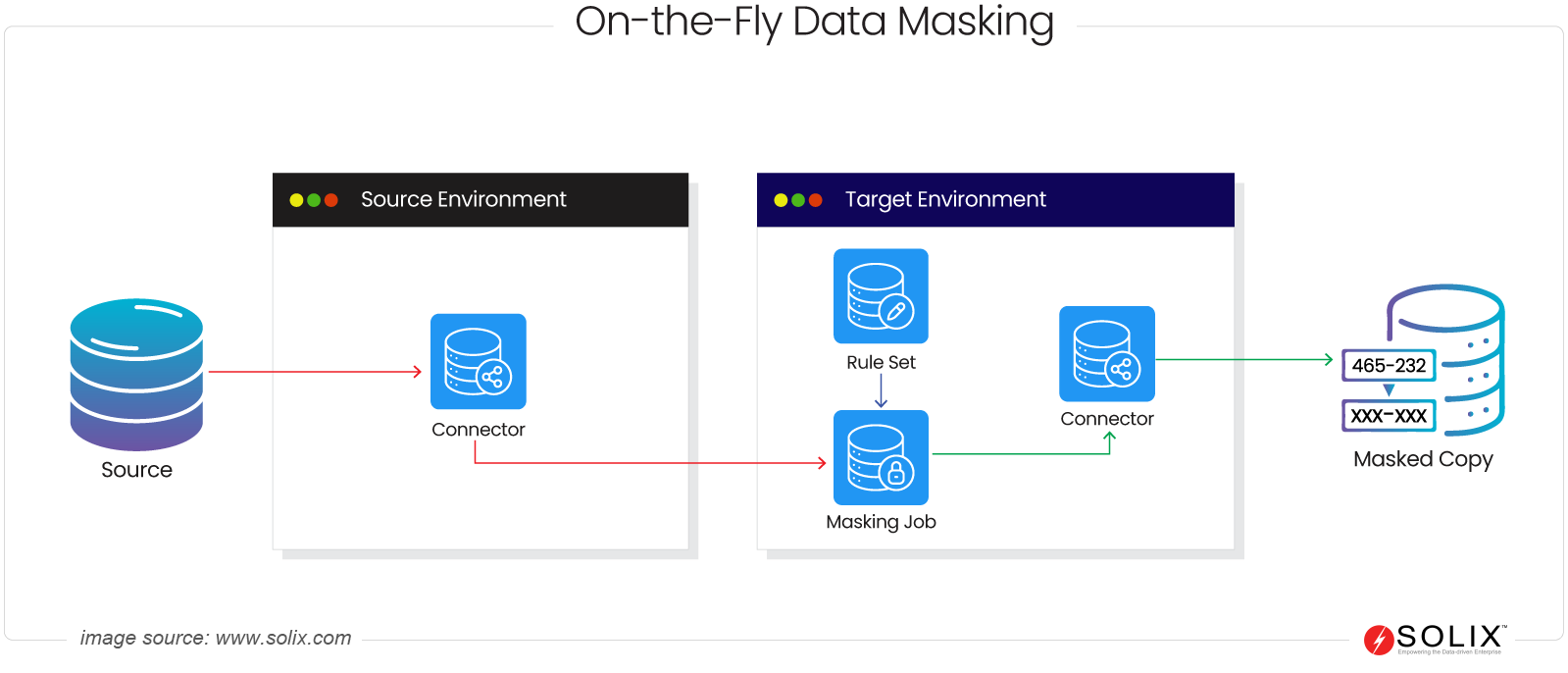
On-the-fly data Masking is a dynamic data protection approach involving real-time modification of sensitive information as it moves through different systems and processes. Unlike static data masking, which applies irreversible changes to the entire dataset, it allows organizations to mask data dynamically based on user privileges and contextual requirements.

How On-the-Fly Data Masking works?

How On-the-Fly Data Masking Works?

This method involves intercepting data requests through different systems and applications, identifying sensitive data elements, and dynamically applying masking techniques to conceal or replace this information.

When a user requests access to data, the On-The-Fly Data Masking mechanism assesses the user’s permissions and the nature of the request. If the data contains sensitive information, the masking process triggers. Various masking techniques, including data anonymization, encryption, redaction, and others, are dynamically applied to ensure that sensitive information is concealed, altered, or substituted.

Difference between On-the-Fly and Dynamic Data Masking

Feature On-the-Fly Data Masking Dynamic Data Masking
Timing Real-time, during data access/transfer On-demand, at query execution
Data Modification Data is masked before it is presented to the user Data presentation is masked in query results
Data Location Masked data is stored in a separate target environment Unmasked data remains in the original database

Here are a few analogies to illustrate the difference.

Scenario 1: Magic Filter

On-the-fly data masking functions as an integral filter seamlessly incorporated into this pipeline. As the data moves through, the filter instantaneously masks sensitive details and stores the original data in the targeted database before presenting the masked data to the user. Dynamic masking filters only when a specific query is run on the database/filter and won’t store any copy anywhere.

Scenario 2: A chef with a secret recipe

The chef has two recipe books – one original and one with masked ingredients. When someone asks for the recipe with an on-the-fly query, the chef grabs the masked book and shows it. For dynamic masking, the chef has only one recipe book (the original). When someone asks for the recipe, the chef might cover up certain ingredients with his hand while showing them the rest.

Both scenarios present a masked recipe “in real-time” from the user’s perspective (the person asking for the recipe). However, masking occurs differently in this case, as it occurs on the fly with a separate masked copy and dynamically by manipulating the presentation at the time of request.

Benefits

  • Real-time Protection: It immediately protects sensitive data as it is accessed, ensuring that unauthorized users only see masked or obfuscated information.
  • Dynamic Adaptability: This approach allows for dynamic adjustments to masking rules. These adjustments are based on the user’s access permissions or specific data requests. This ensures sensitive information remains hidden. It provides access to non-sensitive data.
  • Reduced Data Exposure: On-the-fly masking minimizes the risk of exposing sensitive information. It does this by dynamically masking data as it is accessed. This reduces the likelihood of data breaches or leaks.
  • Improved Performance: It typically imposes minimal overhead on database performance since masking rules are applied dynamically during data retrieval rather than pre-processing the entire dataset.
  • Simplified Implementation: Implementing on-the-fly masking can be simpler than static masking. This can lead to faster deployment and easier maintenance of masking policies.
  • Enhanced Flexibility: It offers greater flexibility in managing access to sensitive data, as masking rules can be adjusted dynamically based on changing business requirements, compliance mandates, or security policies.

Use Cases

With its dynamic and real-time capabilities, on-the-fly masking is a versatile solution across various use cases, significantly contributing to data security and privacy.

  • Non-Production Environments: It allows organizations to dynamically mask sensitive data, ensuring that the testing environment mirrors real-world scenarios without compromising the confidentiality of actual data.
  • Analytical Environments: By dynamically masking data based on user roles and contextual requirements, analytics teams can work with accurate and representative data, fostering data-driven decision-making without compromising data privacy.
  • Secure Data Sharing: It can address the complexities of different masking techniques. This ensures that only authorized individuals access specific details. It minimizes the risk of data exposure or misuse in collaborative projects.
  • Data Privacy Regulations: On-the-fly masking provides a solution by dynamically adapting to changing data privacy requirements. This ensures that organizations can comply with evolving regulations without compromising operational efficiency.
  • Dynamic Access Controls: The dynamic nature of access controls enhances security. It streamlines data access for various organizational stakeholders. This makes on-the-fly masking particularly effective. This is especially true in scenarios where dynamic access controls are critical.

In summary, On-The-Fly Data Masking integrates advanced techniques to address various use cases. It secures non-production environments and facilitates analytics. It enables secure data sharing and ensures compliance with data privacy regulations. Its adaptability and real-time capabilities make it a cornerstone in organizations’ efforts to fortify their data security and privacy strategies across diverse operational scenarios.

FAQs

How does On-the-Fly data masking handle unstructured data formats like text documents or images?

It employs advanced techniques. These include tokenization or encryption. It masks sensitive elements within unstructured data, such as text or images. It preserves data format while ensuring comprehensive protection.

How does On-the-Fly data masking handle complex data relationships and dependencies?

It utilizes sophisticated algorithms to manage intricate data relationships seamlessly. It ensures consistent masking across interconnected data elements, preserving integrity while concealing sensitive information.

Can On-the-Fly data masking support fine-grained access controls for different user roles or privileges?

Yes, On-the-Fly data masking offers fine-grained access controls, ensuring that users see only the data they’re authorized to access. It tailors masking policies based on user roles, maintaining confidentiality while allowing necessary access.

Dynamic Data Masking

What is Dynamic Data Masking?

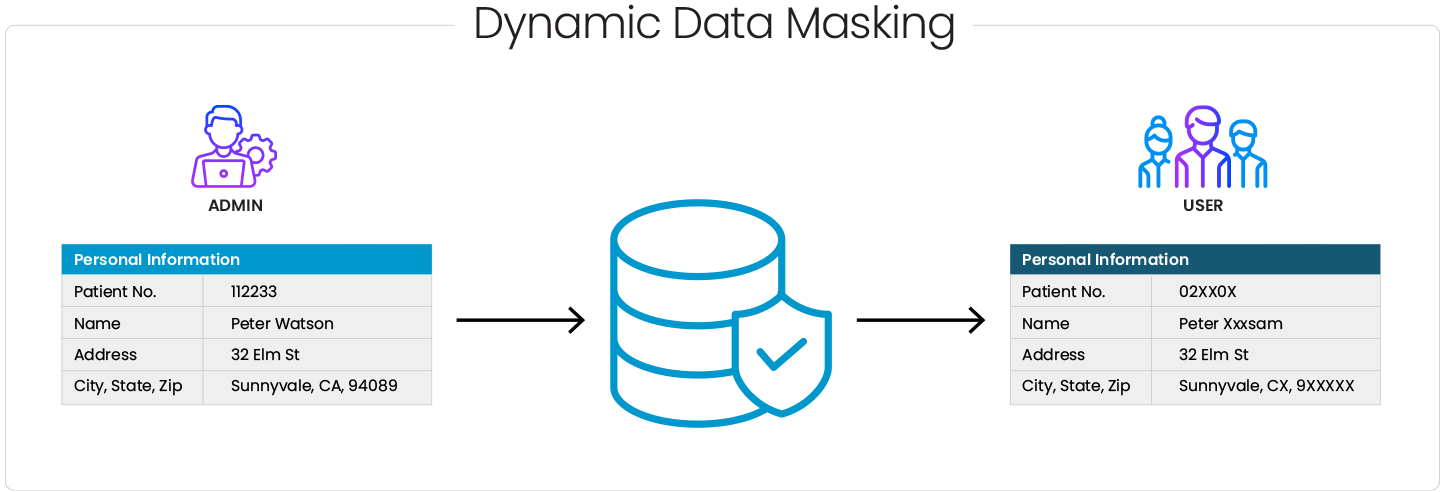
Dynamic Data Masking is a masking approach designed to obscure sensitive information in real-time, ensuring that only authorized users can access and view the complete data. Unlike static data masking, which applies a uniform mask to all users, dynamic masking tailors the level of data exposure according to the user’s role or permissions.

In layman’s language, it dynamically alters data visibility based on user roles or access privileges, while unauthorized or lower-privileged users perceive a masked or redacted version of the information. It ensures a granular and customizable security layer by intercepting database queries and applying masking rules, significantly preventing data breaches, internal threats, and non-compliance issues.

How Dynamic Data Masking Works?

Pictorial representation of how Dynamic Data Masking Works?

How Dynamic Data Masking Works?

The fundamental principle behind DDM lies in its ability to intercept and modify database queries on the fly, dynamically adjusting the visibility of specific data elements based on user permissions.

  • Masking Rules: Dynamic masking relies on predefined rules to control how sensitive information is shown to different users or roles. These rules are crafted to align with security policies and compliance requirements.
  • Policy Enforcement:  Dynamic masking enforces different masking rules at the database level, acting as a gatekeeper to sensitive information. The policies are consistently applied, ensuring a seamless and secure experience for users interacting with the database.
  • Role-Based Access Control (RBAC): Integration with RBAC mechanisms allows dynamic masking to synchronize with the organization’s user roles. This alignment ensures that data exposure is customized based on users’ specific roles and responsibilities, providing a fine-tuned approach to data security.
  • Real-Time Adaptability: One of the key features of dynamic masking is its dynamic nature. As user permissions change or new security policies are implemented, the masking of sensitive data adapts in real time. This adaptability ensures that the data security measures remain effective in evolving user access scenarios.

Dynamic masking combines these elements and offers a granular and customizable security layer. Its real-time, adaptive approach significantly enhances data security, making it crucial in safeguarding against unauthorized access and potential data breaches.

Difference between Static and Dynamic Data Masking:

Unlike dynamic data masking, static masking involves a one-time transformation, making it especially well-suited for scenarios where constant protection is imperative. The primary goal is to create a structurally similar yet fictitious version of the original data, ensuring that sensitive elements remain concealed while maintaining the overall integrity and usability of the dataset.

Feature SDM DDM On-the-Fly Masking
Timing Before data storage During data access (real-time) During data access (real-time)
Masking Rules Pre-defined Based on user permissions Based on specific situations
Data Type More efficient for structured data Efficient for structured and unstructured data Efficient for structured and unstructured data
Advantages Simple, Efficient Granular control, Real-time access Real-time, Context-aware
Disadvantages Not real-time, Inflexible More complex, Performance impact More complex, Performance impact

Adaptability of Masking Techniques Across SDM and DDM:

Technique SDM DDM On-the-Fly Masking
Shuffling Yes Yes Yes
Redaction Yes Yes Yes
Tokenization Yes Yes Yes
FPE Yes Can be used Can be used
Substitution Yes Yes, with user-based variations Yes, with user-based variations
Encryption Possible (if real-time access is not needed) Less Ideal (performance overhead) Less Ideal (performance overhead)
Nulling Simple, but minimal protection Can be used for limited masking Can be used for limited masking
Noice addition Can be used along with other technique Can be used along with other technique Can be used along with other technique

Benefits of Dynamic Data Masking:

Dynamic Data Masking benefits an organization’s data security posture and compliance efforts in the following ways.

  • Data Privacy Compliance: It plays a pivotal role in assisting organizations in complying with stringent data protection regulations, such as GDPR, PCI DSS, HIPAA, LGPD, and more.
  • Customizable Security Policies: Dynamic Data Masking’s ability to enforce obfuscation rules and integrate with Role-Based Access Control (RBAC) allows organizations to tailor security policies according to user roles and needs.
  • Preventing Data Breaches: It dynamically masks data by user permissions and limits the potential impact of unauthorized access, significantly reducing the risk of sensitive information falling into the wrong hands.

Use Cases of Dynamic Data Masking:

Dynamic Data Masking obfuscates sensitive information in real-time, providing an additional layer of security to prevent unauthorized access to sensitive information. Here are some common use cases of dynamic masking:

  • Production Environments: Dynamic masking shines in live production databases, offering an extra layer of security without compromising the utility. This capability is particularly crucial in sectors where real-time access to sensitive information is imperative.
  • Testing and Development: Production data is often necessary to test applications accurately in testing and development environments. However, exposing sensitive information to developers and testers can pose security risks. Dynamic masking allows organizations to use realistic information for testing while protecting sensitive information.
  • Data Analytics and Reporting: Organizations often use data analytics and reporting tools to analyze large datasets and derive insights. Dynamic masking can help organizations anonymize sensitive information while allowing analysts to derive meaningful insights.
  • Compliance Requirements: Many industries, such as healthcare (HIPAA), finance (PCI DSS), and government (GDPR), have strict regulations regarding the protection of sensitive data. Dynamic masking can help organizations comply with these regulations by ensuring that only authorized individuals can access sensitive information.
  • Outsourcing and Offshoring: Companies that outsource or offshore specific business processes may need to share sensitive data with external partners. Dynamic masking ensures that sensitive information remains hidden from third-party vendors who do not need access to it.
  • Role-Based Control: Dynamic masking can be integrated with role-based access control systems to ensure only users with the appropriate permissions can view sensitive information. This helps organizations enforce the principle of least privilege and minimize the risk of data breaches.


In conclusion, Dynamic data masking is a robust solution for safeguarding sensitive information in various environments. Its flexible features, including real-time obfuscation and role-based access control, offer organizations a versatile tool to ensure data security while facilitating efficient data utilization. It is a pivotal asset in today’s data-driven landscape, enabling organizations to conduct thorough analyses without compromising data integrity or regulatory compliance.

FAQ:

How does Dynamic Data Masking differ from static masking?

Dynamic Data Masking differs from static data masking by dynamically applying masking rules at runtime based on user queries or access privileges. In contrast, static data masking permanently alters data before storage, limiting its applicability in dynamic environments.

Can skilled attackers bypass Dynamic Data Masking?

While Dynamic Data Masking provides an additional layer of security, skilled attackers may attempt to bypass masking controls through advanced techniques such as SQL injection or privilege escalation. Continuous monitoring and proactive security measures are essential to detect and prevent such attempts.

Does Dynamic Data Masking support granular access control policies?

Yes, Dynamic Data Masking supports granular access control policies by enabling organizations to define masking rules based on user roles, privileges, or sensitivity levels. This ensures that only authorized users can access unmasked data while maintaining confidentiality and compliance.

Can Dynamic Data Masking be applied to unstructured data formats like documents or images?

Dynamic Or On-The-Fly obfuscation is a more versatile option and can handle both structured and unstructured data, offering greater flexibility for complex masking needs than Static Masking.

Data Masking

What is Data Masking?

Data Masking is a pivotal technique, also known as data obfuscation, data encryption, or data anonymization, designed to protect sensitive information by replacing, encrypting, or scrambling original data with fictitious or pseudonymous data. This digital veil ensures data privacy and security, rendering data unreadable while preserving functionality.

Masking data can be reversible or irreversible, depending on the technique used. For example, encryption can be reversible if the encryption key is available, allowing the original data to be restored. However, techniques like tokenization and anonymization may be irreversible since the original data is not retained.

Common Data Masking Approaches

  • Static Data Masking: Static masking involves applying different masking techniques to sensitive data before it’s stored or transmitted, typically during data migration or database refreshes.
  • Dynamic Data Masking: Refers to real-time masking applied to sensitive data as it’s accessed, often implemented in database systems to protect data without altering the underlying data.
  • On-the-Fly Data Masking: It encompasses static and dynamic masking, referring to the application of masking techniques either permanently or in real-time as data is processed, transmitted, or accessed.

Different Data Masking Techniques

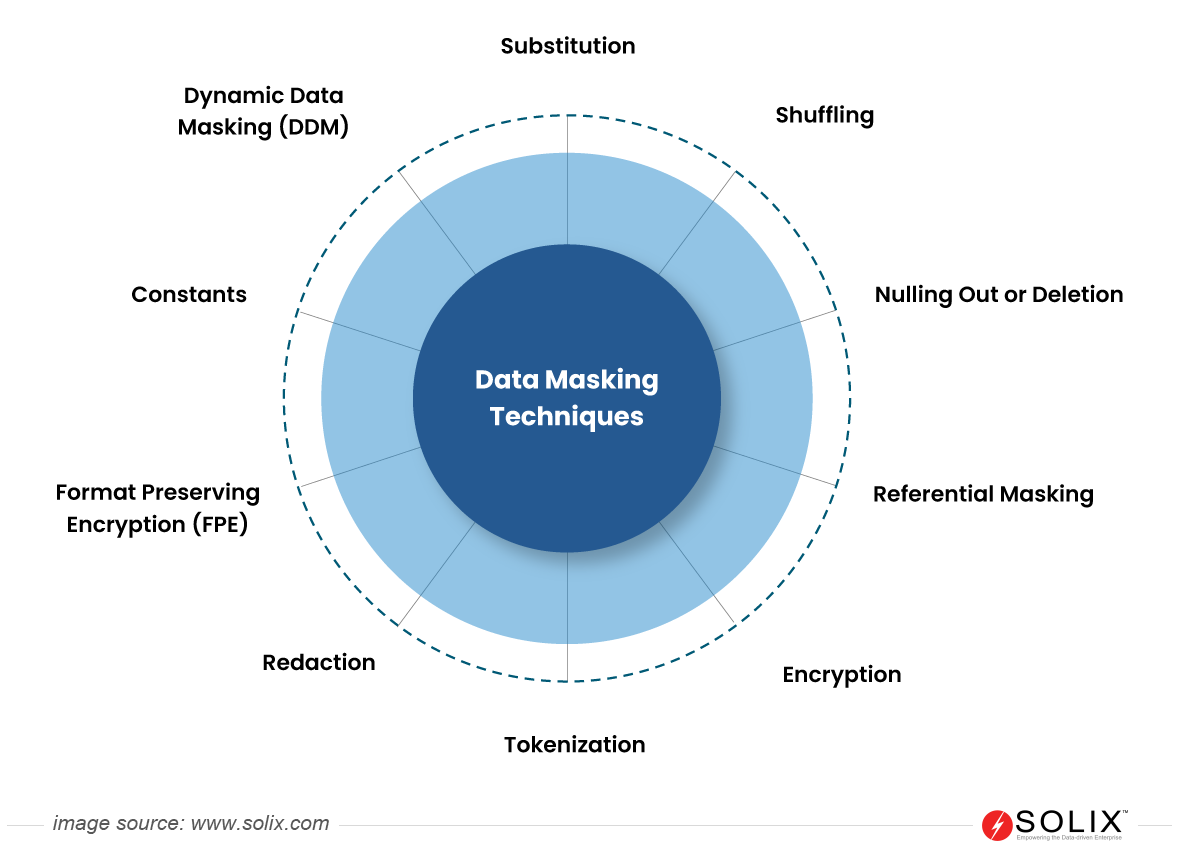
Enhancing enterprise security involves implementing various Data Masking techniques such as tokenization, encryption, anonymization, redaction, Format-Preserving Encryption (FPE), substitution, shuffling, noise addition, hashing, nulling, referential masking, partial data exposure, and data swizzling. These masking techniques are integral components that fortify data security protocols, ensuring a comprehensive and resilient defense against potential internal and external threats.

Data Masking Techniques

Different types of data masking techniques

Key Benefits of Data Masking

By obfuscating real data with realistic but fictitious information, masking enables organizations to mitigate external and internal threats, fortify enterprise security, unleash business value, enhance customer trust, and stringent data privacy regulations like GDPR, CCPA, PIPEDA, LGPD, DPDP, and industry privacy regulations like PCI DSS, GLBA, FedRAMP, FERPA, HIPAA, and among others. By maintaining data realism, masking allows for continued use in development, testing, and analytics, fostering innovation while preserving confidentiality.

Benefits of data masking

Key benefits of data masking

Use cases of Data Masking

Across industries, organizations utilize masking techniques to safeguard sensitive information in various scenarios. Here are a few instances where masking is used.

  • Risk Mitigation: Minimize the impact of potential data breaches.
  • Data Sharing: Share data subsets in a secure, compliant manner.
  • Software Testing: Enable thorough testing without security breaches.
  • Data Analytics and Reporting: Generate insights without compromising privacy.
  • Compliance: Adhere to data protection regulations (GDPR, HIPAA, PCI-DSS, CCPA).
  • User Training: Provide realistic training environments without sensitive data exposure.
  • Collaborate with third parties: Maintain data control while collaborating with third parties.
  • Test – Development Environments: Create datasets safely without exposing production data.

In conclusion, Data Masking is indispensable for protecting sensitive information without compromising data usability. By concealing confidential data with realistic yet fictitious substitutes, organizations can mitigate the risk of data breaches while ensuring compliance with stringent privacy regulations. Ultimately, It empowers businesses to securely share and utilize data for various purposes, safeguarding privacy and utility in today’s digital landscape.

FAQ

What is Data Masking?

Data Masking is a technique used to conceal sensitive information within a database, replacing it with fictitious but realistic data to protect confidentiality.

Is Data Masking reversible?

Data Masking can be reversible or irreversible based on the techniques used. For example, redaction is reversible, as it permanently masks the data, while techniques like encryption are reversible.

Can Data Masking be automated?

Yes, Data Masking can be automated using specialized software tools that streamline the masking process. Automation helps ensure consistency, scalability, and efficiency in masking techniques across large datasets and diverse environments.

Can data masking impact database performance?

Yes, data masking can impact database performance, particularly if complex masking algorithms are used or if the masking process is applied to large datasets. Performance considerations should be carefully evaluated during implementation.