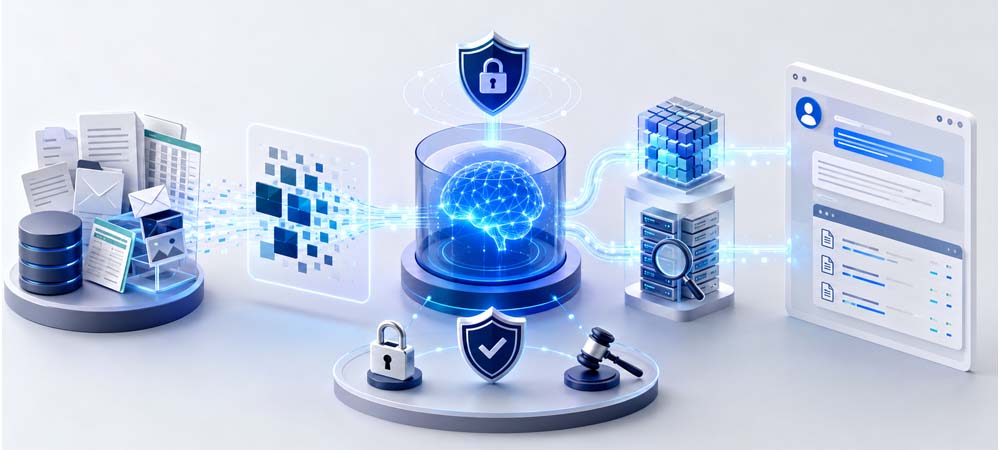
Simple RAG demos are easy to build. Enterprise RAG systems are harder because enterprise data is messy, sensitive, fragmented, and governed by business rules. This article explains the architecture patterns required to make LLM answers accurate, traceable, and trustworthy.
Why Enterprise RAG Is Harder Than It Looks
A basic RAG demo can be built quickly: upload a PDF, split it into chunks, create embeddings, store them in a vector database, retrieve the top results, and send them to an LLM. On a clean tutorial dataset, it works. In an enterprise environment, it rarely works that easily.
The issue is architectural. Poor ingestion creates bad text. Poor chunking damages meaning. Semantic-only retrieval misses exact contract numbers, policy references, or regulation codes. Answers without citations cannot be verified. Pipelines without metadata cannot be governed or audited. Enterprise RAG works only when ingestion, chunking, indexing, retrieval, synthesis, security, and auditability are designed together.
Ingestion: The Foundation for Everything Downstream
Enterprise data is messy — scanned contracts, email threads, spreadsheets, HTML reports, policies, manuals, and legacy application exports. Generic parsers may quietly produce empty text, broken tables, or garbled chunks that later get indexed as though they were reliable.
Ingestion has to be format-aware. Scanned files need OCR. Spreadsheets need structured extraction. Emails need header-aware parsing. The system must also preserve metadata at ingestion: document ID, creation date, owner, source application, access tier, classification level, and PII flags. This metadata controls access, retrieval, governance, and auditability. Retrofitting it later is expensive.
Chunking: Where Many RAG Systems Lose Meaning
Once ingested, documents must be split into chunks. Fixed-size chunks with a small overlap are simple but can damage meaning. Enterprise documents are not written in equal-sized blocks — a legal clause or policy section may depend on surrounding context. If a chunk cuts through that logic, retrieval may return text that looks relevant but is incomplete.
A strong enterprise pattern is the parent-child approach: index small chunks for retrieval precision, but pass a larger parent section to the LLM. The small chunk finds the right passage. The parent section gives the LLM enough context to understand it. Retrieval precision and answer quality are different problems, and the architecture should treat them that way.
Embedding, Indexing, and Hybrid Retrieval
Embeddings convert text into numbers so the system can search by meaning rather than keywords. This helps when users phrase the same question differently. However, general-purpose embedding models may perform unevenly on specialized enterprise language — legal clauses, ERP schemas, finance terms, regulations. For production systems, embeddings should be evaluated against the actual corpus.
A vector index alone is not enough. Enterprises also need a full-text inverted index for exact keyword, phrase, number, and identifier matching — contract numbers, invoice IDs, regulation clauses, product codes. Hybrid retrieval runs both simultaneously. Semantic search finds conceptually relevant content. Full-text search catches exact matches. Results are merged before reaching the LLM. Enterprises that rely on semantic search alone will miss the exact references enterprise questions routinely contain.
Answer Synthesis: Making Answers Trustworthy
Retrieval gets the right material in front of the model. Governance makes the answer trustworthy. Without citation-anchored synthesis, an LLM may fill gaps using general training knowledge instead of retrieved company documents. Enterprise RAG needs controls that validate claims against retrieved passages, attach citations, enforce access tiers, filter PII, and maintain a full audit trail. These belong in the production architecture from the start, not added after a compliance incident.
How Solix Data Ask Operationalizes Enterprise RAG
Solix Data Ask implements this architecture as a production-ready service across three query types through a single governed interface.
An AI-powered Conversation Router classifies every question in real time and dispatches it to the right engine. When intent is ambiguous, the router asks a clarifying question before committing to an answer — precision before execution.
For unstructured data — contracts, policies, manuals, email archives — Data Ask uses Content Intelligence, the Solix capability for document search and answer synthesis. Hybrid retrieval runs across the document corpus and composes answers with full source citations. Permission-aware retrieval runs before the answer is composed: users see only documents their role authorizes, enforced at the data layer before retrieval, not filtered at the interface afterward. Every query is audit-logged with a complete record of what was asked, retrieved, and used. Anti-hallucination controls are built in — the Data Ask data sheet is explicit that AKG grounding is the anti-hallucination mechanism, with citations tracing back to the source document chunk.
For structured data — ERP databases and application archives — Data Ask uses the Application Knowledge Graph, an intelligence layer generated automatically by Solix Data Sense. The AKG captures the structure, semantics, relationships, and business context of enterprise applications: business objects, the relationships between them, business terms mapped to specific tables and columns, and tested query patterns across Procure-to-Pay, Order-to-Cash, Record-to-Report, and Make-to-Order value streams. Pre-built AKGs are available for Oracle EBS, SAP ECC and S/4HANA, PeopleSoft, and JD Edwards. The result is AKG-grounded NL2SQL: natural language in, accurate SQL out, with citations tracing back to the source row and column.
The hybrid query is where Data Ask separates from the market. A single question can draw from both the document corpus and enterprise databases simultaneously — the Conversation Router dispatches both engines in parallel and synthesizes one cited answer. This eliminates the manual cross-tool work most enterprises do today. The Data Ask product page notes this capability is rare in the market.
The same four-layer trust posture governs every query type: Enterprise Data Governance at the policy layer, permission-aware IAM at the data layer, AKG grounding as the anti-hallucination control, and a compliance shell covering ISO 27001, SOC 2 Type 2, GDPR, CCPA, DPDP, and EU AI Act readiness.
The Takeaway
Enterprise RAG has a higher bar than a demo. It must read messy content correctly, preserve meaning through chunking, support exact and semantic search, enforce access controls, cite sources, prevent hallucinations, and maintain an audit trail. That is not a chatbot feature. It is a data architecture, retrieval architecture, and governance architecture working together.

Manish Rathour
Vice President, Product Marketing
DISCLAIMER: THE CONTENT, VIEWS, AND OPINIONS EXPRESSED IN THIS BLOG ARE SOLELY THOSE OF THE AUTHOR(S) AND DO NOT REFLECT THE OFFICIAL POLICY OR POSITION OF SOLIX TECHNOLOGIES, INC., ITS AFFILIATES, OR PARTNERS. THIS BLOG IS OPERATED INDEPENDENTLY AND IS NOT REVIEWED OR ENDORSED BY SOLIX TECHNOLOGIES, INC. IN AN OFFICIAL CAPACITY. ALL THIRD-PARTY TRADEMARKS, LOGOS, AND COPYRIGHTED MATERIALS REFERENCED HEREIN ARE THE PROPERTY OF THEIR RESPECTIVE OWNERS. ANY USE IS STRICTLY FOR IDENTIFICATION, COMMENTARY, OR EDUCATIONAL PURPOSES UNDER THE DOCTRINE OF FAIR USE (U.S. COPYRIGHT ACT § 107 AND INTERNATIONAL EQUIVALENTS). NO SPONSORSHIP, ENDORSEMENT, OR AFFILIATION WITH SOLIX TECHNOLOGIES, INC. IS IMPLIED. CONTENT IS PROVIDED "AS-IS" WITHOUT WARRANTIES OF ACCURACY, COMPLETENESS, OR FITNESS FOR ANY PURPOSE. SOLIX TECHNOLOGIES, INC. DISCLAIMS ALL LIABILITY FOR ACTIONS TAKEN BASED ON THIS MATERIAL. READERS ASSUME FULL RESPONSIBILITY FOR THEIR USE OF THIS INFORMATION. SOLIX RESPECTS INTELLECTUAL PROPERTY RIGHTS. TO SUBMIT A DMCA TAKEDOWN REQUEST, EMAIL INFO@SOLIX.COM WITH: (1) IDENTIFICATION OF THE WORK, (2) THE INFRINGING MATERIAL’S URL, (3) YOUR CONTACT DETAILS, AND (4) A STATEMENT OF GOOD FAITH. VALID CLAIMS WILL RECEIVE PROMPT ATTENTION. BY ACCESSING THIS BLOG, YOU AGREE TO THIS DISCLAIMER AND OUR TERMS OF USE. THIS AGREEMENT IS GOVERNED BY THE LAWS OF CALIFORNIA.
-
 White Paper
Enterprise Information Architecture for Gen AI and Machine Learning
Download White Paper -

-

-
