Zero Data Copy is a data management architecture that eliminates the redundant duplication of datasets across multiple systems by creating a single, logical copy with virtualized access, ensuring consistency, governance, and cost efficiency.
What is Zero Data Copy?
In traditional enterprise architectures, data is constantly copied to serve different business needs. The marketing team copies customer data to a SaaS tool, the analytics team replicates the same data into a data warehouse, and the data science team copies it again to a sandbox. This creates a spiderweb of data copies. Zero Data Copy is an architectural paradigm that breaks this cycle. Instead of physically moving and duplicating data, Zero Data Copy establishes a centralized, authoritative data plane often a cloud data platform and provides various applications and users with direct, virtualized access to the original dataset.
This is achieved through technologies like data virtualization, open table formats (such as Apache Iceberg), and a robust metadata layer. When a business intelligence tool queries data, it doesn’t pull from a stale, replicated copy; it queries the live, governed source in real-time. Zero Data Copy ensures that data remains “single-sourced” while being universally accessible, effectively decoupling data storage from compute consumption across different cloud services and on-premise environments.
Why is Zero Data Copy Important?
The proliferation of data copies has created a silent crisis in enterprise IT. It leads to “data sprawl,” where no one knows which version of the data is correct, and costs spiral out of control. Implementing a Zero Data Copy strategy is critical for modern businesses because it directly addresses these pain points.
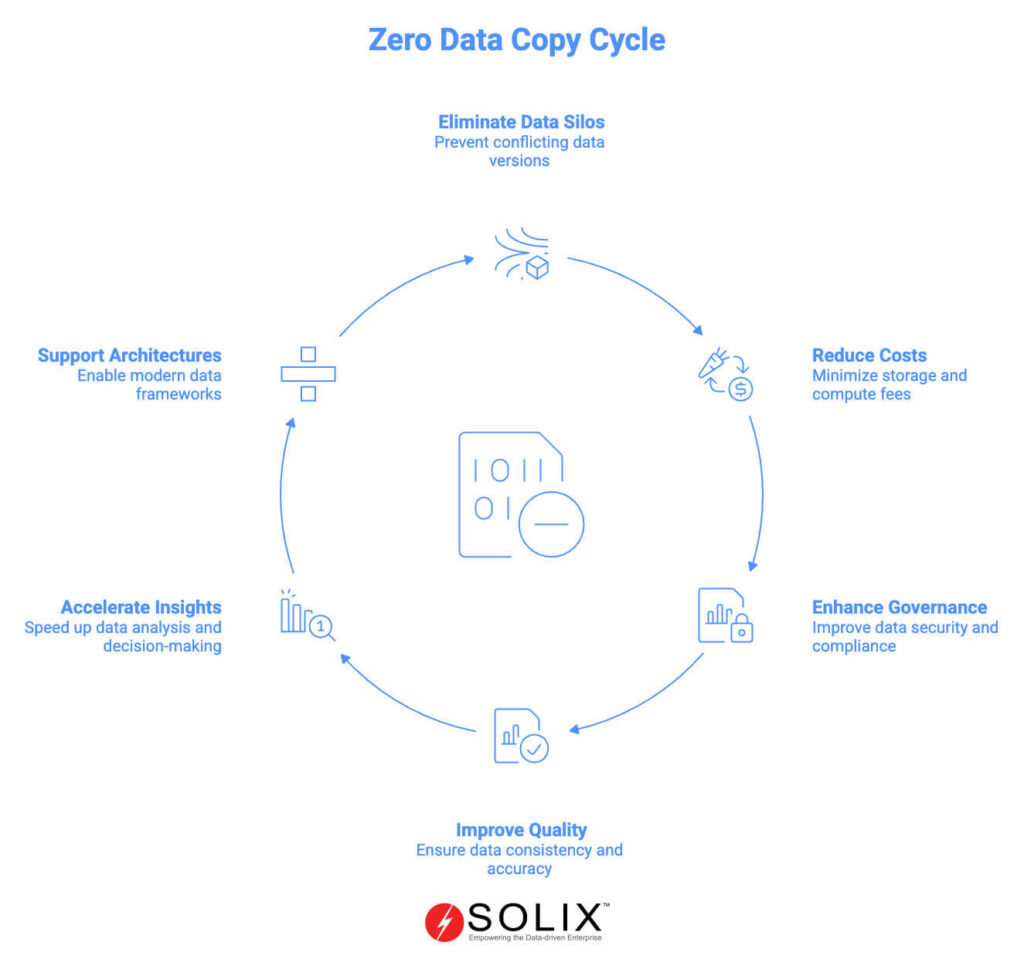
- Eliminates Data Silos: By providing a single source of truth, Zero Data Copy prevents different departments from operating on isolated, and often conflicting, versions of the same information.
- Reduces Storage and Compute Costs: Cloud storage and egress fees accumulate rapidly when moving petabytes of data. Zero Data Copy minimizes redundant storage and stops paying for unnecessary data transfers.
- Enhances Data Governance and Security: When data exists in one place, it is easier to secure. You apply a security policy once, rather than trying to track and secure hundreds of disparate copies scattered across different environments.
- Improves Data Quality and Consistency: With no copies to manage, there is no risk of data divergence. The data an executive sees in a dashboard is identical to the data an engineer uses to train a model.
- Accelerates Time-to-Insight: Data teams spend up to 80% of their time wrangling and preparing data rather than analyzing it. Zero Data Copy removes the friction of data movement, allowing analysts to access fresh data instantly without waiting for ETL pipelines to complete.
- Supports Modern Data Architectures: Frameworks like Data Mesh and Data Fabric rely on decentralization and domain ownership, but they require a strong underlying foundation of interoperability. Zero Data Copy provides the technical glue that makes these architectures viable.
Challenges and Best Practices for Businesses
Transitioning to a Zero Data Copy architecture is not an overnight project. It requires a strategic shift in how an organization views and manages its data assets. Understanding the common challenges and adhering to best practices is essential for a successful implementation.
Common Challenges in Adopting Zero Data Copy
- Legacy Infrastructure: Most enterprises operate a hybrid landscape of mainframes, data warehouses, data lakes, and SaaS applications. These legacy systems were not designed to participate in a virtualized data fabric, making integration complex.
- Metadata Management: Zero Data Copy relies on a powerful metadata layer to understand where data lives, what it means, and who can access it. If an organization has poor metadata practices, implementing Zero Data Copy will be nearly impossible.
- Cultural Resistance: Data silos are often protected by departmental fiefdoms. Teams accustomed to owning their own “copy” of the data may resist giving up control in favor of a centralized, governed model.
- Performance Latency: While virtualization avoids copying, it must be executed with high performance. Poorly optimized virtual queries against source systems can be slow and impact operational workloads.
- Security Complexity: While a single source is easier to secure in theory, it creates a high value target. Implementing fine-grained access control (row-level, column-level security) on a unified platform requires sophisticated tooling.
Best Practices for a Zero Data Copy Strategy
- Start with a Data Audit: Before architecting for Zero Data Copy, conduct a thorough audit to identify all existing data copies. Categorize them for analytics, development, or compliance? This helps you understand the scale of the problem and prioritize which datasets to consolidate first.
- Prioritize Metadata First: Treat your metadata as a first class citizen. Implement a robust metadata management and cataloging solution to create a searchable inventory of your data assets. This catalog becomes the brain of your Zero Data Copy environment.
- Adopt Open Standards: To avoid getting locked into a proprietary virtualization layer, embrace open table formats like Apache Iceberg or Apache Hudi. These formats allow different compute engines (like Spark, Flink, or Trino) to access the same data simultaneously without copying it.
- Implement a Data Governance Council: Address the cultural challenge by forming a cross functional governance council. This ensures that business units have a say in how “their” data is used and shared, easing the transition away from silos.
- Leverage a Unified Data Management Platform: Rather than building a Zero Data Copy architecture from scratch with disparate tools, utilize a comprehensive platform. This ensures that data discovery, governance, security, and lifecycle management are baked into the solution from day one, not added as an afterthought.
How Solix Helps Achieve a Zero Data Copy Architecture
Solix Technologies stands at the forefront of the Zero Data Copy revolution by providing the essential infrastructure required to make this complex architecture a reality. While the concept of Zero Data Copy sounds simple, executing it requires a robust platform capable of handling enterprise scale metadata, governance, and data virtualization which is precisely what the Solix Common Data Platform (CDP) delivers.
Solix helps organizations break free from the vicious cycle of data duplication through a suite of integrated capabilities designed to create a single, logical point of control for all enterprise data.
- Unified Data Governance and Metadata Management: At the heart of any Zero Data Copy strategy is the need to know your data. Solix provides a comprehensive metadata repository that automatically discovers and catalogs data assets across your entire hybrid landscape from legacy mainframes to modern cloud data lakes. This creates the “single source of truth” about your data, allowing you to govern and manage it without moving it.
- Data Virtualization and Federation: Solix enables querying and joining data across disparate systems in real time without physical movement. Whether your data resides in a data warehouse, a NoSQL database, or a legacy application, Solix provides a unified semantic layer. This allows business users to access a Zero Data Copy view of the data, while the underlying physical copies are eliminated or significantly reduced.
- Application Retirement and Data Archiving: One of the biggest sources of data copies is legacy applications. Companies keep these expensive systems alive just to access the historical data inside. Solix allows you to retire these legacy applications while preserving the data in an accessible, governed, and auditable format within the Solix CDP. This is a practical, high impact implementation of Zero Data Copy, you remove the application but keep the data available for future use without creating new silos.
- Compliance and Security Posture: With regulations like GDPR and CCPA imposing strict rules on data residency and deletion, having countless copies of sensitive data is a compliance nightmare. Solix helps enforce data retention policies and security rules centrally. By using Solix to manage the data lifecycle, you ensure that when a data subject deletion request comes in, the data is removed from the authoritative source and because there are no rogue copies, the compliance risk is neutralized.
By providing a unified platform that governs, secures, and virtualizes data, Solix empowers enterprises to move from the outdated “copy and replicate” mindset to a modern, efficient Zero Data Copy model, turning data from a liability into a competitive asset.
Why Solix Technologies is a Leader in Zero Data Copy
Solix Technologies has earned its leadership position in the Zero Data Copy space not by following the trend, but by architecting for it for nearly two decades. The company’s core philosophy has always been to solve the “data problem” through intelligent management rather than brute-force replication. Here’s why Solix stands out:
- Pioneering the Data Management Layer: Long before “Data Fabric” was a buzzword, Solix was building a common data platform designed to sit above infrastructure, providing a single pane of glass for data governance. This heritage gives them a deep, experienced understanding of the metadata challenges that are the biggest hurdle to Zero Data Copy.
- Holistic Lifecycle Management: Many vendors focus only on the “hot” analytics layer. Solix covers the entire data lifecycle—from active enterprise data to historical and dormant data. This holistic view is critical because Zero Data Copy isn’t just about how you analyze data today; it’s about how you archive, retain, and delete it tomorrow without leaving a trail of copies.
- Deep Integration with Open Standards: Solix champions open standards, ensuring that their solutions fit into modern data stacks rather than locking customers into a proprietary ecosystem. This commitment to interoperability especially with Apache Iceberg and Spark makes them a trusted partner for enterprises building future proof Zero Data Copy architectures.
- Proven Enterprise Scalability: Solix has a track record of deploying solutions for the world’s largest banks, healthcare providers, and government agencies. This experience has refined their platform to handle the rigorous performance, security, and compliance demands that are non negotiable when implementing a Zero Data Copy strategy in a mission critical environment.
Frequently Asked Questions (FAQs) about Zero Data Copy
What is the core difference between Zero Data Copy and data virtualization?
While related, they are not the same. Data virtualization is a key enabler of Zero Data Copy. Virtualization allows you to access data without moving it. Zero Data Copy is the broader architectural goal of eliminating all redundant copies across the enterprise, which includes, but is not limited to, using virtualization to avoid creating new ones.
Does Zero Data Copy mean I can’t ever move data?
No. It means you shouldn’t replicate data for every new use case. Data movement for ingestion into a data lake or for processing transformations is still necessary. Zero Data Copy focuses on preventing the creation of persistent, redundant copies that lead to sprawl, not on stopping all data pipelines.
How does Zero Data Copy improve data security?
It reduces the attack surface. If sensitive customer data exists in only one governed location instead of one hundred ungoverned copies, you have fewer vectors for a breach. You can enforce role based access control, encryption, and auditing in one place, ensuring consistent protection.
Can Zero Data Copy help with regulatory compliance like GDPR or CCPA?
Absolutely. Compliance requires you to know where all personal data resides. With Zero Data Copy, you have a single authoritative source. This makes it significantly easier to respond to Data Subject Access Requests (DSARs) or “right to be forgotten” requests, as you don’t have to hunt for data across hundreds of shadow copies.
Is Zero Data Copy only relevant for cloud environments?
No. While the cloud’s pay-as-you-go model highlights the cost benefits of eliminating copies, Zero Data Copy is relevant for on-premise and hybrid environments as well. It helps organizations maximize the value of their existing on-premise storage while reducing the management overhead of siloed legacy systems.
What are the primary cost savings associated with Zero Data Copy?
The savings come from two main areas: reduced cloud storage costs (by not paying for duplicate data) and reduced data engineering costs (by minimizing time spent on data integration and pipeline maintenance). It also lowers egress fees, as data doesn’t need to be transferred constantly between environments.
Does adopting Zero Data Copy require me to replace my existing databases?
Not necessarily. A true Zero Data Copy architecture, like the one enabled by Solix, works with your existing databases. It creates a governance and virtualization layer on top of them, allowing you to manage and access the data without requiring you to migrate everything to a new database system immediately.
How does Zero Data Copy relate to Data Mesh or Data Fabric?
It is a critical technical foundation for both. Data Mesh focuses on decentralized data ownership, and Data Fabric focuses on connecting disparate data sources. Zero Data Copy provides the underlying mechanism by creating a logical data plane that allows those domains or connected sources to share data seamlessly without physical duplication.