
Executive Summary (TL;DR)
- RHITL established that the right human must be in the loop. This blog takes the next step: naming the loop after the expert.
- “Human in the Loop” is engineer-speak. “Clinician in the Loop” is the language of accountability. “Counsel in the Loop.” “Commander in the Loop.” Those are professional standards, not architectural patterns.
- Expert in the Loop is the principle. Domain-specific naming is how the principle is implemented. When AI governance speaks the language of the domain it governs, it stops being a compliance checkbox and starts being something the professionals themselves own.
We Got RHITL Right. Now Let’s Get the Language Right.
In my earlier post, I introduced RHITL — Right Human in the Loop — to push back against the lazy default of treating “human oversight” as a generic checkbox. The argument was simple: not just any human will do. You need the right expert. A legal AI needs a lawyer in review. A clinical AI needs a clinician. A financial scoring model needs someone who can spot bias in real-world terms, not just catch statistical drift.
That argument still holds. But I’ve been sitting with a follow-on question ever since a colleague shared a post about “human in the loop” in AI for healthcare. My reaction was visceral: why are we still calling it that? It sounds like a manufacturing quality-control step, not a clinical decision process.
Even when we put the right person in the loop, we’re still using a phrase borrowed from control systems engineering. It doesn’t speak the language of the industries it’s meant to govern. That needs to evolve, and it needs to evolve industry by industry.
Why Language Isn’t Just Semantics
The phrase “human in the loop” was coined by engineers describing a control system. It says nothing about why that person matters, what their professional obligations are, or what they are uniquely qualified to evaluate. It treats oversight as an abstract architectural feature, not as a domain-specific accountability mechanism.
That framing creates real problems when AI moves from the lab into industries where professional identity, legal liability, and ethical obligation are inseparable from the work:
- It signals the wrong design intent: If you’re building for a “Clinician in the Loop,” you architect the interface, the explainability layer, and the handoff logic differently than if you’re building for an abstract reviewer. The label shapes the system.
- It undercuts practitioner buy-in: A physician is more likely to engage seriously with an oversight mechanism that respects her professional identity than one borrowing terminology from robotics engineering.
- It blurs accountability: “A human reviewed it” is not the same as “a licensed adjuster reviewed this claim.” The second statement carries professional, legal, and regulatory weight. The first carries almost none.
Governance language shapes governance behavior. When we name a process in the vocabulary of the industry it governs, we embed professional norms into the AI system itself.
Naming the Loop
The industries leading AI adoption do not lack precise professional vocabulary. They have licensing boards, certification standards, codes of ethics, and regulatory frameworks built on exactly the kind of domain-specific accountability that generic HITL language ignores. Here is how the loop should be named in the highest-stakes sectors:
| Industry | Expert in the Loop | Why it matters |
|---|---|---|
| Healthcare | Clinician in the Loop | Licensed clinical judgment is required when AI assists with diagnosis, treatment, or medication decisions. |
| Legal | Counsel in the Loop | Legal advice, privilege, and liability demand a licensed attorney’s judgment before any AI output is acted upon. |
| Finance & Banking | Analyst in the Loop | Fiduciary duty and regulatory compliance require qualified validation and ownership of outcomes. |
| Insurance | Adjuster in the Loop | Coverage disputes and policyholder fairness require a trained adjuster before denial or payout. |
| Defense / National Security | Commander in the Loop | Command authority and legal accountability under international humanitarian law cannot be delegated to a model. |
| Government & Social Services | Caseworker in the Loop | Benefit eligibility and child welfare decisions require trained human judgment and full context. |
| Aviation | Pilot in the Loop | Established safety culture already treats the pilot as the final authority over automation. |
A few of these already exist in nascent form. “Pilot in the Loop” is embedded in aviation safety culture. “Driver in the Loop” appears in SAE Level 3 autonomy standards. “Commander in the Loop” shows up in autonomous weapons policy debates. That is no coincidence. Those are industries where the consequences of getting human oversight wrong are immediate, undeniable, and often fatal. They developed precise language for human authority over automated systems because imprecise language gets people killed.
The same principle extends further. Education, journalism, human resources, agriculture, manufacturing, and cybersecurity all require domain experts to validate AI outputs before action is taken. The title changes, but the rule does not: AI can assist, but expertise must decide.
Every industry on this list is heading toward the same reckoning. The difference is whether they adopt precise language before the failure or after it.
From HITL to Expert in the Loop
Think of this as a three-stage maturity progression. Each stage represents a more precise, more accountable answer to the same question: who is responsible when AI gets it wrong?
-
Stage 1
HITL
Someone reviews the AI output — anyone. The focus is architectural: is a human present? Necessary but not sufficient. Catches gross errors, not domain-specific failures.
-
Stage 2
RHITL
The right expert is in the loop. Focus shifts from presence to qualification. A legal AI gets a lawyer. A clinical AI gets a clinician. The standard every production AI system should be held to today.
-
Stage 3
Expert in the Loop
The governance framework speaks the industry’s own language. Clinician in the Loop. Counsel in the Loop. Commander in the Loop. Expert workflows, expert-grade explainability, expert accountability chains — by design.
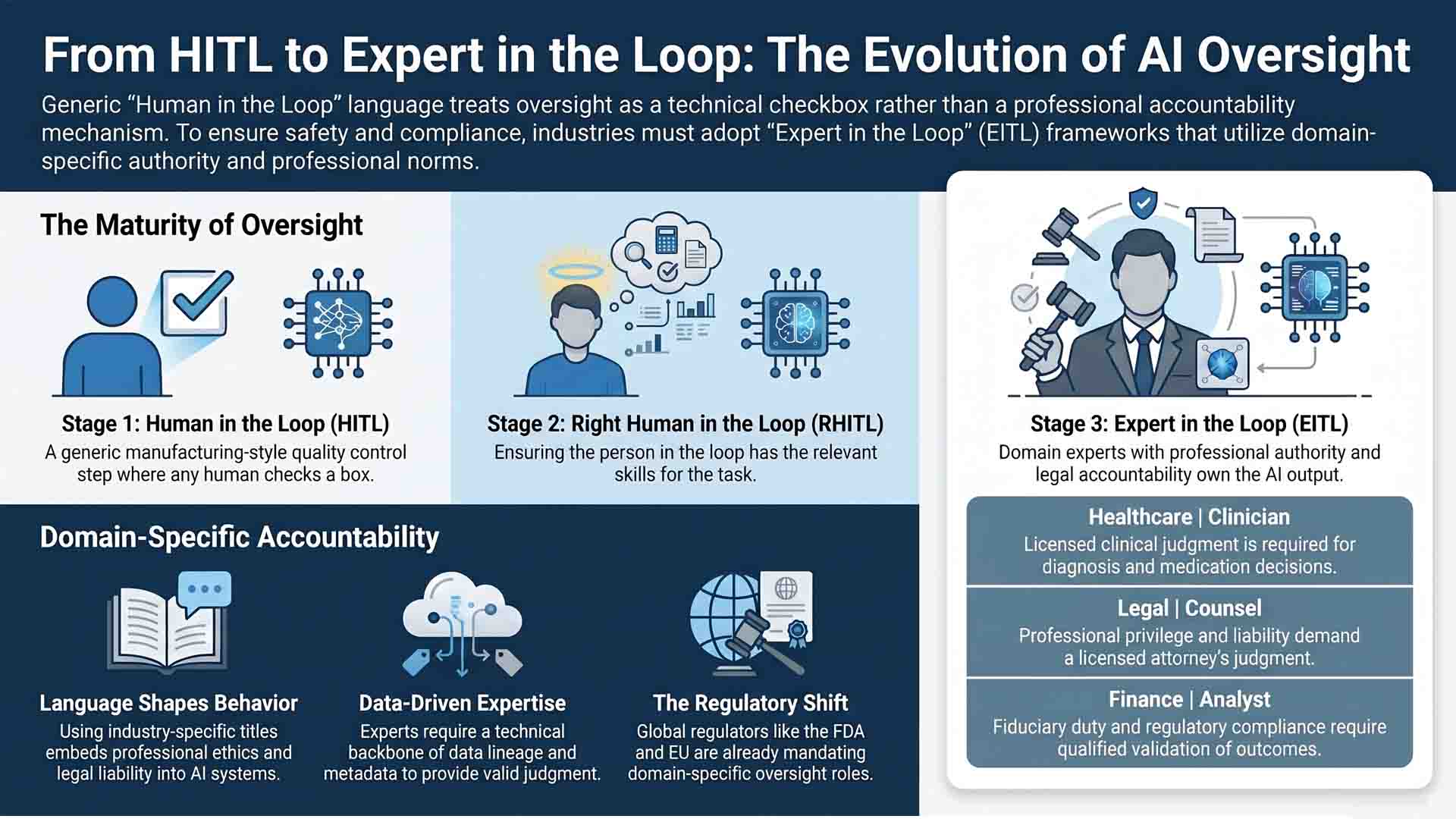
The principle and the implementation are not the same thing.
“Expert in the Loop” is the principle — the Stage 3 standard every AI governance framework should be held to.
But the principle only has teeth when it is implemented in domain-native language. “Clinician in the Loop” is what Expert in the Loop looks like in healthcare. “Counsel in the Loop” is what it looks like in legal. “Commander in the Loop” is what it looks like in defense.
When a product manager writes “Counsel in the Loop” in a requirements document instead of “human reviewer,” she makes downstream decisions about privilege, liability disclosure, bar association compliance, and attorney-client workflow integration — not just about a checkbox in an approval flow. That is the difference between governance as architecture and governance as accountability.
What This Means for AI Governance Frameworks
As I wrote in the original RHITL post, implementing the right human in the loop is not just a management philosophy — it requires a technical backbone. Moving to Expert in the Loop adds a new set of requirements on top of what RHITL already demands:
- Role-based orchestration by domain, not just by job title: A governance framework that routes “clinical validations” to a “clinician” persona is architecturally different from one that routes “high-risk outputs” to a “senior reviewer.” Domain-native routing encodes professional standards, not just organizational hierarchy.
- Domain-specific explainability standards: What a clinician needs to see to trust an AI recommendation is fundamentally different from what a compliance officer or a grid operator needs. Expert in the Loop demands that the governance layer surface the right context for each professional role — not a generic confidence score.
- Professional accountability chains in the audit trail: “A human reviewed it” is not a defense. “Licensed clinical pharmacist Dr. M. Rivera reviewed and approved medication recommendation 2026-04-12 at 14:32 CST, with lineage to training data set v3.1” is a defense. Domain-native loops make the audit trail speak the language of the professional and regulatory bodies that will scrutinize it.
Compliance vocabulary alignment: Regulators — FDA, OCC, CMS, FAA, SEC — speak in domain-specific terms. An AI governance framework that uses the same vocabulary as the body overseeing it is more likely to survive an audit than one that speaks in abstractions.
At Solix, we think about this through the lens of enterprise AI governance and data governance working together. The right data — lineage, metadata, model cards — must flow to the right expert in the right form. A Clinician in the Loop without clinical-grade data context is still just a person with a checkbox.
A Challenge to the Industry
Every industry building AI systems should ask itself two questions:
- When we say “human in the loop,” can we name the specific professional role, license, and accountability standard that phrase represents?
- Does our AI governance framework actually encode the professional standards of that domain, or does it just ensure a human clicked “approve”?
If the answer to either question is vague, the governance is vague. And vague governance is the reason regulatory bodies are stepping in with mandates that, unsurprisingly, use precise, domain-specific language.
The EU AI Act talks about high-risk AI systems requiring human oversight, but the implementing guidance increasingly maps that to domain-specific roles and accountability standards. The FDA’s approach to AI-assisted clinical decision support treats clinical validation differently from software validation. The OCC’s model risk guidance for financial AI does not say “a human reviewed the output” — it specifies validation expertise, independent challenge, and accountability structures.
The regulators are already moving toward domain-native language. The question is whether AI builders get there first.
The Bottom Line
RHITL was the right idea: the right human, not just any human. The next step is naming that human as the expert who owns the loop.
Not “human in the loop.” Not even just “right human in the loop.”
Expert in the Loop — implemented.
Clinician in the Loop. Counsel in the Loop. Commander in the Loop. Caseworker in the Loop. Pilot in the Loop.
When the loop is named after the expert who owns it, the loop becomes something worth owning. It stops being a governance formality and starts being a professional standard — one that the experts themselves can take pride in, that organizations can enforce with specificity, and that regulators can audit with confidence.
That is what responsible AI looks like when it grows up.

Stephen Tallant
Vice President of Product Marketing
DISCLAIMER: THE CONTENT, VIEWS, AND OPINIONS EXPRESSED IN THIS BLOG ARE SOLELY THOSE OF THE AUTHOR(S) AND DO NOT REFLECT THE OFFICIAL POLICY OR POSITION OF SOLIX TECHNOLOGIES, INC., ITS AFFILIATES, OR PARTNERS. THIS BLOG IS OPERATED INDEPENDENTLY AND IS NOT REVIEWED OR ENDORSED BY SOLIX TECHNOLOGIES, INC. IN AN OFFICIAL CAPACITY. ALL THIRD-PARTY TRADEMARKS, LOGOS, AND COPYRIGHTED MATERIALS REFERENCED HEREIN ARE THE PROPERTY OF THEIR RESPECTIVE OWNERS. ANY USE IS STRICTLY FOR IDENTIFICATION, COMMENTARY, OR EDUCATIONAL PURPOSES UNDER THE DOCTRINE OF FAIR USE (U.S. COPYRIGHT ACT § 107 AND INTERNATIONAL EQUIVALENTS). NO SPONSORSHIP, ENDORSEMENT, OR AFFILIATION WITH SOLIX TECHNOLOGIES, INC. IS IMPLIED. CONTENT IS PROVIDED "AS-IS" WITHOUT WARRANTIES OF ACCURACY, COMPLETENESS, OR FITNESS FOR ANY PURPOSE. SOLIX TECHNOLOGIES, INC. DISCLAIMS ALL LIABILITY FOR ACTIONS TAKEN BASED ON THIS MATERIAL. READERS ASSUME FULL RESPONSIBILITY FOR THEIR USE OF THIS INFORMATION. SOLIX RESPECTS INTELLECTUAL PROPERTY RIGHTS. TO SUBMIT A DMCA TAKEDOWN REQUEST, EMAIL INFO@SOLIX.COM WITH: (1) IDENTIFICATION OF THE WORK, (2) THE INFRINGING MATERIAL’S URL, (3) YOUR CONTACT DETAILS, AND (4) A STATEMENT OF GOOD FAITH. VALID CLAIMS WILL RECEIVE PROMPT ATTENTION. BY ACCESSING THIS BLOG, YOU AGREE TO THIS DISCLAIMER AND OUR TERMS OF USE. THIS AGREEMENT IS GOVERNED BY THE LAWS OF CALIFORNIA.
-
 White Paper
Enterprise Information Architecture for Gen AI and Machine Learning
Download White Paper -

-

-
