
On June 22, 2026, HHS and the FDA launched Operation TrialBlazer, a sweeping push to speed up U.S. drug development after China overtook the U.S. in registered clinical trials (39% of the global total in 2024, per HHS). Alongside faster Phase 1 pathways and a shift toward single-pivotal-trial approvals, the initiative leans hard into adaptive master protocols — basket, umbrella, and platform trials that share infrastructure and control-arm data across multiple indications at once.
That last piece is the one worth sitting with if you work anywhere near clinical data. Master protocols only function if the data behind them is interoperable across studies and therapeutic areas, which is close to the opposite of how most clinical trial archives are built today.
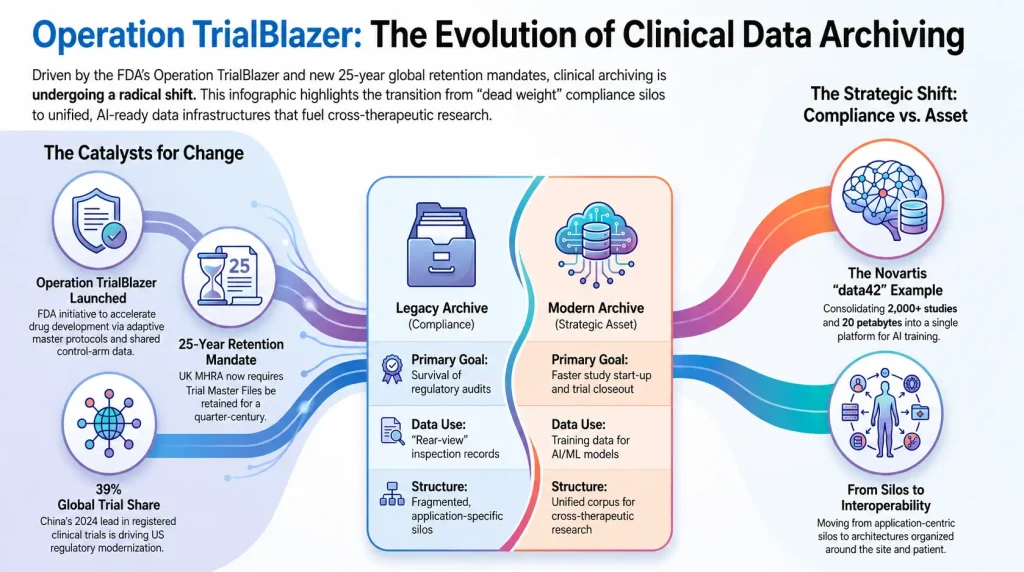
For decades, clinical trial data archiving has sat at the bottom of pharma’s priority list, a compliance obligation, not a competitive one. TrialBlazer, layered on top of a wave of other regulatory change, is about to test whether that’s still good enough.
Start with the regulatory floor moving under our feet. The UK’s MHRA just extended the mandatory retention period for Trial Master Files from 5 years to 25 years, effective April 2026, one of the biggest updates to clinical trials regulation in two decades, and one that also pushes alignment with ICH E6(R3). The FDA’s own Data Modernization Action Plan has been pressing the industry toward standardized, cloud-native, AI-ready data infrastructure well before TrialBlazer arrived. The message from regulators everywhere is converging: trial data isn’t something you generate and forget. It’s something you’re accountable for, sometimes for a quarter of a century — and now, something regulators expect to move faster and connect further than it currently does.
At the same time, McKinsey’s research on biopharma R&D IT found that while 40–50% of top-20 pharmaceutical companies have invested heavily in modernizing clinical IT applications, many still haven’t achieved a clear ROI. Legacy, application-centric architecture with fragmented, siloed, hard to connect are the reason why, and every merger or acquisition tends to bolt on another disconnected system rather than remove one. The outcome is familiar to anyone who’s tried to pull an old study’s data for a new analysis: technically retained, practically unusable. Compliant, and completely inert.
Here’s the shift worth watching: leading organizations have stopped treating their archives as a rear-view mirror and started treating them as a forward-looking asset. It’s playing out across five concrete dimensions:
- Cost center → strategic asset. Data once maintained purely to survive an audit is becoming a lever for faster study start-up and quicker trial closeout, because history informs the design of the next protocol instead of just defending the last one.
- Rear-view mirror data → training data. Records once opened only for inspections are now being curated, sampled, and subsetted specifically to train and validate the AI/ML models being built across R&D.
- Fragmentation from disparate systems and M&A → unified archival advantage. Instead of every acquisition bolting on another disconnected repository, a unified archive turns decades of inherited systems into one corpus that supports cross-therapeutic research, not just single-study lookups.
- Application-centric silos → real interoperability. Architectures built around whichever tool happened to capture the data are giving way to structures organized around the site and the patient, so data moves across systems instead of dying inside them.
- Application-specific search → study-level retrieval and reproducibility. Instead of hunting through the original capture tool, teams can search, retrieve, and reproduce results at the study level — exactly what both regulators and AI pipelines need.
Novartis’s data42 program is the clearest public proof point of what this looks like at scale. Instead of leaving legacy trial data scattered across disconnected repositories, Novartis consolidated more than 2,000 clinical studies, roughly 2 million patient-years and 20 petabytes of R&D data onto a single platform where machine learning models could be trained across studies instead of trapped within one. Teams have used it to identify disease subtypes in rheumatoid arthritis and map disease progression in oncology — analysis that was effectively impossible when the same data sat siloed by study and by system.
That’s the real transformation underway in clinical data archiving: from a cost center justified by regulatory necessity, to a strategic asset that fuels AI/ML training data, cross-therapeutic research, and faster study start-up and closeout. The organizations pulling ahead aren’t just storing data for longer. They’re making it findable at the study level, interoperable across systems, and structured with the metadata needed for traceability and reuse years later.
The 25-year retention clock is now running in the UK, and similar pressure is building globally. That’s either 25 years of accumulating dead weight, or 25 years of compounding strategic value and the difference comes down to whether archiving is designed as an afterthought or built as infrastructure from day one.
A lot of the interoperability and metadata work above only holds up if it doesn’t quietly become another job your team has to maintain by hand forever. Solix Technologies has a good related read on that exact trap by my colleague Mark Lee — “Is Your AI Working for You — or Are You Working for Your AI?”:
If you work in clinical operations, data management, or R&D IT: is your organization still archiving for compliance, or has it started architecting for reuse?
Frequently Asked Questions About Operation TrialBlazer and Clinical Trial Data
What is FDA Operation TrialBlazer?
Operation TrialBlazer is a 2026 U.S. initiative focused on accelerating and modernizing clinical development, including faster development pathways and greater use of adaptive clinical trial approaches.
Why does Operation TrialBlazer matter for clinical trial data management?
The initiative increases the importance of having clinical trial data that is accessible, interoperable, structured, and reusable across studies and therapeutic areas.
How does clinical trial archiving support modern drug development?
Modern clinical trial archives can provide reusable historical data for trial design, cross-study research, AI/ML development, regulatory analysis, and faster study execution.
What is the difference between compliance-focused and strategic clinical data archiving?
Compliance-focused archiving primarily preserves records for regulatory requirements, while strategic archiving makes data searchable, interoperable, and reusable for research, analytics, AI, and future clinical development.
Why is interoperability important for clinical trial archives?
Interoperability allows data from different studies, systems, and therapeutic areas to be connected and reused instead of remaining isolated in separate repositories.
How does M&A create challenges for clinical trial data archiving?
Mergers and acquisitions can introduce multiple legacy systems and disconnected repositories, making it difficult to search, harmonize, and reuse historical clinical data across the combined organization.
How long should clinical trial records be retained?
Retention requirements vary by jurisdiction, trial type, and applicable regulations. Organizations should follow the specific requirements that apply to their studies and markets.
What makes a clinical trial archive AI-ready?
An AI-ready archive provides structured, searchable, interoperable data with appropriate metadata, provenance, governance, and consistent access to historical clinical information.
How can clinical trial archives support AI and machine learning?
Well-structured archives can provide historical datasets that can be prepared and governed for AI/ML training, validation, research, and cross-study analysis.
Why should pharmaceutical companies move beyond compliance-focused archiving?
Moving beyond compliance-focused archiving allows organizations to turn historical clinical data into a reusable asset that supports research, AI/ML, trial design, interoperability, and faster development.
References:
- Ropes & Gray, “HHS ‘Operation TrialBlazer’: FDA Moves to Accelerate and Modernize Clinical Development“
- Applied Clinical Trials, “HHS Launches Operation TrialBlazer to Restore US Leadership in Clinical Research“
- GOV.UK / MHRA, “Archiving and retention of clinical trial records“
- McKinsey & Company, “Faster, smarter trials: Modernizing biopharma’s R&D IT applications“
- Novartis, “The data42 program shows Novartis’ intent to go big on data and digital“
#ClinicalTrials #ClinicalDataManagement #LifeSciences #DigitalHealth #PharmaAI #ClinicalOperations #DataStrategy

Murali Krishnam
VP - Product Strategy, Enterprise Pharma AI
DISCLAIMER: THE CONTENT, VIEWS, AND OPINIONS EXPRESSED IN THIS BLOG ARE SOLELY THOSE OF THE AUTHOR(S) AND DO NOT REFLECT THE OFFICIAL POLICY OR POSITION OF SOLIX TECHNOLOGIES, INC., ITS AFFILIATES, OR PARTNERS. THIS BLOG IS OPERATED INDEPENDENTLY AND IS NOT REVIEWED OR ENDORSED BY SOLIX TECHNOLOGIES, INC. IN AN OFFICIAL CAPACITY. ALL THIRD-PARTY TRADEMARKS, LOGOS, AND COPYRIGHTED MATERIALS REFERENCED HEREIN ARE THE PROPERTY OF THEIR RESPECTIVE OWNERS. ANY USE IS STRICTLY FOR IDENTIFICATION, COMMENTARY, OR EDUCATIONAL PURPOSES UNDER THE DOCTRINE OF FAIR USE (U.S. COPYRIGHT ACT § 107 AND INTERNATIONAL EQUIVALENTS). NO SPONSORSHIP, ENDORSEMENT, OR AFFILIATION WITH SOLIX TECHNOLOGIES, INC. IS IMPLIED. CONTENT IS PROVIDED "AS-IS" WITHOUT WARRANTIES OF ACCURACY, COMPLETENESS, OR FITNESS FOR ANY PURPOSE. SOLIX TECHNOLOGIES, INC. DISCLAIMS ALL LIABILITY FOR ACTIONS TAKEN BASED ON THIS MATERIAL. READERS ASSUME FULL RESPONSIBILITY FOR THEIR USE OF THIS INFORMATION. SOLIX RESPECTS INTELLECTUAL PROPERTY RIGHTS. TO SUBMIT A DMCA TAKEDOWN REQUEST, EMAIL INFO@SOLIX.COM WITH: (1) IDENTIFICATION OF THE WORK, (2) THE INFRINGING MATERIAL’S URL, (3) YOUR CONTACT DETAILS, AND (4) A STATEMENT OF GOOD FAITH. VALID CLAIMS WILL RECEIVE PROMPT ATTENTION. BY ACCESSING THIS BLOG, YOU AGREE TO THIS DISCLAIMER AND OUR TERMS OF USE. THIS AGREEMENT IS GOVERNED BY THE LAWS OF CALIFORNIA.
-
 White Paper
Enterprise Information Architecture for Gen AI and Machine Learning
Download White Paper -

-

-
