IDPC

What is IDPC?

The Italian Data Protection Code, IDPC (Legislative Decree No. 196 of 2003), also known as the Privacy Code, safeguards the processing of personal data in Italy. It establishes data collection, use, storage, and disclosure principles and grants individuals the right to control their information. The GDPR became directly applicable in all EU member states, including Italy, in May 2018. However, Italy passed a decree to harmonize the IDPC with the GDPR.

Overview of IDPC

  • Law: Italian Data Protection Code
  • Region: Italy
  • Signed On: 30-06-2003
  • Effective Date: 01-01-2004
  • Industry: All industries that do business with Italian residents

Personal Data Under the IDPC

The Code defines personal data broadly, encompassing any information relating to an identified or identifiable natural person. Here’s a breakdown of what the Code considers personal data:

  • Direct identifiers: This includes information that can directly identify an individual, such as name, identification number, address, phone number, and email address.
  • Indirect identifiers: Examples include location data (GPS coordinates, IP address), online identifiers (cookies, usernames), and physical, physiological, genetic, mental, economic, cultural, or social identity specifics.

The Code offers additional protection for specific categories of personal data deemed more sensitive. This “special category data” includes information revealing racial or ethnic origin, political opinions, religious or philosophical beliefs, trade union membership, genetic data, biometric data for identification purposes, and data concerning health.

Data Protection Principles

The act was built on core principles like adherence to the law, fairness, transparency, limitations on purposes, minimizing data, ensuring accuracy, restricting storage, maintaining integrity, and preserving confidentiality. Adhering to these principles ensures the lawful and ethical handling of personal data.

Rights Under the IDPC

Individuals in Italy possess various rights under the Data Protection Code, including access, rectification, erase, restrict processing, object to processing, and data portability. Individuals gain authority over their personal information through these rights, allowing them to assert control over how their data is handled.

Who Needs to Comply with the IDPC?

The Italian Data Protection Code applies broadly and transcends specific industries. Any organization that processes the personal data of Italian residents must comply with the Code, regardless of industry or location. Here’s a breakdown of which entities are required to comply with the act:

  • Companies: This includes all for-profit businesses, large or small.
  • Non-Profit Organizations: Charities, NGOs, and other non-profits must comply if they handle Italian resident data.
  • Government Agencies: Public sector entities also need to adhere to the Code when processing the personal information of Italian citizens.

Noncompliance Fines

The Italian Data Protection Code imposes significant fines for non-compliance. The maximum fine under the Code reaches €3 million. The Code utilizes a two-tiered system for determining fines. This means the specific penalty amount depends on the severity of the violation. Here’s a breakdown of the structure:

  • Lower Tier: For less severe infringements, fines can range from a warning to a maximum of €250,000.
  • Higher Tier: More severe violations, such as unlawful processing of sensitive data or failure to implement appropriate security measures, can incur a maximum fine of €3 million.
  • GDPR Interaction: “It’s vital to note that the Italian Data Protection Code complements the GDPR, which imposes hefty fines for violations, up to €20 million or 4% of global annual turnover.

Compliance Authority

The Italian Data Protection Authority (Garante per la protezione dei dati personali) is responsible for enforcing the Code. They can investigate complaints, issue fines, and order corrective actions.

In conclusion, understanding and adhering to the Italian Data Protection Code is essential for organizations operating within Italy’s jurisdiction to ensure personal data’s lawful and ethical handling. Conducting regular audits, providing ongoing staff training on data protection practices, and implementing robust data governance practices, like data masking, can significantly aid compliance efforts.

FAQ

How does the Italian Data Protection Code align with the GDPR?

The Italian Data Protection Code aligns closely with the GDPR, supplementing its provisions to ensure comprehensive data protection within Italy’s legal framework. Both regulations share similar principles and rights, providing a unified approach to safeguarding personal data.

How does the Italian Data Protection Code handle data transfers outside the EU?

The Italian Data Protection Code permits data transfers to countries outside the EU only if adequate safeguards exist, such as standard contractual clauses, binding corporate rules, or the recipient country’s adequacy status.

Are there any exemptions for small businesses under the Italian Data Protection Code?

While the Code applies to all organizations processing personal data, certain obligations may be tailored to a business’s size and complexity, ensuring proportionate compliance efforts.
Parallel Data Masking

What is Parallel Data Masking?

Parallel Data Masking is a method that simultaneously manipulates multiple data elements in the data masking workflows. This Palarallization is achieved by distributing the masking process across multiple threads or processors, significantly accelerating the masking cycle. Parallelizing the workloads eases the masking process and ensures seamless data transformation without compromising output quality.

Traditional masking methods may encounter bottlenecks when dealing with substantial volumes of information, leading to prolonged processing times. In contrast, this masking technique divides the workload, allowing multiple tasks to be executed simultaneously.

How Parallel Data Masking Works?

In contrast to serial masking, parallel masking is renowned for its expeditious and efficient safeguarding of extensive datasets, making it particularly well-suited for big data analytics and real-time data security applications. Let’s delve into the intricate workings of this powerful technique:

  • Data Partitioning: The initial step involves dividing the dataset into smaller, manageable chunks. This partitioning allows simultaneous processing on multiple cores or processors.
  • Masking Algorithm Distribution: A chosen data masking algorithm (e.g., tokenization, character substitution) is distributed across the available processing units.
  • Concurrent Masking: Each processing unit independently applies the masking algorithm to its assigned data chunk, masking multiple data elements simultaneously.
  • Data Reassembly: Once individual parts are masked, the processed chunks are reassembled to form the final, anonymized dataset.

Comparison: Sequential And Parallel Masking

Here’s a breakdown of serial and parallel approaches:

Feature Serial Data Masking Parallel Data Masking
Processing One data element at a time Multiple data elements simultaneously
Implementation Simpler Requires specialized algorithms
Efficiency (large datasets) Slower and less efficient Faster and more efficient
Security Analysis Focus Common approaches More complex approaches

Benefits of Parallel Data Masking

Parallel masking emerges as a game-changer for handling massive datasets in data security. Simulating multiple data elements offers advantages over traditional serial masking, particularly speed, scalability, and real-time protection. Let’s explore this masking technique’s benefits:

Unleashing Scalability

  • Large Dataset: Processing terabytes or even petabytes of data one element at a time can be painfully slow. Masking data parallel leverages the power of multiple cores or processors, drastically reducing processing times.
  • Growing Datasets: It seamlessly scales to accommodate ever-growing datasets, making it the perfect fit for big data environments where traditional methods struggle.

Boosting Agility

  • Real-Time Masking: Its concurrent processing makes real-time masking a reality, ensuring sensitive information remains hidden even in dynamic environments like streaming applications.
  • Faster Development Cycles: Testing and development processes often involve repeated data masking. Parallelizing the workloads can significantly accelerate these cycles, accelerating development timelines and improving overall efficiency.

Additional Advantages

  • Cost Savings The reduced processing time translates to lower infrastructure costs, especially when dealing with large datasets. Remember, time is money, and parallel masking saves both.
  • Improved Resource Utilization: Parallelizing the workloads efficiently utilizes available processing power, freeing up resources for other tasks and allowing you to do more with the same hardware.

Limitations

While parallel masking offers impressive processing speed and scalability for large datasets, it has a few limitations. Understanding these potential drawbacks is crucial for making informed decisions when choosing this technique for data protection.

Complexity and Security Challenges

  • Algorithmic Adaptation: Traditional data masking algorithms designed for serial processing might not translate well to parallel environments. Adapting or developing algorithms for parallel execution requires specialized expertise and careful security considerations.
  • Increased Attack Surface: The distributed nature of parallel processing introduces additional attack vectors for potential adversaries. Thorough security assessments and mitigation strategies are essential to identify and address these vulnerabilities.
  • Security Analysis Complexity: Existing security analysis models built for serial masking might not directly apply to parallel environments. Developing new models or adapting existing ones requires significant effort and expertise.

Potential Data Leakage

  • Data Disclosure: Although individual data elements might be masked, combining and statistically analyzing multiple masked elements across parallel operations could reveal sensitive information. Implementing robust noise addition or differential privacy techniques can mitigate this risk.
  • Reassembly Errors: Errors during data partitioning, processing, or reassembly could expose sensitive information. Rigorous data integrity checks and error-handling mechanisms are crucial to prevent such vulnerabilities.

Other Considerations

  • Hardware Requirements: Implementing parallel masking requires specialized hardware, such as multi-core processors or GPUs, which can be costly and resource-intensive.
  • Limited Suitability for Small Datasets: The overhead of parallel processing might outweigh the benefits for smaller datasets, making serial masking a more efficient choice.
  • Technical Expertise: Successfully implementing and maintaining parallel masking requires specialized technical knowledge and skills, which might only be available in some organizations.

Use Cases

Parallel Data Masking, with its ability to anonymize massive datasets simultaneously, unlocks exciting possibilities across various domains. Let’s explore some critical use cases where this multi-threaded approach shines:

  • Big Data Analytics: In healthcare, finance, and social sciences, valuable insights often reside within vast, sensitive datasets. Parallel masking enables secure knowledge extraction by efficiently anonymizing large-scale data, preserving critical patterns while safeguarding individual privacy.
  • Cloud Masking: Parallelizing the workloads empowers organizations to efficiently anonymize sensitive data before entering cloud environments, mitigating privacy risks and compliance concerns associated with cloud storage and processing.
  • Dynamic Data Masking: It allows on-the-fly data masking based on user roles, permissions, or specific security policies. This ensures that only authorized users see the necessary level of detail, safeguarding sensitive information in real-time.
  • Regulatory Compliance: With its efficient scalability, parallel masking empowers organizations to comply with regulations like GDPR, CCPA, etc, by effectively masking large datasets while adhering to complex compliance requirements.
  • Data Sharing and Collaboration: It facilitates secure data sharing for collaborative research projects by efficiently anonymizing datasets, enabling researchers to leverage combined data insights while safeguarding individual privacy.

In conclusion, Parallel Data Masking is a beacon of efficiency and data security effectiveness. Its ability to swiftly and securely protect vast datasets, particularly in big data analytics and real-time security, makes it an invaluable asset for organizations navigating the complexities of modern data protection. As the digital landscape evolves, adopting advanced techniques like parallel masking becomes not just a choice but a strategic imperative for safeguarding sensitive information.

FAQ

Can Parallel Masking be applied to structured and unstructured data?

Parallel Masking can be applied to structured and unstructured data types, including databases, documents, and multimedia files, making it versatile for various data masking needs.

Is Parallel Masking suitable for real-time data masking applications?

Yes, Parallel Masking can be applied in real-time data masking scenarios. This allows organizations to anonymize data on the fly as it enters the system, ensuring continuous protection of sensitive information.

What are the hardware and software requirements for implementing Parallel Masking?

Implementing Parallel Masking requires hardware with multiple processing units (such as multi-core CPUs or GPU clusters) and software frameworks that support parallel processing, such as Apache Spark or Hadoop.

Dynamic Data Masking

What is Dynamic Data Masking?

Dynamic Data Masking is a masking approach designed to obscure sensitive information in real-time, ensuring that only authorized users can access and view the complete data. Unlike static data masking, which applies a uniform mask to all users, dynamic masking tailors the level of data exposure according to the user’s role or permissions.

In layman’s language, it dynamically alters data visibility based on user roles or access privileges, while unauthorized or lower-privileged users perceive a masked or redacted version of the information. It ensures a granular and customizable security layer by intercepting database queries and applying masking rules, significantly preventing data breaches, internal threats, and non-compliance issues.

How Dynamic Data Masking Works?

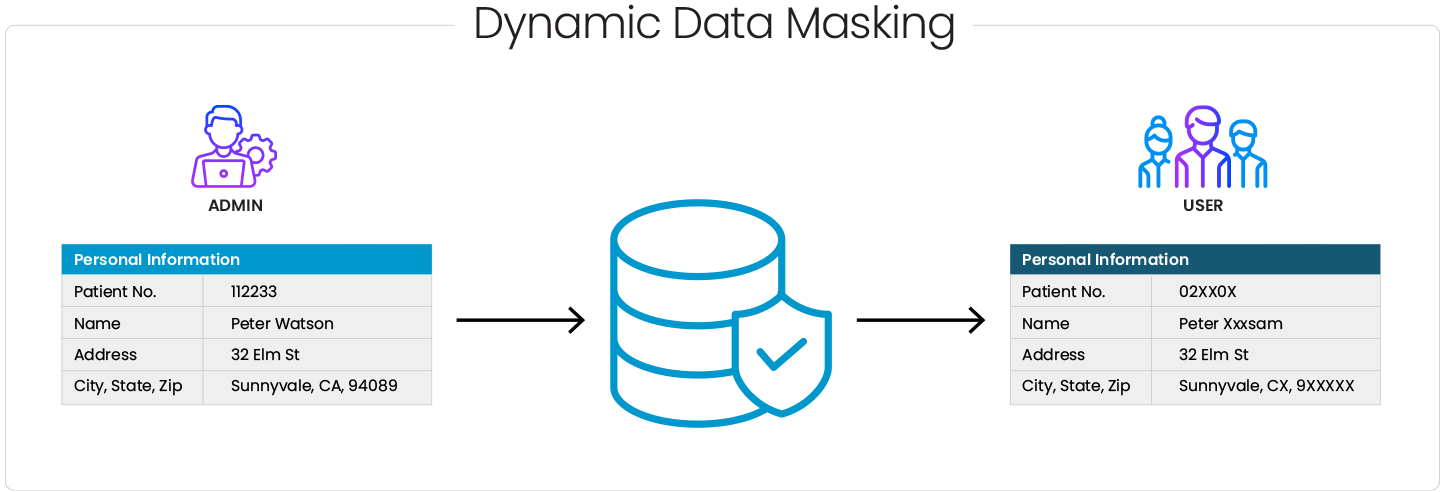
Pictorial representation of how Dynamic Data Masking Works?

How Dynamic Data Masking Works?

The fundamental principle behind DDM lies in its ability to intercept and modify database queries on the fly, dynamically adjusting the visibility of specific data elements based on user permissions.

  • Masking Rules: Dynamic masking relies on predefined rules to control how sensitive information is shown to different users or roles. These rules are crafted to align with security policies and compliance requirements.
  • Policy Enforcement:  Dynamic masking enforces different masking rules at the database level, acting as a gatekeeper to sensitive information. The policies are consistently applied, ensuring a seamless and secure experience for users interacting with the database.
  • Role-Based Access Control (RBAC): Integration with RBAC mechanisms allows dynamic masking to synchronize with the organization’s user roles. This alignment ensures that data exposure is customized based on users’ specific roles and responsibilities, providing a fine-tuned approach to data security.
  • Real-Time Adaptability: One of the key features of dynamic masking is its dynamic nature. As user permissions change or new security policies are implemented, the masking of sensitive data adapts in real time. This adaptability ensures that the data security measures remain effective in evolving user access scenarios.

Dynamic masking combines these elements and offers a granular and customizable security layer. Its real-time, adaptive approach significantly enhances data security, making it crucial in safeguarding against unauthorized access and potential data breaches.

Difference between Static and Dynamic Data Masking:

Unlike dynamic data masking, static masking involves a one-time transformation, making it especially well-suited for scenarios where constant protection is imperative. The primary goal is to create a structurally similar yet fictitious version of the original data, ensuring that sensitive elements remain concealed while maintaining the overall integrity and usability of the dataset.

Feature SDM DDM On-the-Fly Masking
Timing Before data storage During data access (real-time) During data access (real-time)
Masking Rules Pre-defined Based on user permissions Based on specific situations
Data Type More efficient for structured data Efficient for structured and unstructured data Efficient for structured and unstructured data
Advantages Simple, Efficient Granular control, Real-time access Real-time, Context-aware
Disadvantages Not real-time, Inflexible More complex, Performance impact More complex, Performance impact

Adaptability of Masking Techniques Across SDM and DDM:

Technique SDM DDM On-the-Fly Masking
Shuffling Yes Yes Yes
Redaction Yes Yes Yes
Tokenization Yes Yes Yes
FPE Yes Can be used Can be used
Substitution Yes Yes, with user-based variations Yes, with user-based variations
Encryption Possible (if real-time access is not needed) Less Ideal (performance overhead) Less Ideal (performance overhead)
Nulling Simple, but minimal protection Can be used for limited masking Can be used for limited masking
Noice addition Can be used along with other technique Can be used along with other technique Can be used along with other technique

Benefits of Dynamic Data Masking:

Dynamic Data Masking benefits an organization’s data security posture and compliance efforts in the following ways.

  • Data Privacy Compliance: It plays a pivotal role in assisting organizations in complying with stringent data protection regulations, such as GDPR, PCI DSS, HIPAA, LGPD, and more.
  • Customizable Security Policies: Dynamic Data Masking’s ability to enforce obfuscation rules and integrate with Role-Based Access Control (RBAC) allows organizations to tailor security policies according to user roles and needs.
  • Preventing Data Breaches: It dynamically masks data by user permissions and limits the potential impact of unauthorized access, significantly reducing the risk of sensitive information falling into the wrong hands.

Use Cases of Dynamic Data Masking:

Dynamic Data Masking obfuscates sensitive information in real-time, providing an additional layer of security to prevent unauthorized access to sensitive information. Here are some common use cases of dynamic masking:

  • Production Environments: Dynamic masking shines in live production databases, offering an extra layer of security without compromising the utility. This capability is particularly crucial in sectors where real-time access to sensitive information is imperative.
  • Testing and Development: Production data is often necessary to test applications accurately in testing and development environments. However, exposing sensitive information to developers and testers can pose security risks. Dynamic masking allows organizations to use realistic information for testing while protecting sensitive information.
  • Data Analytics and Reporting: Organizations often use data analytics and reporting tools to analyze large datasets and derive insights. Dynamic masking can help organizations anonymize sensitive information while allowing analysts to derive meaningful insights.
  • Compliance Requirements: Many industries, such as healthcare (HIPAA), finance (PCI DSS), and government (GDPR), have strict regulations regarding the protection of sensitive data. Dynamic masking can help organizations comply with these regulations by ensuring that only authorized individuals can access sensitive information.
  • Outsourcing and Offshoring: Companies that outsource or offshore specific business processes may need to share sensitive data with external partners. Dynamic masking ensures that sensitive information remains hidden from third-party vendors who do not need access to it.
  • Role-Based Control: Dynamic masking can be integrated with role-based access control systems to ensure only users with the appropriate permissions can view sensitive information. This helps organizations enforce the principle of least privilege and minimize the risk of data breaches.


In conclusion, Dynamic data masking is a robust solution for safeguarding sensitive information in various environments. Its flexible features, including real-time obfuscation and role-based access control, offer organizations a versatile tool to ensure data security while facilitating efficient data utilization. It is a pivotal asset in today’s data-driven landscape, enabling organizations to conduct thorough analyses without compromising data integrity or regulatory compliance.

FAQ:

How does Dynamic Data Masking differ from static masking?

Dynamic Data Masking differs from static data masking by dynamically applying masking rules at runtime based on user queries or access privileges. In contrast, static data masking permanently alters data before storage, limiting its applicability in dynamic environments.

Can skilled attackers bypass Dynamic Data Masking?

While Dynamic Data Masking provides an additional layer of security, skilled attackers may attempt to bypass masking controls through advanced techniques such as SQL injection or privilege escalation. Continuous monitoring and proactive security measures are essential to detect and prevent such attempts.

Does Dynamic Data Masking support granular access control policies?

Yes, Dynamic Data Masking supports granular access control policies by enabling organizations to define masking rules based on user roles, privileges, or sensitivity levels. This ensures that only authorized users can access unmasked data while maintaining confidentiality and compliance.

Can Dynamic Data Masking be applied to unstructured data formats like documents or images?

Dynamic Or On-The-Fly obfuscation is a more versatile option and can handle both structured and unstructured data, offering greater flexibility for complex masking needs than Static Masking.

Static Data Masking

What is Static Data Masking?

Static Data Masking, or Persistent Data Masking, is a masking technique operating on the irreversible data transformation principle. It ensures that confidential data elements are permanently replaced with fictitious yet structurally identical counterparts. However, in some specific cases, with additional information or context, it might be possible to partially reconstruct the original data, especially if weak masking techniques are used.

How Static Data Masking Works?

  • Identification of Sensitive Data Elements: The first step is identifying the specific data elements containing sensitive information. This often includes personally identifiable information (PII), financial details, and other confidential data critical to an organization.
  • Data Profiling and Analysis: Data profiling tools analyze and understand the characteristics, structure, content, consistency, trends, anomalies, and relationships between the identified sensitive data elements.
  • Masking Rule Definition: Masking rules are established based on the insights gained from data profiling. These rules dictate how the sensitive data will be transformed.
  • Data Transformation: The actual data transformation occurs in this stage, where the different data masking techniques are executed on the identified sensitive data. Depending on the technique used, the masking can be reversible or irreversible.
  • Validation and Quality Assurance: Rigorous validation processes are then implemented to ensure that the masked dataset mirrors the original, preserving usability for analysis while protecting privacy.
  • Deployment to Environments: Once validated, the masked dataset is deployed in different environments, ensuring the teams working in these environments can utilize authentic yet privacy-compliant data without the risk of exposing sensitive information.
How Static Data Masking Works?

A general representation of how Static Data Masking Works

Difference between Static and Dynamic Data Masking:

Static masking permanently replaces sensitive information with masked values in a database, while dynamic masking dynamically masks information in real-time based on user permissions, ensuring sensitive information remains hidden from unauthorized users without altering the underlying data.

Feature Static Data Masking Dynamic Data Masking On-the-Fly Masking
Timing Before data storage During data access (real-time) During data access (real-time)
Masking Rules Pre-defined Based on user permissions Based on specific situations
Data Type More efficient for structured data Efficient for structured and unstructured data Efficient for structured and unstructured data
Advantages Simple, Efficient Granular control, Real-time access Real-time, Context-aware
Disadvantages Not real-time, Inflexible More complex, Performance impact More complex, Performance impact

Applicability of Masking Techniques Across SDM and DDM:

Technique Static Data Masking Dynamic Data Masking On-the-Fly Masking
Shuffling Yes Yes Yes
Redaction Yes Yes Yes
Tokenization Yes Yes Yes
FPE Yes Can be used Can be used
Substitution Yes Yes, with user-based variations Yes, with user-based variations
Encryption Possible (if real-time access is not needed) Less Ideal (performance overhead) Less Ideal (performance overhead)
Nulling Simple, but minimal protection Can be used for limited masking Can be used for limited masking
Noice addition Can be used along with other technique Can be used along with other technique Can be used along with other technique

Benefits:

  • Enhanced Security and Privacy: Static masking provides a robust layer of protection that ensures compliance with data privacy regulations like GDPR, PCI DSS, HIPAA, LGPD, etc, by rendering sensitive information unreadable and useless to unauthorized individuals.
  • Mitigation of Internal and External Threats: It is a potent deterrent against internal and external threats by thwarting access to the unauthorized and helps reduce the risk of adversary activities within the organization.
  • Maintain Data Utility: It preserves the dataset’s utility for testing, development, and analytics, making it essential for non-production environments. This allows organizations to validate applications securely without compromising data privacy.

Use Cases:

Static Data Masking has various use cases across different industries and scenarios where there’s a need to protect sensitive data while maintaining its utility. Some common use cases include:

  • Non-Production Environment: Static masking allows organizations to replace sensitive data in non-production environments with fictitious or anonymized equivalents, enabling developers and testers to work with realistic datasets without compromising privacy.
  • Outsourcing and Offshoring: Static masking allows organizations to share datasets with external partners while protecting sensitive information. With stringent data privacy regulations, this is crucial for the finance, healthcare, and legal services industries.
  • Analytics and Business Intelligence: It enables organizations to share masked datasets with analysts and BI teams, ensuring that confidential information such as customer identities or financial details remains secure while allowing for meaningful analysis.
  • Training and Education: By masking sensitive information such as personal identifiers, educators can ensure compliance with data privacy regulations while providing valuable learning experiences with authentic data.
  • Software Demonstrations and Sales Presentations: Static masking allows organizations to anonymize or mask sensitive information in demonstration datasets, ensuring client privacy while demonstrating their products’ capabilities and functionalities.

In conclusion, as the landscape of data security and privacy evolves rapidly, Static Data Masking emerges as a pivotal strategy for organizations seeking robust protection against unauthorized access, data breaches, and compliance challenges. It ensures a formidable defense by permanently transforming sensitive information within non-production environments, allowing enterprises to navigate the intricate web of regulatory requirements, internal threats, and external vulnerabilities.

FAQ:

What distinguishes Static Data Masking from other data protection methods?

SDM permanently replaces sensitive data with fictitious but realistic values, ensuring data confidentiality without altering the original dataset. Unlike dynamic masking, it applies consistent transformations regardless of user access.

Can Static Data Masking be applied to unstructured data formats like documents or images?

SDM is primarily designed for structured data formats like databases, making it less suitable for unstructured data like documents or images. Organizations may need alternative techniques like redaction or encryption to protect unstructured data.

What role does tokenization play in Static Data Masking?

Tokenization complements SDM by replacing sensitive data with unique tokens while preserving data format and structure. This hybrid approach enhances security and privacy, particularly when reversible masking is required for specific use cases.

Can Static Data Masking be applied to streaming or real-time data environments?

SDM is typically applied to batch processing environments with static or non-changing data. It may not be suitable for streaming or real-time data environments due to its irreversible nature and potential latency implications.